Jump to
S1C2
Energy calculated at MP2/STO-3G
| | hartrees |
|---|
| Energy at 0K | -947.134759 |
| Energy at 298.15K | |
| HF Energy | -947.078096 |
| Nuclear repulsion energy | 120.555760 |
The energy at 298.15K was derived from the energy at 0K
and an integrated heat capacity that used the calculated vibrational frequencies.
Vibrational Frequencies calculated at MP2/STO-3G
| Mode Number |
Symmetry |
Frequency
(cm-1) |
Scaled Frequency
(cm-1) |
IR Intensities
(km mol-1) |
Raman Act
(Å4/u) |
Dep P |
Dep U |
|---|
| 1 |
A1 |
3542 |
3088 |
5.29 |
|
|
|
| 2 |
A1 |
797 |
695 |
22.08 |
|
|
|
| 3 |
A1 |
299 |
260 |
3.83 |
|
|
|
| 4 |
B1 |
632i |
551i |
27.12 |
|
|
|
| 5 |
B2 |
1330 |
1160 |
112.18 |
|
|
|
| 6 |
B2 |
1053 |
918 |
54.68 |
|
|
|
Unscaled Zero Point Vibrational Energy (zpe) 3194.4 cm
-1
Scaled (by 0.8719) Zero Point Vibrational Energy (zpe) 2785.2 cm
-1
See section
III.C.1 List or set vibrational scaling factors
to change the scale factors used here.
See section
III.C.2
Calculate a vibrational scaling factor for a given set of molecules
to determine the least squares best scaling factor.
Geometric Data calculated at MP2/STO-3G
Point Group is C2v
Cartesians (Å)
| Atom |
x (Å) |
y (Å) |
z (Å) |
|---|
| C1 |
0.000 |
0.000 |
0.701 |
| H2 |
0.000 |
0.000 |
1.802 |
| Cl3 |
0.000 |
1.541 |
-0.177 |
| Cl4 |
0.000 |
-1.541 |
-0.177 |
Atom - Atom Distances (Å)
| |
C1 |
H2 |
Cl3 |
Cl4 |
| C1 | | 1.1009 | 1.7734 | 1.7734 |
H2 | 1.1009 | | 2.5078 | 2.5078 | Cl3 | 1.7734 | 2.5078 | | 3.0819 | Cl4 | 1.7734 | 2.5078 | 3.0819 | |
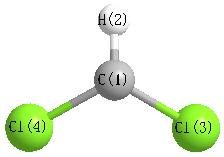 More geometry information
Calculated Bond Angles
| atom1 |
atom2 |
atom3 |
angle |
|
atom1 |
atom2 |
atom3 |
angle |
| Cl3 |
C1 |
H2 |
119.666 |
|
Cl3 |
C1 |
Cl4 |
120.667 |
| Cl4 |
C1 |
H2 |
119.666 |
|
Electronic energy levels
Charges, Dipole, Quadrupole and Polarizability
Jump to
S1C1
Energy calculated at MP2/STO-3G
| | hartrees |
|---|
| Energy at 0K | -947.139312 |
| Energy at 298.15K | -947.140160 |
| HF Energy | -947.080874 |
| Nuclear repulsion energy | 120.577580 |
The energy at 298.15K was derived from the energy at 0K
and an integrated heat capacity that used the calculated vibrational frequencies.
Vibrational Frequencies calculated at MP2/STO-3G
| Mode Number |
Symmetry |
Frequency
(cm-1) |
Scaled Frequency
(cm-1) |
IR Intensities
(km mol-1) |
Raman Act
(Å4/u) |
Dep P |
Dep U |
|---|
| 1 |
A' |
3479 |
3034 |
1.89 |
|
|
|
| 2 |
A' |
826 |
720 |
25.30 |
|
|
|
| 3 |
A' |
721 |
628 |
2.21 |
|
|
|
| 4 |
A' |
295 |
258 |
3.08 |
|
|
|
| 5 |
A" |
1337 |
1165 |
71.60 |
|
|
|
| 6 |
A" |
1016 |
885 |
90.09 |
|
|
|
Unscaled Zero Point Vibrational Energy (zpe) 3836.4 cm
-1
Scaled (by 0.8719) Zero Point Vibrational Energy (zpe) 3344.9 cm
-1
See section
III.C.1 List or set vibrational scaling factors
to change the scale factors used here.
See section
III.C.2
Calculate a vibrational scaling factor for a given set of molecules
to determine the least squares best scaling factor.
Geometric Data calculated at MP2/STO-3G
Point Group is Cs
Cartesians (Å)
| Atom |
x (Å) |
y (Å) |
z (Å) |
|---|
| C1 |
0.017 |
0.751 |
0.000 |
| H2 |
-0.670 |
1.622 |
0.000 |
| Cl3 |
0.017 |
-0.180 |
1.527 |
| Cl4 |
0.017 |
-0.180 |
-1.527 |
Atom - Atom Distances (Å)
| |
C1 |
H2 |
Cl3 |
Cl4 |
| C1 | | 1.1090 | 1.7891 | 1.7891 |
H2 | 1.1090 | | 2.4603 | 2.4603 | Cl3 | 1.7891 | 2.4603 | | 3.0549 | Cl4 | 1.7891 | 2.4603 | 3.0549 | |
More geometry information
Calculated Bond Angles
| atom1 |
atom2 |
atom3 |
angle |
|
atom1 |
atom2 |
atom3 |
angle |
| Cl3 |
C1 |
H2 |
114.137 |
|
Cl3 |
C1 |
Cl4 |
117.249 |
| Cl4 |
C1 |
H2 |
114.137 |
|
Electronic energy levels
Charges, Dipole, Quadrupole and Polarizability
