Jump to
S1C2
Energy calculated at B2PLYP=FULL/STO-3G
| | hartrees |
|---|
| Energy at 0K | -948.141042 |
| Energy at 298.15K | |
| HF Energy | -948.119562 |
| Nuclear repulsion energy | 120.542272 |
The energy at 298.15K was derived from the energy at 0K
and an integrated heat capacity that used the calculated vibrational frequencies.
Vibrational Frequencies calculated at B2PLYP=FULL/STO-3G
| Mode Number |
Symmetry |
Frequency
(cm-1) |
Scaled Frequency
(cm-1) |
IR Intensities
(km mol-1) |
Raman Act
(Å4/u) |
Dep P |
Dep U |
|---|
| 1 |
A1 |
3506 |
3506 |
8.50 |
|
|
|
| 2 |
A1 |
778 |
778 |
22.30 |
|
|
|
| 3 |
A1 |
293 |
293 |
3.28 |
|
|
|
| 4 |
B1 |
569i |
569i |
35.61 |
|
|
|
| 5 |
B2 |
1295 |
1295 |
99.81 |
|
|
|
| 6 |
B2 |
1020 |
1020 |
72.52 |
|
|
|
Unscaled Zero Point Vibrational Energy (zpe) 3161.2 cm
-1
Scaled (by 1) Zero Point Vibrational Energy (zpe) 3161.2 cm
-1
See section
III.C.1 List or set vibrational scaling factors
to change the scale factors used here.
See section
III.C.2
Calculate a vibrational scaling factor for a given set of molecules
to determine the least squares best scaling factor.
Geometric Data calculated at B2PLYP=FULL/STO-3G
Point Group is C2v
Cartesians (Å)
| Atom |
x (Å) |
y (Å) |
z (Å) |
|---|
| C1 |
0.000 |
0.000 |
0.702 |
| H2 |
0.000 |
0.000 |
1.800 |
| Cl3 |
0.000 |
1.541 |
-0.177 |
| Cl4 |
0.000 |
-1.541 |
-0.177 |
Atom - Atom Distances (Å)
| |
C1 |
H2 |
Cl3 |
Cl4 |
| C1 | | 1.0988 | 1.7739 | 1.7739 |
H2 | 1.0988 | | 2.5069 | 2.5069 | Cl3 | 1.7739 | 2.5069 | | 3.0821 | Cl4 | 1.7739 | 2.5069 | 3.0821 | |
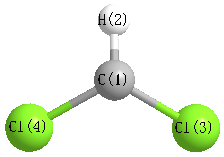 More geometry information
Calculated Bond Angles
| atom1 |
atom2 |
atom3 |
angle |
|
atom1 |
atom2 |
atom3 |
angle |
| Cl3 |
C1 |
H2 |
119.685 |
|
Cl3 |
C1 |
Cl4 |
120.630 |
| Cl4 |
C1 |
H2 |
119.685 |
|
Electronic energy levels
Charges, Dipole, Quadrupole and Polarizability
Jump to
S1C1
Energy calculated at B2PLYP=FULL/STO-3G
| | hartrees |
|---|
| Energy at 0K | -948.144829 |
| Energy at 298.15K | -948.145629 |
| HF Energy | -948.122727 |
| Nuclear repulsion energy | 120.482249 |
The energy at 298.15K was derived from the energy at 0K
and an integrated heat capacity that used the calculated vibrational frequencies.
Vibrational Frequencies calculated at B2PLYP=FULL/STO-3G
| Mode Number |
Symmetry |
Frequency
(cm-1) |
Scaled Frequency
(cm-1) |
IR Intensities
(km mol-1) |
Raman Act
(Å4/u) |
Dep P |
Dep U |
|---|
| 1 |
A' |
3435 |
3435 |
3.61 |
|
|
|
| 2 |
A' |
805 |
805 |
28.34 |
|
|
|
| 3 |
A' |
677 |
677 |
2.43 |
|
|
|
| 4 |
A' |
289 |
289 |
2.55 |
|
|
|
| 5 |
A" |
1305 |
1305 |
62.41 |
|
|
|
| 6 |
A" |
980 |
980 |
109.38 |
|
|
|
Unscaled Zero Point Vibrational Energy (zpe) 3745.3 cm
-1
Scaled (by 1) Zero Point Vibrational Energy (zpe) 3745.3 cm
-1
See section
III.C.1 List or set vibrational scaling factors
to change the scale factors used here.
See section
III.C.2
Calculate a vibrational scaling factor for a given set of molecules
to determine the least squares best scaling factor.
Geometric Data calculated at B2PLYP=FULL/STO-3G
Point Group is Cs
Cartesians (Å)
| Atom |
x (Å) |
y (Å) |
z (Å) |
|---|
| C1 |
0.017 |
0.752 |
0.000 |
| H2 |
-0.667 |
1.623 |
0.000 |
| Cl3 |
0.017 |
-0.180 |
1.529 |
| Cl4 |
0.017 |
-0.180 |
-1.529 |
Atom - Atom Distances (Å)
| |
C1 |
H2 |
Cl3 |
Cl4 |
| C1 | | 1.1074 | 1.7906 | 1.7906 |
H2 | 1.1074 | | 2.4610 | 2.4610 | Cl3 | 1.7906 | 2.4610 | | 3.0578 | Cl4 | 1.7906 | 2.4610 | 3.0578 | |
More geometry information
Calculated Bond Angles
| atom1 |
atom2 |
atom3 |
angle |
|
atom1 |
atom2 |
atom3 |
angle |
| Cl3 |
C1 |
H2 |
114.171 |
|
Cl3 |
C1 |
Cl4 |
117.268 |
| Cl4 |
C1 |
H2 |
114.171 |
|
Electronic energy levels
Charges, Dipole, Quadrupole and Polarizability
