Jump to
S1C2
Energy calculated at B3LYP/STO-3G
| | hartrees |
|---|
| Energy at 0K | -948.519779 |
| Energy at 298.15K | |
| HF Energy | -948.519779 |
| Nuclear repulsion energy | 120.305720 |
The energy at 298.15K was derived from the energy at 0K
and an integrated heat capacity that used the calculated vibrational frequencies.
Vibrational Frequencies calculated at B3LYP/STO-3G
| Mode Number |
Symmetry |
Frequency
(cm-1) |
Scaled Frequency
(cm-1) |
IR Intensities
(km mol-1) |
Raman Act
(Å4/u) |
Dep P |
Dep U |
|---|
| 1 |
A1 |
3459 |
3087 |
9.45 |
|
|
|
| 2 |
A1 |
763 |
681 |
22.56 |
|
|
|
| 3 |
A1 |
289 |
258 |
2.82 |
|
|
|
| 4 |
B1 |
533i |
476i |
41.11 |
|
|
|
| 5 |
B2 |
1268 |
1131 |
91.49 |
|
|
|
| 6 |
B2 |
994 |
887 |
87.55 |
|
|
|
Unscaled Zero Point Vibrational Energy (zpe) 3119.6 cm
-1
Scaled (by 0.8924) Zero Point Vibrational Energy (zpe) 2784.0 cm
-1
See section
III.C.1 List or set vibrational scaling factors
to change the scale factors used here.
See section
III.C.2
Calculate a vibrational scaling factor for a given set of molecules
to determine the least squares best scaling factor.
Geometric Data calculated at B3LYP/STO-3G
Point Group is C2v
Cartesians (Å)
| Atom |
x (Å) |
y (Å) |
z (Å) |
|---|
| C1 |
0.000 |
0.000 |
0.702 |
| H2 |
0.000 |
0.000 |
1.802 |
| Cl3 |
0.000 |
1.545 |
-0.177 |
| Cl4 |
0.000 |
-1.545 |
-0.177 |
Atom - Atom Distances (Å)
| |
C1 |
H2 |
Cl3 |
Cl4 |
| C1 | | 1.1000 | 1.7771 | 1.7771 |
H2 | 1.1000 | | 2.5104 | 2.5104 | Cl3 | 1.7771 | 2.5104 | | 3.0891 | Cl4 | 1.7771 | 2.5104 | 3.0891 | |
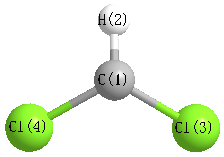 More geometry information
Calculated Bond Angles
| atom1 |
atom2 |
atom3 |
angle |
|
atom1 |
atom2 |
atom3 |
angle |
| Cl3 |
C1 |
H2 |
119.645 |
|
Cl3 |
C1 |
Cl4 |
120.711 |
| Cl4 |
C1 |
H2 |
119.645 |
|
Electronic energy levels
Charges, Dipole, Quadrupole and Polarizability
Charges from optimized geometry at B3LYP/STO-3G
Charges (e)
| Number |
Element |
Mulliken |
CHELPG |
AIM |
ESP |
| 1 |
C |
-0.024 |
|
|
|
| 2 |
H |
0.133 |
|
|
|
| 3 |
Cl |
-0.054 |
|
|
|
| 4 |
Cl |
-0.054 |
|
|
|
Electric dipole moments
Electric dipole components in Debye
(What's a Debye? See section
VII.A.3)
| |
x |
y |
z |
Total |
| |
0.000 |
0.000 |
1.378 |
1.378 |
| CHELPG |
|
|
|
|
| AIM |
|
|
|
|
| ESP |
|
|
|
|
Electric Quadrupole moment
Quadrupole components in D Å
| Primitive |
|---|
| | x | y | z |
|---|
| x |
-29.141 |
0.000 |
0.000 |
| y |
0.000 |
-31.213 |
0.000 |
| z |
0.000 |
0.000 |
-26.950 |
|
| Traceless |
|---|
| | x | y | z |
|---|
| x |
-0.060 |
0.000 |
0.000 |
| y |
0.000 |
-3.167 |
0.000 |
| z |
0.000 |
0.000 |
3.227 |
|
| Polar |
|---|
| 3z2-r2 | 6.454 |
|---|
| x2-y2 | 2.072 |
|---|
| xy | 0.000 |
|---|
| xz | 0.000 |
|---|
| yz | 0.000 |
|---|
|
Polarizabilities
Components of the polarizability tensor.
Units are
Å
3 (Angstrom cubed)
Change units.
| |
x |
y |
z |
| x |
0.463 |
0.000 |
0.000 |
| y |
0.000 |
3.960 |
0.000 |
| z |
0.000 |
0.000 |
1.525 |
<r2> (average value of r
2) Å
2
| <r2> |
106.555 |
| (<r2>)1/2 |
10.323 |
Jump to
S1C1
Energy calculated at B3LYP/STO-3G
| | hartrees |
|---|
| Energy at 0K | -948.523321 |
| Energy at 298.15K | -948.524084 |
| HF Energy | -948.523321 |
| Nuclear repulsion energy | 120.157733 |
The energy at 298.15K was derived from the energy at 0K
and an integrated heat capacity that used the calculated vibrational frequencies.
Vibrational Frequencies calculated at B3LYP/STO-3G
| Mode Number |
Symmetry |
Frequency
(cm-1) |
Scaled Frequency
(cm-1) |
IR Intensities
(km mol-1) |
Raman Act
(Å4/u) |
Dep P |
Dep U |
|---|
| 1 |
A' |
3382 |
3018 |
3.96 |
|
|
|
| 2 |
A' |
791 |
706 |
30.17 |
|
|
|
| 3 |
A' |
647 |
577 |
3.53 |
|
|
|
| 4 |
A' |
284 |
253 |
2.11 |
|
|
|
| 5 |
A" |
1278 |
1140 |
55.30 |
|
|
|
| 6 |
A" |
951 |
848 |
124.19 |
|
|
|
Unscaled Zero Point Vibrational Energy (zpe) 3666.0 cm
-1
Scaled (by 0.8924) Zero Point Vibrational Energy (zpe) 3271.5 cm
-1
See section
III.C.1 List or set vibrational scaling factors
to change the scale factors used here.
See section
III.C.2
Calculate a vibrational scaling factor for a given set of molecules
to determine the least squares best scaling factor.
Geometric Data calculated at B3LYP/STO-3G
Point Group is Cs
Cartesians (Å)
| Atom |
x (Å) |
y (Å) |
z (Å) |
|---|
| C1 |
0.017 |
0.753 |
0.000 |
| H2 |
-0.676 |
1.619 |
0.000 |
| Cl3 |
0.017 |
-0.181 |
1.533 |
| Cl4 |
0.017 |
-0.181 |
-1.533 |
Atom - Atom Distances (Å)
| |
C1 |
H2 |
Cl3 |
Cl4 |
| C1 | | 1.1091 | 1.7955 | 1.7955 |
H2 | 1.1091 | | 2.4640 | 2.4640 | Cl3 | 1.7955 | 2.4640 | | 3.0668 | Cl4 | 1.7955 | 2.4640 | 3.0668 | |
More geometry information
Calculated Bond Angles
| atom1 |
atom2 |
atom3 |
angle |
|
atom1 |
atom2 |
atom3 |
angle |
| Cl3 |
C1 |
H2 |
113.963 |
|
Cl3 |
C1 |
Cl4 |
117.307 |
| Cl4 |
C1 |
H2 |
113.963 |
|
Electronic energy levels
Charges, Dipole, Quadrupole and Polarizability
Charges from optimized geometry at B3LYP/STO-3G
Charges (e)
| Number |
Element |
Mulliken |
CHELPG |
AIM |
ESP |
| 1 |
C |
0.001 |
|
|
|
| 2 |
H |
0.129 |
|
|
|
| 3 |
Cl |
-0.065 |
|
|
|
| 4 |
Cl |
-0.065 |
|
|
|
Electric dipole moments
Electric dipole components in Debye
(What's a Debye? See section
VII.A.3)
| |
x |
y |
z |
Total |
| |
-0.599 |
1.295 |
0.000 |
1.427 |
| CHELPG |
|
|
|
|
| AIM |
|
|
|
|
| ESP |
|
|
|
|
Electric Quadrupole moment
Quadrupole components in D Å
| Primitive |
|---|
| | x | y | z |
|---|
| x |
-28.747 |
-0.804 |
0.000 |
| y |
-0.804 |
-27.507 |
0.000 |
| z |
0.000 |
0.000 |
-31.431 |
|
| Traceless |
|---|
| | x | y | z |
|---|
| x |
0.722 |
-0.804 |
0.000 |
| y |
-0.804 |
2.582 |
0.000 |
| z |
0.000 |
0.000 |
-3.304 |
|
| Polar |
|---|
| 3z2-r2 | -6.608 |
|---|
| x2-y2 | -1.240 |
|---|
| xy | -0.804 |
|---|
| xz | 0.000 |
|---|
| yz | 0.000 |
|---|
|
Polarizabilities
Components of the polarizability tensor.
Units are
Å
3 (Angstrom cubed)
Change units.
| |
x |
y |
z |
| x |
0.559 |
-0.210 |
0.000 |
| y |
-0.210 |
1.557 |
0.000 |
| z |
0.000 |
0.000 |
4.101 |
<r2> (average value of r
2) Å
2
| <r2> |
105.804 |
| (<r2>)1/2 |
10.286 |
