Jump to
S1C2
Energy calculated at B3LYP/STO-3G
| | hartrees |
|---|
| Energy at 0K | -493.935222 |
| Energy at 298.15K | |
| HF Energy | -493.935222 |
| Nuclear repulsion energy | 43.590837 |
The energy at 298.15K was derived from the energy at 0K
and an integrated heat capacity that used the calculated vibrational frequencies.
Vibrational Frequencies calculated at B3LYP/STO-3G
| Mode Number |
Symmetry |
Frequency
(cm-1) |
Scaled Frequency
(cm-1) |
IR Intensities
(km mol-1) |
Raman Act
(Å4/u) |
Dep P |
Dep U |
|---|
| 1 |
A' |
3351 |
2990 |
2.61 |
|
|
|
| 2 |
A' |
1501 |
1340 |
18.05 |
|
|
|
| 3 |
A' |
886 |
790 |
35.53 |
|
|
|
| 4 |
A' |
612 |
546 |
22.53 |
|
|
|
| 5 |
A" |
3554 |
3172 |
0.35 |
|
|
|
| 6 |
A" |
1042 |
929 |
2.23 |
|
|
|
Unscaled Zero Point Vibrational Energy (zpe) 5472.4 cm
-1
Scaled (by 0.8924) Zero Point Vibrational Energy (zpe) 4883.6 cm
-1
See section
III.C.1 List or set vibrational scaling factors
to change the scale factors used here.
See section
III.C.2
Calculate a vibrational scaling factor for a given set of molecules
to determine the least squares best scaling factor.
Geometric Data calculated at B3LYP/STO-3G
Point Group is Cs
Cartesians (Å)
| Atom |
x (Å) |
y (Å) |
z (Å) |
|---|
| C1 |
-0.023 |
1.177 |
0.000 |
| Cl2 |
-0.023 |
-0.609 |
0.000 |
| H3 |
0.261 |
1.641 |
0.956 |
| H4 |
0.261 |
1.641 |
-0.956 |
Atom - Atom Distances (Å)
| |
C1 |
Cl2 |
H3 |
H4 |
| C1 | | 1.7855 | 1.1001 | 1.1001 |
Cl2 | 1.7855 | | 2.4610 | 2.4610 | H3 | 1.1001 | 2.4610 | | 1.9118 | H4 | 1.1001 | 2.4610 | 1.9118 | |
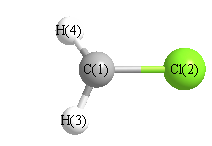 More geometry information
Calculated Bond Angles
| atom1 |
atom2 |
atom3 |
angle |
|
atom1 |
atom2 |
atom3 |
angle |
| Br2 |
C1 |
H3 |
114.976 |
|
Br2 |
C1 |
H4 |
114.976 |
| H3 |
C1 |
H4 |
120.666 |
|
Electronic energy levels
Charges, Dipole, Quadrupole and Polarizability
Charges from optimized geometry at B3LYP/STO-3G
Charges (e)
| Number |
Element |
Mulliken |
CHELPG |
AIM |
ESP |
| 1 |
C |
-0.098 |
|
|
|
| 2 |
Cl |
-0.107 |
|
|
|
| 3 |
H |
0.103 |
|
|
|
| 4 |
H |
0.103 |
|
|
|
Electric dipole moments
Electric dipole components in Debye
(What's a Debye? See section
VII.A.3)
| |
x |
y |
z |
Total |
| |
0.394 |
1.610 |
0.000 |
1.657 |
| CHELPG |
|
|
|
|
| AIM |
|
|
|
|
| ESP |
|
|
|
|
Electric Quadrupole moment
Quadrupole components in D Å
| Primitive |
|---|
| | x | y | z |
|---|
| x |
-18.221 |
0.573 |
0.000 |
| y |
0.573 |
-16.563 |
0.000 |
| z |
0.000 |
0.000 |
-17.236 |
|
| Traceless |
|---|
| | x | y | z |
|---|
| x |
-1.322 |
0.573 |
0.000 |
| y |
0.573 |
1.165 |
0.000 |
| z |
0.000 |
0.000 |
0.156 |
|
| Polar |
|---|
| 3z2-r2 | 0.312 |
|---|
| x2-y2 | -1.658 |
|---|
| xy | 0.573 |
|---|
| xz | 0.000 |
|---|
| yz | 0.000 |
|---|
|
Polarizabilities
Components of the polarizability tensor.
Units are
Å
3 (Angstrom cubed)
Change units.
| |
x |
y |
z |
| x |
0.399 |
0.105 |
0.000 |
| y |
0.105 |
2.478 |
0.000 |
| z |
0.000 |
0.000 |
0.900 |
<r2> (average value of r
2) Å
2
| <r2> |
32.801 |
| (<r2>)1/2 |
5.727 |
Jump to
S1C1
Energy calculated at B3LYP/STO-3G
| | hartrees |
|---|
| Energy at 0K | -493.934313 |
| Energy at 298.15K | |
| HF Energy | -493.934313 |
| Nuclear repulsion energy | 43.694653 |
The energy at 298.15K was derived from the energy at 0K
and an integrated heat capacity that used the calculated vibrational frequencies.
Vibrational Frequencies calculated at B3LYP/STO-3G
| Mode Number |
Symmetry |
Frequency
(cm-1) |
Scaled Frequency
(cm-1) |
IR Intensities
(km mol-1) |
Raman Act
(Å4/u) |
Dep P |
Dep U |
|---|
| 1 |
A1 |
3385 |
3021 |
3.48 |
|
|
|
| 2 |
A1 |
1484 |
1324 |
23.53 |
|
|
|
| 3 |
A1 |
894 |
798 |
32.20 |
|
|
|
| 4 |
B1 |
465i |
415i |
49.93 |
|
|
|
| 5 |
B2 |
3600 |
3213 |
2.32 |
|
|
|
| 6 |
B2 |
1008 |
900 |
2.03 |
|
|
|
Unscaled Zero Point Vibrational Energy (zpe) 4953.3 cm
-1
Scaled (by 0.8924) Zero Point Vibrational Energy (zpe) 4420.3 cm
-1
See section
III.C.1 List or set vibrational scaling factors
to change the scale factors used here.
See section
III.C.2
Calculate a vibrational scaling factor for a given set of molecules
to determine the least squares best scaling factor.
Geometric Data calculated at B3LYP/STO-3G
Point Group is C2v
Cartesians (Å)
| Atom |
x (Å) |
y (Å) |
z (Å) |
|---|
| C1 |
0.000 |
0.000 |
-1.168 |
| Cl2 |
0.000 |
0.000 |
0.609 |
| H3 |
0.000 |
0.971 |
-1.675 |
| H4 |
0.000 |
-0.971 |
-1.675 |
Atom - Atom Distances (Å)
| |
C1 |
Cl2 |
H3 |
H4 |
| C1 | | 1.7770 | 1.0953 | 1.0953 |
Cl2 | 1.7770 | | 2.4817 | 2.4817 | H3 | 1.0953 | 2.4817 | | 1.9420 | H4 | 1.0953 | 2.4817 | 1.9420 | |
More geometry information
Calculated Bond Angles
| atom1 |
atom2 |
atom3 |
angle |
|
atom1 |
atom2 |
atom3 |
angle |
| Br2 |
C1 |
H3 |
117.564 |
|
Br2 |
C1 |
H4 |
117.564 |
| H3 |
C1 |
H4 |
124.871 |
|
Electronic energy levels
Charges, Dipole, Quadrupole and Polarizability
Charges from optimized geometry at B3LYP/STO-3G
Charges (e)
| Number |
Element |
Mulliken |
CHELPG |
AIM |
ESP |
| 1 |
C |
-0.109 |
|
|
|
| 2 |
Cl |
-0.101 |
|
|
|
| 3 |
H |
0.105 |
|
|
|
| 4 |
H |
0.105 |
|
|
|
Electric dipole moments
Electric dipole components in Debye
(What's a Debye? See section
VII.A.3)
| |
x |
y |
z |
Total |
| |
0.000 |
0.000 |
-1.622 |
1.622 |
| CHELPG |
|
|
|
|
| AIM |
|
|
|
|
| ESP |
|
|
|
|
Electric Quadrupole moment
Quadrupole components in D Å
| Primitive |
|---|
| | x | y | z |
|---|
| x |
-18.348 |
0.000 |
0.000 |
| y |
0.000 |
-17.118 |
0.000 |
| z |
0.000 |
0.000 |
-16.390 |
|
| Traceless |
|---|
| | x | y | z |
|---|
| x |
-1.594 |
0.000 |
0.000 |
| y |
0.000 |
0.251 |
0.000 |
| z |
0.000 |
0.000 |
1.343 |
|
| Polar |
|---|
| 3z2-r2 | 2.687 |
|---|
| x2-y2 | -1.230 |
|---|
| xy | 0.000 |
|---|
| xz | 0.000 |
|---|
| yz | 0.000 |
|---|
|
Polarizabilities
Components of the polarizability tensor.
Units are
Å
3 (Angstrom cubed)
Change units.
| |
x |
y |
z |
| x |
0.370 |
0.000 |
0.000 |
| y |
0.000 |
0.896 |
0.000 |
| z |
0.000 |
0.000 |
2.434 |
<r2> (average value of r
2) Å
2
| <r2> |
32.783 |
| (<r2>)1/2 |
5.726 |
