Jump to
S1C2
Energy calculated at MP2=FULL/STO-3G
| | hartrees |
|---|
| Energy at 0K | -1059.129036 |
| Energy at 298.15K | -1059.131248 |
| HF Energy | -1058.926169 |
| Nuclear repulsion energy | 253.754128 |
The energy at 298.15K was derived from the energy at 0K
and an integrated heat capacity that used the calculated vibrational frequencies.
Vibrational Frequencies calculated at MP2=FULL/STO-3G
| Mode Number |
Symmetry |
Frequency
(cm-1) |
Scaled Frequency
(cm-1) |
IR Intensities
(km mol-1) |
Raman Act
(Å4/u) |
Dep P |
Dep U |
|---|
| 1 |
A' |
3429 |
3048 |
0.53 |
|
|
|
| 2 |
A' |
3345 |
2974 |
14.16 |
|
|
|
| 3 |
A' |
1728 |
1536 |
21.30 |
|
|
|
| 4 |
A' |
1473 |
1309 |
10.23 |
|
|
|
| 5 |
A' |
1314 |
1168 |
19.43 |
|
|
|
| 6 |
A' |
1081 |
961 |
10.72 |
|
|
|
| 7 |
A' |
852 |
757 |
19.62 |
|
|
|
| 8 |
A' |
443 |
393 |
1.51 |
|
|
|
| 9 |
A' |
315 |
280 |
17.84 |
|
|
|
| 10 |
A' |
254 |
226 |
4.58 |
|
|
|
| 11 |
A" |
1341 |
1192 |
28.48 |
|
|
|
| 12 |
A" |
999 |
888 |
50.21 |
|
|
|
| 13 |
A" |
864 |
768 |
23.36 |
|
|
|
| 14 |
A" |
260 |
231 |
1.04 |
|
|
|
| 15 |
A" |
60 |
54 |
4.12 |
|
|
|
Unscaled Zero Point Vibrational Energy (zpe) 8879.2 cm
-1
Scaled (by 0.8889) Zero Point Vibrational Energy (zpe) 7892.8 cm
-1
See section
III.C.1 List or set vibrational scaling factors
to change the scale factors used here.
See section
III.C.2
Calculate a vibrational scaling factor for a given set of molecules
to determine the least squares best scaling factor.
Geometric Data calculated at MP2=FULL/STO-3G
Point Group is Cs
Cartesians (Å)
| Atom |
x (Å) |
y (Å) |
z (Å) |
|---|
| C1 |
0.386 |
-0.012 |
0.000 |
| C2 |
-0.178 |
1.472 |
0.000 |
| H3 |
1.500 |
-0.021 |
0.000 |
| Cl4 |
-0.178 |
-0.885 |
1.517 |
| Cl5 |
-0.178 |
-0.885 |
-1.517 |
| O6 |
0.575 |
2.481 |
0.000 |
| H7 |
-1.298 |
1.514 |
0.000 |
Atom - Atom Distances (Å)
| |
C1 |
C2 |
H3 |
Cl4 |
Cl5 |
O6 |
H7 |
| C1 | | 1.5878 | 1.1147 | 1.8385 | 1.8385 | 2.5004 | 2.2732 |
C2 | 1.5878 | | 2.2460 | 2.8031 | 2.8031 | 1.2586 | 1.1213 | H3 | 1.1147 | 2.2460 | | 2.4216 | 2.4216 | 2.6674 | 3.1921 | Cl4 | 1.8385 | 2.8031 | 2.4216 | | 3.0337 | 3.7679 | 3.0520 | Cl5 | 1.8385 | 2.8031 | 2.4216 | 3.0337 | | 3.7679 | 3.0520 | O6 | 2.5004 | 1.2586 | 2.6674 | 3.7679 | 3.7679 | | 2.1077 | H7 | 2.2732 | 1.1213 | 3.1921 | 3.0520 | 3.0520 | 2.1077 | |
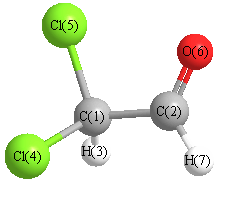 More geometry information
Calculated Bond Angles
| atom1 |
atom2 |
atom3 |
angle |
|
atom1 |
atom2 |
atom3 |
angle |
| C1 |
C2 |
O6 |
122.490 |
|
C1 |
C2 |
H7 |
112.957 |
| C2 |
C1 |
H3 |
111.219 |
|
C2 |
C1 |
Cl4 |
109.573 |
| C2 |
C1 |
Cl5 |
109.573 |
|
H3 |
C1 |
Cl4 |
107.635 |
| H3 |
C1 |
Cl5 |
107.635 |
|
Cl4 |
C1 |
Cl5 |
111.186 |
| O6 |
C2 |
H7 |
124.553 |
|
Electronic energy levels
Charges, Dipole, Quadrupole and Polarizability
Jump to
S1C1
Energy calculated at MP2=FULL/STO-3G
| | hartrees |
|---|
| Energy at 0K | -1059.128485 |
| Energy at 298.15K | |
| HF Energy | -1058.924764 |
| Nuclear repulsion energy | 257.194423 |
The energy at 298.15K was derived from the energy at 0K
and an integrated heat capacity that used the calculated vibrational frequencies.
Vibrational Frequencies calculated at MP2=FULL/STO-3G
| Mode Number |
Symmetry |
Frequency
(cm-1) |
Scaled Frequency
(cm-1) |
IR Intensities
(km mol-1) |
Raman Act
(Å4/u) |
Dep P |
Dep U |
|---|
| 1 |
A |
3414 |
3035 |
0.51 |
36.37 |
0.33 |
0.50 |
| 2 |
A |
3329 |
2959 |
14.38 |
56.64 |
0.32 |
0.49 |
| 3 |
A |
1732 |
1539 |
29.93 |
0.32 |
0.75 |
0.86 |
| 4 |
A |
1463 |
1300 |
32.55 |
7.23 |
0.73 |
0.85 |
| 5 |
A |
1347 |
1197 |
3.21 |
4.66 |
0.69 |
0.82 |
| 6 |
A |
1331 |
1183 |
20.41 |
10.06 |
0.72 |
0.84 |
| 7 |
A |
1054 |
937 |
15.31 |
3.32 |
0.74 |
0.85 |
| 8 |
A |
957 |
851 |
43.17 |
9.97 |
0.71 |
0.83 |
| 9 |
A |
935 |
831 |
7.67 |
4.88 |
0.61 |
0.76 |
| 10 |
A |
696 |
618 |
19.67 |
11.46 |
0.06 |
0.12 |
| 11 |
A |
629 |
559 |
20.71 |
4.90 |
0.75 |
0.86 |
| 12 |
A |
337 |
300 |
1.09 |
2.99 |
0.31 |
0.47 |
| 13 |
A |
262 |
233 |
5.41 |
4.15 |
0.74 |
0.85 |
| 14 |
A |
191 |
170 |
0.84 |
1.03 |
0.69 |
0.82 |
| 15 |
A |
77 |
68 |
5.38 |
1.24 |
0.75 |
0.86 |
Unscaled Zero Point Vibrational Energy (zpe) 8876.8 cm
-1
Scaled (by 0.8889) Zero Point Vibrational Energy (zpe) 7890.6 cm
-1
See section
III.C.1 List or set vibrational scaling factors
to change the scale factors used here.
See section
III.C.2
Calculate a vibrational scaling factor for a given set of molecules
to determine the least squares best scaling factor.
Geometric Data calculated at MP2=FULL/STO-3G
Point Group is C1
Cartesians (Å)
| Atom |
x (Å) |
y (Å) |
z (Å) |
|---|
| C1 |
0.122 |
-0.051 |
0.544 |
| C2 |
-0.783 |
-1.316 |
0.207 |
| H3 |
0.264 |
0.050 |
1.646 |
| Cl4 |
1.797 |
-0.295 |
-0.180 |
| Cl5 |
-0.663 |
1.493 |
-0.054 |
| O6 |
-1.912 |
-1.243 |
-0.338 |
| H7 |
-0.286 |
-2.273 |
0.517 |
Atom - Atom Distances (Å)
| |
C1 |
C2 |
H3 |
Cl4 |
Cl5 |
O6 |
H7 |
| C1 | | 1.5913 | 1.1154 | 1.8405 | 1.8319 | 2.5177 | 2.2600 |
C2 | 1.5913 | | 2.2429 | 2.8011 | 2.8229 | 1.2566 | 1.1223 | H3 | 1.1154 | 2.2429 | | 2.4085 | 2.4143 | 3.2162 | 2.6411 | Cl4 | 1.8405 | 2.8011 | 2.4085 | | 3.0431 | 3.8320 | 2.9564 | Cl5 | 1.8319 | 2.8229 | 2.4143 | 3.0431 | | 3.0206 | 3.8276 | O6 | 2.5177 | 1.2566 | 3.2162 | 3.8320 | 3.0206 | | 2.1066 | H7 | 2.2600 | 1.1223 | 2.6411 | 2.9564 | 3.8276 | 2.1066 | |
More geometry information
Calculated Bond Angles
| atom1 |
atom2 |
atom3 |
angle |
|
atom1 |
atom2 |
atom3 |
angle |
| C1 |
C2 |
O6 |
123.848 |
|
C1 |
C2 |
H7 |
111.612 |
| C2 |
C1 |
H3 |
110.685 |
|
C2 |
C1 |
Cl4 |
109.199 |
| C2 |
C1 |
Cl5 |
110.906 |
|
H3 |
C1 |
Cl4 |
106.543 |
| H3 |
C1 |
Cl5 |
107.500 |
|
Cl4 |
C1 |
Cl5 |
111.917 |
| O6 |
C2 |
H7 |
124.540 |
|
Electronic energy levels
Charges, Dipole, Quadrupole and Polarizability
