Jump to
S2C1
Energy calculated at MP2=FULL/6-311G**
| | hartrees |
|---|
| Energy at 0K | -150.950048 |
| Energy at 298.15K | -150.948506 |
| HF Energy | -150.499267 |
| Nuclear repulsion energy | 45.759366 |
The energy at 298.15K was derived from the energy at 0K
and an integrated heat capacity that used the calculated vibrational frequencies.
Vibrational Frequencies calculated at MP2=FULL/6-311G**
| Mode Number |
Symmetry |
Frequency
(cm-1) |
Scaled Frequency
(cm-1) |
IR Intensities
(km mol-1) |
Raman Act
(Å4/u) |
Dep P |
Dep U |
|---|
| 1 |
Σ |
2094 |
1986 |
383.98 |
|
|
|
| 2 |
Σ |
1075 |
1019 |
8.10 |
|
|
|
| 3 |
Π |
424 |
402 |
48.26 |
|
|
|
| 3 |
Π |
424 |
402 |
48.26 |
|
|
|
Unscaled Zero Point Vibrational Energy (zpe) 2007.9 cm
-1
Scaled (by 0.9486) Zero Point Vibrational Energy (zpe) 1904.7 cm
-1
See section
III.C.1 List or set vibrational scaling factors
to change the scale factors used here.
See section
III.C.2
Calculate a vibrational scaling factor for a given set of molecules
to determine the least squares best scaling factor.
Geometric Data calculated at MP2=FULL/6-311G**
Point Group is C∞v
Cartesians (Å)
| Atom |
x (Å) |
y (Å) |
z (Å) |
|---|
| C1 |
0.000 |
0.000 |
-1.427 |
| C2 |
0.000 |
0.000 |
-0.051 |
| O3 |
0.000 |
0.000 |
1.109 |
Atom - Atom Distances (Å)
| |
C1 |
C2 |
O3 |
| C1 | | 1.3761 | 2.5360 |
C2 | 1.3761 | | 1.1599 | O3 | 2.5360 | 1.1599 | |
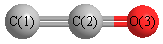 More geometry information
Calculated Bond Angles
| atom1 |
atom2 |
atom3 |
angle |
|
atom1 |
atom2 |
atom3 |
angle |
| C1 |
C2 |
O3 |
180.000 |
|
Electronic energy levels
Charges, Dipole, Quadrupole and Polarizability
Jump to
S1C1
Energy calculated at MP2=FULL/6-311G**
| | hartrees |
|---|
| Energy at 0K | -150.914193 |
| Energy at 298.15K | -150.912615 |
| HF Energy | -150.437531 |
| Nuclear repulsion energy | 45.472504 |
The energy at 298.15K was derived from the energy at 0K
and an integrated heat capacity that used the calculated vibrational frequencies.
Geometric Data calculated at MP2=FULL/6-311G**
Point Group is C∞v
Cartesians (Å)
| Atom |
x (Å) |
y (Å) |
z (Å) |
|---|
| C1 |
0.000 |
0.000 |
-1.429 |
| C2 |
0.000 |
0.000 |
-0.060 |
| O3 |
0.000 |
0.000 |
1.117 |
Atom - Atom Distances (Å)
| |
C1 |
C2 |
O3 |
| C1 | | 1.3692 | 2.5461 |
C2 | 1.3692 | | 1.1769 | O3 | 2.5461 | 1.1769 | |
More geometry information
Calculated Bond Angles
| atom1 |
atom2 |
atom3 |
angle |
|
atom1 |
atom2 |
atom3 |
angle |
| C1 |
C2 |
O3 |
180.000 |
|
Electronic energy levels
Charges, Dipole, Quadrupole and Polarizability
