return to home page Computational Chemistry Comparison and Benchmark DataBase Release 22 (May 2022) Standard Reference Database 101 National Institute of Standards and Technology
You are here: Calculated > Energy > Optimized > Energy

All results from a given calculation for CCO (Dicarbon monoxide)

using model chemistry: B2PLYP=FULL/6-311G**

19 10 17 12 22

States and conformations

State Conformation minimum conformation conformer description state description
1 1 yes C*V 3Σ
2 1 yes C*V 1Π

State 1 (3Σ)

Jump to S2C1
Energy calculated at B2PLYP=FULL/6-311G**
 hartrees
Energy at 0K-151.183445
Energy at 298.15K-151.181829
HF Energy-151.031956
Nuclear repulsion energy45.848470
The energy at 298.15K was derived from the energy at 0K and an integrated heat capacity that used the calculated vibrational frequencies.
Vibrational Frequencies calculated at B2PLYP=FULL/6-311G**
Mode Number Symmetry Frequency
(cm-1)
Scaled Frequency
(cm-1)
IR Intensities
(km mol-1)
Raman Act
4/u)
Dep P Dep U
1 Σ 2034 2034 163.07      
2 Σ 1089 1089 12.76      
3 Π 384 384 42.97      
3 Π 384 384 42.97      

Unscaled Zero Point Vibrational Energy (zpe) 1945.4 cm-1
Scaled (by 1) Zero Point Vibrational Energy (zpe) 1945.4 cm-1
See section III.C.1 List or set vibrational scaling factors to change the scale factors used here.
See section III.C.2 Calculate a vibrational scaling factor for a given set of molecules to determine the least squares best scaling factor.
Rotational Constants (cm-1) from geometry optimized at B2PLYP=FULL/6-311G**
B
0.38454

See section I.F.4 to change rotational constant units
Geometric Data calculated at B2PLYP=FULL/6-311G**

Point Group is C∞v

Cartesians (Å)
Atom x (Å) y (Å) z (Å)
C1 0.000 0.000 -1.420
C2 0.000 0.000 -0.057
O3 0.000 0.000 1.107

Atom - Atom Distances (Å)
  C1 C2 O3
C11.36302.5271
C21.36301.1641
O32.52711.1641

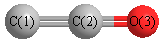
picture of Dicarbon monoxide state 1 conformation 1
More geometry information
Calculated Bond Angles
atom1 atom2 atom3 angle atom1 atom2 atom3 angle
C1 C2 O3 180.000
Electronic energy levels
Charges, Dipole, Quadrupole and Polarizability

State 2 (1Π)

Jump to S1C1
Energy calculated at B2PLYP=FULL/6-311G**
 hartrees
Energy at 0K-151.145545
Energy at 298.15K-151.143944
HF Energy-150.985250
Nuclear repulsion energy45.669114
The energy at 298.15K was derived from the energy at 0K and an integrated heat capacity that used the calculated vibrational frequencies.
Vibrational Frequencies calculated at B2PLYP=FULL/6-311G**
Mode Number Symmetry Frequency
(cm-1)
Scaled Frequency
(cm-1)
IR Intensities
(km mol-1)
Raman Act
4/u)
Dep P Dep U
1 Σ 2012 2012 75.99      
2 Σ 1101 1101 29.77      
3 Π 480 480 3.88      
3 Π 317 317 62.05      

Unscaled Zero Point Vibrational Energy (zpe) 1954.7 cm-1
Scaled (by 1) Zero Point Vibrational Energy (zpe) 1954.7 cm-1
See section III.C.1 List or set vibrational scaling factors to change the scale factors used here.
See section III.C.2 Calculate a vibrational scaling factor for a given set of molecules to determine the least squares best scaling factor.
Rotational Constants (cm-1) from geometry optimized at B2PLYP=FULL/6-311G**
B
0.38216

See section I.F.4 to change rotational constant units
Geometric Data calculated at B2PLYP=FULL/6-311G**

Point Group is C∞v

Cartesians (Å)
Atom x (Å) y (Å) z (Å)
C1 0.000 0.000 -1.423
C2 0.000 0.000 -0.060
O3 0.000 0.000 1.112

Atom - Atom Distances (Å)
  C1 C2 O3
C11.36212.5347
C21.36211.1726
O32.53471.1726

picture of Dicarbon monoxide state 2 conformation 1
More geometry information
Calculated Bond Angles
atom1 atom2 atom3 angle atom1 atom2 atom3 angle
C1 C2 O3 180.000
Electronic energy levels
Charges, Dipole, Quadrupole and Polarizability