Jump to
S1C2
S2C1
S2C2
Energy calculated at MP2=FULL/6-311G**
| | hartrees |
|---|
| Energy at 0K | -131.111196 |
| Energy at 298.15K | -131.110817 |
| HF Energy | -130.706329 |
| Nuclear repulsion energy | 47.514817 |
The energy at 298.15K was derived from the energy at 0K
and an integrated heat capacity that used the calculated vibrational frequencies.
Vibrational Frequencies calculated at MP2=FULL/6-311G**
| Mode Number |
Symmetry |
Frequency
(cm-1) |
Scaled Frequency
(cm-1) |
IR Intensities
(km mol-1) |
Raman Act
(Å4/u) |
Dep P |
Dep U |
|---|
| 1 |
A' |
3356 |
3184 |
14.31 |
|
|
|
| 2 |
A' |
2309 |
2190 |
0.68 |
|
|
|
| 3 |
A' |
1066 |
1011 |
29.89 |
|
|
|
| 4 |
A' |
840 |
797 |
7.61 |
|
|
|
| 5 |
A' |
452 |
429 |
4.74 |
|
|
|
| 6 |
A" |
534 |
507 |
7.12 |
|
|
|
Unscaled Zero Point Vibrational Energy (zpe) 4278.3 cm
-1
Scaled (by 0.9486) Zero Point Vibrational Energy (zpe) 4058.4 cm
-1
See section
III.C.1 List or set vibrational scaling factors
to change the scale factors used here.
See section
III.C.2
Calculate a vibrational scaling factor for a given set of molecules
to determine the least squares best scaling factor.
Geometric Data calculated at MP2=FULL/6-311G**
Point Group is Cs
Cartesians (Å)
| Atom |
x (Å) |
y (Å) |
z (Å) |
|---|
| C1 |
-0.278 |
-1.227 |
0.000 |
| C2 |
0.000 |
0.122 |
0.000 |
| N3 |
0.193 |
1.250 |
0.000 |
| H4 |
0.314 |
-2.126 |
0.000 |
Atom - Atom Distances (Å)
| |
C1 |
C2 |
N3 |
H4 |
| C1 | | 1.3776 | 2.5214 | 1.0760 |
C2 | 1.3776 | | 1.1442 | 2.2698 | N3 | 2.5214 | 1.1442 | | 3.3778 | H4 | 1.0760 | 2.2698 | 3.3778 | |
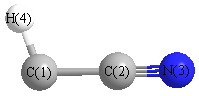 More geometry information
Calculated Bond Angles
| atom1 |
atom2 |
atom3 |
angle |
|
atom1 |
atom2 |
atom3 |
angle |
| C1 |
C2 |
N3 |
178.092 |
|
C2 |
C1 |
H4 |
135.005 |
Electronic energy levels
Charges, Dipole, Quadrupole and Polarizability
Jump to
S1C1
S2C1
S2C2
Energy calculated at MP2=FULL/6-311G**
| | hartrees |
|---|
| Energy at 0K | -131.105955 |
| Energy at 298.15K | |
| HF Energy | -130.706365 |
| Nuclear repulsion energy | 47.837589 |
The energy at 298.15K was derived from the energy at 0K
and an integrated heat capacity that used the calculated vibrational frequencies.
Vibrational Frequencies calculated at MP2=FULL/6-311G**
| Mode Number |
Symmetry |
Frequency
(cm-1) |
Scaled Frequency
(cm-1) |
IR Intensities
(km mol-1) |
Raman Act
(Å4/u) |
Dep P |
Dep U |
|---|
| 1 |
Σ |
3497 |
3317 |
78.73 |
|
|
|
| 2 |
Σ |
1717 |
1628 |
33.24 |
|
|
|
| 3 |
Σ |
1181 |
1121 |
45.05 |
|
|
|
| 4 |
Π |
521 |
495 |
1.16 |
|
|
|
| 4 |
Π |
521 |
495 |
1.16 |
|
|
|
| 5 |
Π |
488i |
463i |
53.84 |
|
|
|
| 5 |
Π |
488i |
463i |
53.84 |
|
|
|
Unscaled Zero Point Vibrational Energy (zpe) 3231.0 cm
-1
Scaled (by 0.9486) Zero Point Vibrational Energy (zpe) 3064.9 cm
-1
See section
III.C.1 List or set vibrational scaling factors
to change the scale factors used here.
See section
III.C.2
Calculate a vibrational scaling factor for a given set of molecules
to determine the least squares best scaling factor.
Geometric Data calculated at MP2=FULL/6-311G**
Point Group is C∞v
Cartesians (Å)
| Atom |
x (Å) |
y (Å) |
z (Å) |
|---|
| C1 |
0.000 |
0.000 |
-1.208 |
| C2 |
0.000 |
0.000 |
0.102 |
| N3 |
0.000 |
0.000 |
1.273 |
| H4 |
0.000 |
0.000 |
-2.273 |
Atom - Atom Distances (Å)
| |
C1 |
C2 |
N3 |
H4 |
| C1 | | 1.3104 | 2.4815 | 1.0642 |
C2 | 1.3104 | | 1.1711 | 2.3746 | N3 | 2.4815 | 1.1711 | | 3.5457 | H4 | 1.0642 | 2.3746 | 3.5457 | |
More geometry information
Calculated Bond Angles
| atom1 |
atom2 |
atom3 |
angle |
|
atom1 |
atom2 |
atom3 |
angle |
| C1 |
C2 |
N3 |
180.000 |
|
C2 |
C1 |
H4 |
180.000 |
Electronic energy levels
Charges, Dipole, Quadrupole and Polarizability
Charges from optimized geometry at MP2=FULL/6-311G**
Charges (e)
| Number |
Element |
Mulliken |
CHELPG |
AIM |
ESP |
| 1 |
C |
0.030 |
|
|
|
| 2 |
C |
0.045 |
|
|
|
| 3 |
N |
-0.256 |
|
|
|
| 4 |
H |
0.180 |
|
|
|
Electric dipole moments
Electric dipole components in Debye
(What's a Debye? See section
VII.A.3)
| |
x |
y |
z |
Total |
| |
0.000 |
0.000 |
-3.632 |
3.632 |
| CHELPG |
|
|
|
|
| AIM |
|
|
|
|
| ESP |
|
|
|
|
Electric Quadrupole moment
Quadrupole components in D Å
| Primitive |
|---|
| | x | y | z |
|---|
| x |
-17.396 |
0.000 |
0.000 |
| y |
0.000 |
-17.396 |
0.000 |
| z |
0.000 |
0.000 |
-15.727 |
|
| Traceless |
|---|
| | x | y | z |
|---|
| x |
-0.835 |
0.000 |
0.000 |
| y |
0.000 |
-0.835 |
0.000 |
| z |
0.000 |
0.000 |
1.669 |
|
| Polar |
|---|
| 3z2-r2 | 3.338 |
|---|
| x2-y2 | 0.000 |
|---|
| xy | 0.000 |
|---|
| xz | 0.000 |
|---|
| yz | 0.000 |
|---|
|
Polarizabilities
Components of the polarizability tensor.
Units are
Å
3 (Angstrom cubed)
Change units.
| |
x |
y |
z |
| x |
1.858 |
0.000 |
0.000 |
| y |
0.000 |
1.858 |
0.000 |
| z |
0.000 |
0.000 |
6.279 |
<r2> (average value of r
2) Å
2
| <r2> |
35.852 |
| (<r2>)1/2 |
5.988 |
Jump to
S1C1
S1C2
S2C2
Energy calculated at MP2=FULL/6-311G**
| | hartrees |
|---|
| Energy at 0K | -131.105549 |
| Energy at 298.15K | -131.105009 |
| HF Energy | -130.646425 |
| Nuclear repulsion energy | 46.589232 |
The energy at 298.15K was derived from the energy at 0K
and an integrated heat capacity that used the calculated vibrational frequencies.
Vibrational Frequencies calculated at MP2=FULL/6-311G**
| Mode Number |
Symmetry |
Frequency
(cm-1) |
Scaled Frequency
(cm-1) |
IR Intensities
(km mol-1) |
Raman Act
(Å4/u) |
Dep P |
Dep U |
|---|
| 1 |
A' |
3100 |
2940 |
14.80 |
|
|
|
| 2 |
A' |
2241 |
2126 |
12.49 |
|
|
|
| 3 |
A' |
1066 |
1011 |
70.45 |
|
|
|
| 4 |
A' |
983 |
933 |
1.28 |
|
|
|
| 5 |
A' |
417 |
396 |
17.21 |
|
|
|
| 6 |
A" |
350 |
332 |
13.36 |
|
|
|
Unscaled Zero Point Vibrational Energy (zpe) 4078.0 cm
-1
Scaled (by 0.9486) Zero Point Vibrational Energy (zpe) 3868.4 cm
-1
See section
III.C.1 List or set vibrational scaling factors
to change the scale factors used here.
See section
III.C.2
Calculate a vibrational scaling factor for a given set of molecules
to determine the least squares best scaling factor.
Geometric Data calculated at MP2=FULL/6-311G**
Point Group is Cs
Cartesians (Å)
| Atom |
x (Å) |
y (Å) |
z (Å) |
|---|
| C1 |
0.051 |
-1.305 |
0.000 |
| C2 |
0.000 |
0.099 |
0.000 |
| N3 |
-0.202 |
1.263 |
0.000 |
| H4 |
1.111 |
-1.606 |
0.000 |
Atom - Atom Distances (Å)
| |
C1 |
C2 |
N3 |
H4 |
| C1 | | 1.4053 | 2.5811 | 1.1019 |
C2 | 1.4053 | | 1.1818 | 2.0350 | N3 | 2.5811 | 1.1818 | | 3.1556 | H4 | 1.1019 | 2.0350 | 3.1556 | |
More geometry information
Electronic energy levels
Charges, Dipole, Quadrupole and Polarizability
Jump to
S1C1
S1C2
S2C1
Energy calculated at MP2=FULL/6-311G**
| | hartrees |
|---|
| Energy at 0K | -131.105549 |
| Energy at 298.15K | -131.105009 |
| HF Energy | -130.646425 |
| Nuclear repulsion energy | 46.589232 |
The energy at 298.15K was derived from the energy at 0K
and an integrated heat capacity that used the calculated vibrational frequencies.
Vibrational Frequencies calculated at MP2=FULL/6-311G**
Geometric Data calculated at MP2=FULL/6-311G**
Point Group is Cs
Electronic energy levels
Charges, Dipole, Quadrupole and Polarizability
