Jump to
S1C2
S2C1
S2C2
Energy calculated at QCISD/6-311G**
| | hartrees |
|---|
| Energy at 0K | -131.098582 |
| Energy at 298.15K | -131.097997 |
| HF Energy | -130.709751 |
| Nuclear repulsion energy | 47.004410 |
The energy at 298.15K was derived from the energy at 0K
and an integrated heat capacity that used the calculated vibrational frequencies.
Vibrational Frequencies calculated at QCISD/6-311G**
| Mode Number |
Symmetry |
Frequency
(cm-1) |
Scaled Frequency
(cm-1) |
IR Intensities
(km mol-1) |
Raman Act
(Å4/u) |
Dep P |
Dep U |
|---|
| 1 |
A' |
3351 |
3197 |
19.63 |
|
|
|
| 2 |
A' |
1833 |
1749 |
41.52 |
|
|
|
| 3 |
A' |
1146 |
1094 |
10.68 |
|
|
|
| 4 |
A' |
629 |
600 |
26.41 |
|
|
|
| 5 |
A' |
398 |
380 |
3.76 |
|
|
|
| 6 |
A" |
437 |
417 |
1.20 |
|
|
|
Unscaled Zero Point Vibrational Energy (zpe) 3896.9 cm
-1
Scaled (by 0.9541) Zero Point Vibrational Energy (zpe) 3718.0 cm
-1
See section
III.C.1 List or set vibrational scaling factors
to change the scale factors used here.
See section
III.C.2
Calculate a vibrational scaling factor for a given set of molecules
to determine the least squares best scaling factor.
Geometric Data calculated at QCISD/6-311G**
Point Group is Cs
Cartesians (Å)
| Atom |
x (Å) |
y (Å) |
z (Å) |
|---|
| C1 |
0.023 |
-1.244 |
0.000 |
| C2 |
0.000 |
0.095 |
0.000 |
| N3 |
-0.117 |
1.284 |
0.000 |
| H4 |
0.681 |
-2.094 |
0.000 |
Atom - Atom Distances (Å)
| |
C1 |
C2 |
N3 |
H4 |
| C1 | | 1.3389 | 2.5321 | 1.0756 |
C2 | 1.3389 | | 1.1953 | 2.2926 | N3 | 2.5321 | 1.1953 | | 3.4715 | H4 | 1.0756 | 2.2926 | 3.4715 | |
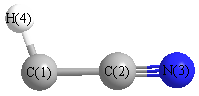 More geometry information
Calculated Bond Angles
| atom1 |
atom2 |
atom3 |
angle |
|
atom1 |
atom2 |
atom3 |
angle |
| C1 |
C2 |
N3 |
175.364 |
|
C2 |
C1 |
H4 |
143.202 |
Electronic energy levels
Charges, Dipole, Quadrupole and Polarizability
Jump to
S1C1
S2C1
S2C2
Energy calculated at QCISD/6-311G**
| | hartrees |
|---|
| Energy at 0K | -131.096395 |
| Energy at 298.15K | |
| HF Energy | -130.707857 |
| Nuclear repulsion energy | 47.158510 |
The energy at 298.15K was derived from the energy at 0K
and an integrated heat capacity that used the calculated vibrational frequencies.
Vibrational Frequencies calculated at QCISD/6-311G**
| Mode Number |
Symmetry |
Frequency
(cm-1) |
Scaled Frequency
(cm-1) |
IR Intensities
(km mol-1) |
Raman Act
(Å4/u) |
Dep P |
Dep U |
|---|
| 1 |
Σ |
3445 |
3287 |
65.01 |
|
|
|
| 2 |
Σ |
1668 |
1592 |
46.66 |
|
|
|
| 3 |
Σ |
1228 |
1172 |
5.69 |
|
|
|
| 4 |
Π |
441 |
421 |
0.03 |
|
|
|
| 4 |
Π |
441 |
421 |
0.03 |
|
|
|
| 5 |
Π |
408i |
389i |
47.82 |
|
|
|
| 5 |
Π |
408i |
389i |
47.82 |
|
|
|
Unscaled Zero Point Vibrational Energy (zpe) 3203.1 cm
-1
Scaled (by 0.9541) Zero Point Vibrational Energy (zpe) 3056.1 cm
-1
See section
III.C.1 List or set vibrational scaling factors
to change the scale factors used here.
See section
III.C.2
Calculate a vibrational scaling factor for a given set of molecules
to determine the least squares best scaling factor.
Geometric Data calculated at QCISD/6-311G**
Point Group is C∞v
Cartesians (Å)
| Atom |
x (Å) |
y (Å) |
z (Å) |
|---|
| C1 |
0.000 |
0.000 |
-1.218 |
| C2 |
0.000 |
0.000 |
0.086 |
| N3 |
0.000 |
0.000 |
1.297 |
| H4 |
0.000 |
0.000 |
-2.285 |
Atom - Atom Distances (Å)
| |
C1 |
C2 |
N3 |
H4 |
| C1 | | 1.3032 | 2.5142 | 1.0676 |
C2 | 1.3032 | | 1.2110 | 2.3708 | N3 | 2.5142 | 1.2110 | | 3.5818 | H4 | 1.0676 | 2.3708 | 3.5818 | |
More geometry information
Calculated Bond Angles
| atom1 |
atom2 |
atom3 |
angle |
|
atom1 |
atom2 |
atom3 |
angle |
| C1 |
C2 |
N3 |
180.000 |
|
C2 |
C1 |
H4 |
180.000 |
Electronic energy levels
Charges, Dipole, Quadrupole and Polarizability
Charges from optimized geometry at QCISD/6-311G**
Charges (e)
| Number |
Element |
Mulliken |
CHELPG |
AIM |
ESP |
| 1 |
C |
0.039 |
|
|
|
| 2 |
C |
0.025 |
|
|
|
| 3 |
N |
-0.231 |
|
|
|
| 4 |
H |
0.168 |
|
|
|
Electric dipole moments
Electric dipole components in Debye
(What's a Debye? See section
VII.A.3)
| |
x |
y |
z |
Total |
| |
0.000 |
0.000 |
-3.187 |
3.187 |
| CHELPG |
|
|
|
|
| AIM |
|
|
|
|
| ESP |
|
|
|
|
Electric Quadrupole moment
Quadrupole components in D Å
Polarizabilities
Components of the polarizability tensor.
Units are
Å
3 (Angstrom cubed)
Change units.
| |
x |
y |
z |
| x |
0.000 |
0.000 |
0.000 |
| y |
0.000 |
0.000 |
0.000 |
| z |
0.000 |
0.000 |
0.000 |
<r2> (average value of r
2) Å
2
| <r2> |
36.428 |
| (<r2>)1/2 |
6.036 |
Jump to
S1C1
S1C2
S2C2
Energy calculated at QCISD/6-311G**
| | hartrees |
|---|
| Energy at 0K | -131.072834 |
| Energy at 298.15K | -131.072263 |
| HF Energy | -130.647039 |
| Nuclear repulsion energy | 46.612569 |
The energy at 298.15K was derived from the energy at 0K
and an integrated heat capacity that used the calculated vibrational frequencies.
Vibrational Frequencies calculated at QCISD/6-311G**
| Mode Number |
Symmetry |
Frequency
(cm-1) |
Scaled Frequency
(cm-1) |
IR Intensities
(km mol-1) |
Raman Act
(Å4/u) |
Dep P |
Dep U |
|---|
| 1 |
A' |
3055 |
2915 |
17.95 |
|
|
|
| 2 |
A' |
2112 |
2015 |
46.43 |
|
|
|
| 3 |
A' |
1064 |
1015 |
61.73 |
|
|
|
| 4 |
A' |
978 |
933 |
7.31 |
|
|
|
| 5 |
A' |
426 |
406 |
17.50 |
|
|
|
| 6 |
A" |
316 |
301 |
9.14 |
|
|
|
Unscaled Zero Point Vibrational Energy (zpe) 3975.7 cm
-1
Scaled (by 0.9541) Zero Point Vibrational Energy (zpe) 3793.2 cm
-1
See section
III.C.1 List or set vibrational scaling factors
to change the scale factors used here.
See section
III.C.2
Calculate a vibrational scaling factor for a given set of molecules
to determine the least squares best scaling factor.
Geometric Data calculated at QCISD/6-311G**
Point Group is Cs
Cartesians (Å)
| Atom |
x (Å) |
y (Å) |
z (Å) |
|---|
| C1 |
-0.005 |
-1.309 |
0.000 |
| C2 |
0.000 |
0.101 |
0.000 |
| N3 |
-0.145 |
1.269 |
0.000 |
| H4 |
1.049 |
-1.640 |
0.000 |
Atom - Atom Distances (Å)
| |
C1 |
C2 |
N3 |
H4 |
| C1 | | 1.4098 | 2.5818 | 1.1055 |
C2 | 1.4098 | | 1.1772 | 2.0327 | N3 | 2.5818 | 1.1772 | | 3.1449 | H4 | 1.1055 | 2.0327 | 3.1449 | |
More geometry information
Electronic energy levels
Charges, Dipole, Quadrupole and Polarizability
Jump to
S1C1
S1C2
S2C1
Energy calculated at QCISD/6-311G**
| | hartrees |
|---|
| Energy at 0K | -131.072834 |
| Energy at 298.15K | -131.072263 |
| HF Energy | -130.647039 |
| Nuclear repulsion energy | 46.612569 |
The energy at 298.15K was derived from the energy at 0K
and an integrated heat capacity that used the calculated vibrational frequencies.
Vibrational Frequencies calculated at QCISD/6-311G**
Geometric Data calculated at QCISD/6-311G**
Point Group is Cs
Electronic energy levels
Charges, Dipole, Quadrupole and Polarizability
