Jump to
S1C2
Energy calculated at QCISD/6-311G**
| | hartrees |
|---|
| Energy at 0K | -189.362188 |
| Energy at 298.15K | -189.364929 |
| HF Energy | -188.818123 |
| Nuclear repulsion energy | 70.254303 |
The energy at 298.15K was derived from the energy at 0K
and an integrated heat capacity that used the calculated vibrational frequencies.
Vibrational Frequencies calculated at QCISD/6-311G**
| Mode Number |
Symmetry |
Frequency
(cm-1) |
Scaled Frequency
(cm-1) |
IR Intensities
(km mol-1) |
Raman Act
(Å4/u) |
Dep P |
Dep U |
|---|
| 1 |
A' |
3836 |
3660 |
55.29 |
|
|
|
| 2 |
A' |
3108 |
2965 |
50.87 |
|
|
|
| 3 |
A' |
1859 |
1774 |
322.16 |
|
|
|
| 4 |
A' |
1444 |
1378 |
4.85 |
|
|
|
| 5 |
A' |
1351 |
1289 |
7.72 |
|
|
|
| 6 |
A' |
1163 |
1110 |
251.76 |
|
|
|
| 7 |
A' |
642 |
613 |
49.93 |
|
|
|
| 8 |
A" |
1077 |
1028 |
0.63 |
|
|
|
| 9 |
A" |
687 |
655 |
151.47 |
|
|
|
Unscaled Zero Point Vibrational Energy (zpe) 7583.9 cm
-1
Scaled (by 0.9541) Zero Point Vibrational Energy (zpe) 7235.8 cm
-1
See section
III.C.1 List or set vibrational scaling factors
to change the scale factors used here.
See section
III.C.2
Calculate a vibrational scaling factor for a given set of molecules
to determine the least squares best scaling factor.
Geometric Data calculated at QCISD/6-311G**
Point Group is Cs
Cartesians (Å)
| Atom |
x (Å) |
y (Å) |
z (Å) |
|---|
| C1 |
0.000 |
0.421 |
0.000 |
| O2 |
-1.031 |
-0.443 |
0.000 |
| O3 |
1.159 |
0.112 |
0.000 |
| H4 |
-0.384 |
1.450 |
0.000 |
| H5 |
-0.638 |
-1.325 |
0.000 |
Atom - Atom Distances (Å)
| |
C1 |
O2 |
O3 |
H4 |
H5 |
| C1 | | 1.3454 | 1.1992 | 1.0982 | 1.8592 |
O2 | 1.3454 | | 2.2591 | 2.0008 | 0.9654 | O3 | 1.1992 | 2.2591 | | 2.0420 | 2.3011 | H4 | 1.0982 | 2.0008 | 2.0420 | | 2.7867 | H5 | 1.8592 | 0.9654 | 2.3011 | 2.7867 | |
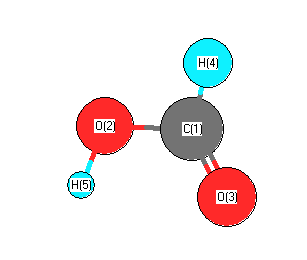 More geometry information
Calculated Bond Angles
| atom1 |
atom2 |
atom3 |
angle |
|
atom1 |
atom2 |
atom3 |
angle |
| C1 |
O2 |
H5 |
105.970 |
|
O2 |
C1 |
O3 |
125.093 |
| O2 |
C1 |
H4 |
109.512 |
|
O3 |
C1 |
H4 |
125.395 |
Electronic energy levels
Charges, Dipole, Quadrupole and Polarizability
Jump to
S1C1
Energy calculated at QCISD/6-311G**
| | hartrees |
|---|
| Energy at 0K | -189.353874 |
| Energy at 298.15K | |
| HF Energy | -188.808857 |
| Nuclear repulsion energy | 70.002061 |
The energy at 298.15K was derived from the energy at 0K
and an integrated heat capacity that used the calculated vibrational frequencies.
Vibrational Frequencies calculated at QCISD/6-311G**
| Mode Number |
Symmetry |
Frequency
(cm-1) |
Scaled Frequency
(cm-1) |
IR Intensities
(km mol-1) |
Raman Act
(Å4/u) |
Dep P |
Dep U |
|---|
| 1 |
A' |
3896 |
3717 |
56.05 |
|
|
|
| 2 |
A' |
3008 |
2870 |
90.95 |
|
|
|
| 3 |
A' |
1900 |
1813 |
260.29 |
|
|
|
| 4 |
A' |
1460 |
1393 |
0.86 |
|
|
|
| 5 |
A' |
1325 |
1264 |
313.03 |
|
|
|
| 6 |
A' |
1138 |
1086 |
50.34 |
|
|
|
| 7 |
A' |
668 |
638 |
12.12 |
|
|
|
| 8 |
A" |
1059 |
1010 |
1.07 |
|
|
|
| 9 |
A" |
503 |
480 |
92.45 |
|
|
|
Unscaled Zero Point Vibrational Energy (zpe) 7478.4 cm
-1
Scaled (by 0.9541) Zero Point Vibrational Energy (zpe) 7135.1 cm
-1
See section
III.C.1 List or set vibrational scaling factors
to change the scale factors used here.
See section
III.C.2
Calculate a vibrational scaling factor for a given set of molecules
to determine the least squares best scaling factor.
Geometric Data calculated at QCISD/6-311G**
Point Group is Cs
Cartesians (Å)
| Atom |
x (Å) |
y (Å) |
z (Å) |
|---|
| C1 |
0.000 |
0.382 |
0.000 |
| O2 |
-0.898 |
-0.628 |
0.000 |
| O3 |
1.179 |
0.199 |
0.000 |
| H4 |
-0.468 |
1.384 |
0.000 |
| H5 |
-1.779 |
-0.245 |
0.000 |
Atom - Atom Distances (Å)
| |
C1 |
O2 |
O3 |
H4 |
H5 |
| C1 | | 1.3520 | 1.1929 | 1.1058 | 1.8861 |
O2 | 1.3520 | | 2.2358 | 2.0582 | 0.9603 | O3 | 1.1929 | 2.2358 | | 2.0287 | 2.9907 | H4 | 1.1058 | 2.0582 | 2.0287 | | 2.0914 | H5 | 1.8861 | 0.9603 | 2.9907 | 2.0914 | |
More geometry information
Calculated Bond Angles
| atom1 |
atom2 |
atom3 |
angle |
|
atom1 |
atom2 |
atom3 |
angle |
| C1 |
O2 |
H5 |
108.106 |
|
O2 |
C1 |
O3 |
122.800 |
| O2 |
C1 |
H4 |
113.353 |
|
O3 |
C1 |
H4 |
123.847 |
Electronic energy levels
Charges, Dipole, Quadrupole and Polarizability
