Jump to
S1C2
Vibrational Frequencies calculated at CCSD/6-311G**
Geometric Data calculated at CCSD/6-311G**
Electronic energy levels
Charges, Dipole, Quadrupole and Polarizability
Jump to
S1C1
Energy calculated at CCSD/6-311G**
| | hartrees |
|---|
| Energy at 0K | -1071.572651 |
| Energy at 298.15K | |
| HF Energy | -1070.785952 |
| Nuclear repulsion energy | 266.178180 |
The energy at 298.15K was derived from the energy at 0K
and an integrated heat capacity that used the calculated vibrational frequencies.
Vibrational Frequencies calculated at CCSD/6-311G**
| Mode Number |
Symmetry |
Frequency
(cm-1) |
Scaled Frequency
(cm-1) |
IR Intensities
(km mol-1) |
Raman Act
(Å4/u) |
Dep P |
Dep U |
|---|
| 1 |
A |
3151 |
3151 |
6.44 |
|
|
|
| 2 |
A |
3002 |
3002 |
55.94 |
|
|
|
| 3 |
A |
1861 |
1861 |
116.96 |
|
|
|
| 4 |
A |
1435 |
1435 |
17.67 |
|
|
|
| 5 |
A |
1314 |
1314 |
20.47 |
|
|
|
| 6 |
A |
1281 |
1281 |
10.82 |
|
|
|
| 7 |
A |
1060 |
1060 |
13.97 |
|
|
|
| 8 |
A |
966 |
966 |
7.41 |
|
|
|
| 9 |
A |
860 |
860 |
73.76 |
|
|
|
| 10 |
A |
668 |
668 |
31.02 |
|
|
|
| 11 |
A |
636 |
636 |
30.45 |
|
|
|
| 12 |
A |
356 |
356 |
0.98 |
|
|
|
| 13 |
A |
289 |
289 |
2.57 |
|
|
|
| 14 |
A |
229 |
229 |
2.80 |
|
|
|
| 15 |
A |
85 |
85 |
10.28 |
|
|
|
Unscaled Zero Point Vibrational Energy (zpe) 8596.5 cm
-1
Scaled (by 1) Zero Point Vibrational Energy (zpe) 8596.5 cm
-1
See section
III.C.1 List or set vibrational scaling factors
to change the scale factors used here.
See section
III.C.2
Calculate a vibrational scaling factor for a given set of molecules
to determine the least squares best scaling factor.
Geometric Data calculated at CCSD/6-311G**
Point Group is C1
Cartesians (Å)
| Atom |
x (Å) |
y (Å) |
z (Å) |
|---|
| C1 |
0.102 |
-0.024 |
0.515 |
| C2 |
-0.728 |
-1.276 |
0.194 |
| H3 |
0.222 |
0.046 |
1.597 |
| Cl4 |
1.731 |
-0.274 |
-0.168 |
| Cl5 |
-0.658 |
1.455 |
-0.057 |
| O6 |
-1.810 |
-1.264 |
-0.317 |
| H7 |
-0.217 |
-2.209 |
0.500 |
Atom - Atom Distances (Å)
| |
C1 |
C2 |
H3 |
Cl4 |
Cl5 |
O6 |
H7 |
| C1 | | 1.5359 | 1.0908 | 1.7836 | 1.7585 | 2.4263 | 2.2084 |
C2 | 1.5359 | | 2.1489 | 2.6792 | 2.7428 | 1.1970 | 1.1068 | H3 | 1.0908 | 2.1489 | | 2.3443 | 2.3439 | 3.0836 | 2.5464 | Cl4 | 1.7836 | 2.6792 | 2.3443 | | 2.9510 | 3.6793 | 2.8257 | Cl5 | 1.7585 | 2.7428 | 2.3439 | 2.9510 | | 2.9639 | 3.7320 | O6 | 2.4263 | 1.1970 | 3.0836 | 3.6793 | 2.9639 | | 2.0242 | H7 | 2.2084 | 1.1068 | 2.5464 | 2.8257 | 3.7320 | 2.0242 | |
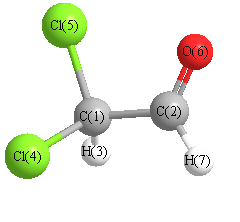 More geometry information
Calculated Bond Angles
| atom1 |
atom2 |
atom3 |
angle |
|
atom1 |
atom2 |
atom3 |
angle |
| C1 |
C2 |
O6 |
124.735 |
|
C1 |
C2 |
H7 |
112.355 |
| C2 |
C1 |
H3 |
108.607 |
|
C2 |
C1 |
Cl4 |
107.396 |
| C2 |
C1 |
Cl5 |
112.555 |
|
H3 |
C1 |
Cl4 |
106.805 |
| H3 |
C1 |
Cl5 |
108.414 |
|
Cl4 |
C1 |
Cl5 |
112.839 |
| O6 |
C2 |
H7 |
122.907 |
|
Electronic energy levels
Charges, Dipole, Quadrupole and Polarizability
