Jump to
S1C2
Energy calculated at B97D3/6-311G**
| | hartrees |
|---|
| Energy at 0K | -2780.451521 |
| Energy at 298.15K | -2780.455396 |
| HF Energy | -2780.451521 |
| Nuclear repulsion energy | 223.165221 |
The energy at 298.15K was derived from the energy at 0K
and an integrated heat capacity that used the calculated vibrational frequencies.
Vibrational Frequencies calculated at B97D3/6-311G**
| Mode Number |
Symmetry |
Frequency
(cm-1) |
Scaled Frequency
(cm-1) |
IR Intensities
(km mol-1) |
Raman Act
(Å4/u) |
Dep P |
Dep U |
|---|
| 1 |
A' |
1805 |
1779 |
389.98 |
|
|
|
| 2 |
A' |
824 |
812 |
127.56 |
|
|
|
| 3 |
A' |
533 |
526 |
87.62 |
|
|
|
| 4 |
A' |
338 |
333 |
54.67 |
|
|
|
| 5 |
A' |
200 |
197 |
0.12 |
|
|
|
| 6 |
A" |
168 |
165 |
0.13 |
|
|
|
Unscaled Zero Point Vibrational Energy (zpe) 1933.4 cm
-1
Scaled (by 0.9857) Zero Point Vibrational Energy (zpe) 1905.7 cm
-1
See section
III.C.1 List or set vibrational scaling factors
to change the scale factors used here.
See section
III.C.2
Calculate a vibrational scaling factor for a given set of molecules
to determine the least squares best scaling factor.
Geometric Data calculated at B97D3/6-311G**
Point Group is Cs
Cartesians (Å)
| Atom |
x (Å) |
y (Å) |
z (Å) |
|---|
| Br1 |
-0.764 |
-0.806 |
0.000 |
| O2 |
0.000 |
0.899 |
0.000 |
| N3 |
1.568 |
0.824 |
0.000 |
| O4 |
1.972 |
1.906 |
0.000 |
Atom - Atom Distances (Å)
| |
Br1 |
O2 |
N3 |
O4 |
| Br1 | | 1.8684 | 2.8452 | 3.8525 |
O2 | 1.8684 | | 1.5695 | 2.2143 | N3 | 2.8452 | 1.5695 | | 1.1549 | O4 | 3.8525 | 2.2143 | 1.1549 | |
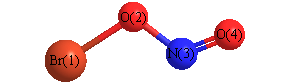 More geometry information
Calculated Bond Angles
| atom1 |
atom2 |
atom3 |
angle |
|
atom1 |
atom2 |
atom3 |
angle |
| Br1 |
O2 |
N3 |
113.564 |
|
O2 |
N3 |
O4 |
108.871 |
Electronic energy levels
Charges, Dipole, Quadrupole and Polarizability
Charges from optimized geometry at B97D3/6-311G**
Charges (e)
| Number |
Element |
Mulliken |
CHELPG |
AIM |
ESP |
| 1 |
Br |
0.181 |
|
|
|
| 2 |
O |
-0.340 |
|
|
|
| 3 |
N |
0.218 |
|
|
|
| 4 |
O |
-0.059 |
|
|
|
Electric dipole moments
Electric dipole components in Debye
(What's a Debye? See section
VII.A.3)
| |
x |
y |
z |
Total |
| |
0.405 |
-0.717 |
0.000 |
0.824 |
| CHELPG |
|
|
|
|
| AIM |
|
|
|
|
| ESP |
|
|
|
|
Electric Quadrupole moment
Quadrupole components in D Å
| Primitive |
|---|
| | x | y | z |
|---|
| x |
-32.650 |
2.013 |
0.000 |
| y |
2.013 |
-32.865 |
0.000 |
| z |
0.000 |
0.000 |
-33.309 |
|
| Traceless |
|---|
| | x | y | z |
|---|
| x |
0.437 |
2.013 |
0.000 |
| y |
2.013 |
0.115 |
0.000 |
| z |
0.000 |
0.000 |
-0.552 |
|
| Polar |
|---|
| 3z2-r2 | -1.103 |
|---|
| x2-y2 | 0.215 |
|---|
| xy | 2.013 |
|---|
| xz | 0.000 |
|---|
| yz | 0.000 |
|---|
|
Polarizabilities
Components of the polarizability tensor.
Units are
Å
3 (Angstrom cubed)
Change units.
| |
x |
y |
z |
| x |
6.615 |
3.191 |
0.000 |
| y |
3.191 |
6.093 |
0.000 |
| z |
0.000 |
0.000 |
2.343 |
<r2> (average value of r
2) Å
2
| <r2> |
152.351 |
| (<r2>)1/2 |
12.343 |
Jump to
S1C1
Energy calculated at B97D3/6-311G**
| | hartrees |
|---|
| Energy at 0K | -2780.469211 |
| Energy at 298.15K | -2780.473472 |
| HF Energy | -2780.469211 |
| Nuclear repulsion energy | 225.012645 |
The energy at 298.15K was derived from the energy at 0K
and an integrated heat capacity that used the calculated vibrational frequencies.
Vibrational Frequencies calculated at B97D3/6-311G**
| Mode Number |
Symmetry |
Frequency
(cm-1) |
Scaled Frequency
(cm-1) |
IR Intensities
(km mol-1) |
Raman Act
(Å4/u) |
Dep P |
Dep U |
|---|
| 1 |
A' |
1663 |
1640 |
297.63 |
|
|
|
| 2 |
A' |
1093 |
1078 |
143.37 |
|
|
|
| 3 |
A' |
772 |
761 |
123.63 |
|
|
|
| 4 |
A' |
292 |
288 |
60.60 |
|
|
|
| 5 |
A' |
138 |
136 |
4.56 |
|
|
|
| 6 |
A" |
473 |
466 |
2.20 |
|
|
|
Unscaled Zero Point Vibrational Energy (zpe) 2215.9 cm
-1
Scaled (by 0.9857) Zero Point Vibrational Energy (zpe) 2184.2 cm
-1
See section
III.C.1 List or set vibrational scaling factors
to change the scale factors used here.
See section
III.C.2
Calculate a vibrational scaling factor for a given set of molecules
to determine the least squares best scaling factor.
Geometric Data calculated at B97D3/6-311G**
Point Group is Cs
Cartesians (Å)
| Atom |
x (Å) |
y (Å) |
z (Å) |
|---|
| Br1 |
0.000 |
1.028 |
0.000 |
| O2 |
-0.906 |
-0.919 |
0.000 |
| N3 |
-0.149 |
-1.907 |
0.000 |
| O4 |
1.037 |
-1.908 |
0.000 |
Atom - Atom Distances (Å)
| |
Br1 |
O2 |
N3 |
O4 |
| Br1 | | 2.1479 | 2.9388 | 3.1136 |
O2 | 2.1479 | | 1.2445 | 2.1804 | N3 | 2.9388 | 1.2445 | | 1.1863 | O4 | 3.1136 | 2.1804 | 1.1863 | |
More geometry information
Calculated Bond Angles
| atom1 |
atom2 |
atom3 |
angle |
|
atom1 |
atom2 |
atom3 |
angle |
| Br1 |
O2 |
N3 |
120.462 |
|
O2 |
N3 |
O4 |
123.449 |
Electronic energy levels
Charges, Dipole, Quadrupole and Polarizability
Charges from optimized geometry at B97D3/6-311G**
Charges (e)
| Number |
Element |
Mulliken |
CHELPG |
AIM |
ESP |
| 1 |
Br |
-0.040 |
|
|
|
| 2 |
O |
-0.144 |
|
|
|
| 3 |
N |
0.315 |
|
|
|
| 4 |
O |
-0.130 |
|
|
|
Electric dipole moments
Electric dipole components in Debye
(What's a Debye? See section
VII.A.3)
| |
x |
y |
z |
Total |
| |
-0.135 |
-0.884 |
0.000 |
0.894 |
| CHELPG |
|
|
|
|
| AIM |
|
|
|
|
| ESP |
|
|
|
|
Electric Quadrupole moment
Quadrupole components in D Å
| Primitive |
|---|
| | x | y | z |
|---|
| x |
-35.409 |
1.481 |
0.000 |
| y |
1.481 |
-31.751 |
0.000 |
| z |
0.000 |
0.000 |
-33.390 |
|
| Traceless |
|---|
| | x | y | z |
|---|
| x |
-2.838 |
1.481 |
0.000 |
| y |
1.481 |
2.648 |
0.000 |
| z |
0.000 |
0.000 |
0.190 |
|
| Polar |
|---|
| 3z2-r2 | 0.380 |
|---|
| x2-y2 | -3.658 |
|---|
| xy | 1.481 |
|---|
| xz | 0.000 |
|---|
| yz | 0.000 |
|---|
|
Polarizabilities
Components of the polarizability tensor.
Units are
Å
3 (Angstrom cubed)
Change units.
| |
x |
y |
z |
| x |
4.097 |
-0.398 |
0.000 |
| y |
-0.398 |
10.306 |
0.000 |
| z |
0.000 |
0.000 |
2.310 |
<r2> (average value of r
2) Å
2
| <r2> |
134.588 |
| (<r2>)1/2 |
11.601 |
