Jump to
S1C2
S1C3
Energy calculated at BLYP/cc-pCVTZ
| | hartrees |
|---|
| Energy at 0K | -100.394056 |
| Energy at 298.15K | -100.393115 |
| HF Energy | -100.394056 |
| Nuclear repulsion energy | 27.588089 |
The energy at 298.15K was derived from the energy at 0K
and an integrated heat capacity that used the calculated vibrational frequencies.
Geometric Data calculated at BLYP/cc-pCVTZ
Point Group is C∞v
Cartesians (Å)
| Atom |
x (Å) |
y (Å) |
z (Å) |
|---|
| Li1 |
0.000 |
0.000 |
-2.063 |
| C2 |
0.000 |
0.000 |
-0.154 |
| N3 |
0.000 |
0.000 |
1.016 |
Atom - Atom Distances (Å)
| |
Li1 |
C2 |
N3 |
| Li1 | | 1.9087 | 3.0791 |
C2 | 1.9087 | | 1.1705 | N3 | 3.0791 | 1.1705 | |
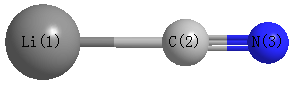 More geometry information
Calculated Bond Angles
| atom1 |
atom2 |
atom3 |
angle |
|
atom1 |
atom2 |
atom3 |
angle |
| Li1 |
C2 |
N3 |
180.000 |
|
Li1 |
N3 |
C2 |
0.000 |
| C2 |
Li1 |
N3 |
0.000 |
|
Electronic energy levels
Charges, Dipole, Quadrupole and Polarizability
Charges from optimized geometry at BLYP/cc-pCVTZ
Charges (e)
| Number |
Element |
Mulliken |
CHELPG |
AIM |
ESP |
| 1 |
Li |
0.408 |
|
|
|
| 2 |
C |
-0.204 |
|
|
|
| 3 |
N |
-0.204 |
|
|
|
Electric dipole moments
Electric dipole components in Debye
(What's a Debye? See section
VII.A.3)
| |
x |
y |
z |
Total |
| |
0.000 |
0.000 |
-8.810 |
8.810 |
| CHELPG |
|
|
|
|
| AIM |
|
|
|
|
| ESP |
|
|
|
|
Electric Quadrupole moment
Quadrupole components in D Å
| Primitive |
|---|
| | x | y | z |
|---|
| x |
-14.472 |
0.000 |
0.000 |
| y |
0.000 |
-14.472 |
0.000 |
| z |
0.000 |
0.000 |
0.693 |
|
| Traceless |
|---|
| | x | y | z |
|---|
| x |
-7.582 |
0.000 |
0.000 |
| y |
0.000 |
-7.582 |
0.000 |
| z |
0.000 |
0.000 |
15.165 |
|
| Polar |
|---|
| 3z2-r2 | 30.330 |
|---|
| x2-y2 | 0.000 |
|---|
| xy | 0.000 |
|---|
| xz | 0.000 |
|---|
| yz | 0.000 |
|---|
|
Polarizabilities
Components of the polarizability tensor.
Units are
Å
3 (Angstrom cubed)
Change units.
| |
x |
y |
z |
| x |
2.956 |
0.000 |
-0.000 |
| y |
0.000 |
2.956 |
0.000 |
| z |
-0.000 |
0.000 |
4.765 |
<r2> (average value of r
2) Å
2
| <r2> |
26.020 |
| (<r2>)1/2 |
5.101 |
Jump to
S1C1
S1C3
Energy calculated at BLYP/cc-pCVTZ
| | hartrees |
|---|
| Energy at 0K | -100.397098 |
| Energy at 298.15K | -100.396339 |
| HF Energy | -100.397098 |
| Nuclear repulsion energy | 29.262357 |
The energy at 298.15K was derived from the energy at 0K
and an integrated heat capacity that used the calculated vibrational frequencies.
Geometric Data calculated at BLYP/cc-pCVTZ
Point Group is Cs
Cartesians (Å)
| Atom |
x (Å) |
y (Å) |
z (Å) |
|---|
| Li1 |
1.419 |
-0.603 |
0.000 |
| C2 |
-0.710 |
-0.370 |
0.000 |
| N3 |
0.000 |
0.576 |
0.000 |
Atom - Atom Distances (Å)
| |
Li1 |
C2 |
N3 |
| Li1 | | 2.1412 | 1.8451 |
C2 | 2.1412 | | 1.1828 | N3 | 1.8451 | 1.1828 | |
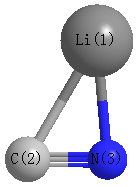 More geometry information
Calculated Bond Angles
| atom1 |
atom2 |
atom3 |
angle |
|
atom1 |
atom2 |
atom3 |
angle |
| Li1 |
C2 |
N3 |
59.386 |
|
Li1 |
N3 |
C2 |
87.132 |
| C2 |
Li1 |
N3 |
33.483 |
|
Electronic energy levels
Charges, Dipole, Quadrupole and Polarizability
Charges from optimized geometry at BLYP/cc-pCVTZ
Charges (e)
| Number |
Element |
Mulliken |
CHELPG |
AIM |
ESP |
| 1 |
Li |
0.251 |
|
|
|
| 2 |
C |
-0.070 |
|
|
|
| 3 |
N |
-0.181 |
|
|
|
Electric dipole moments
Electric dipole components in Debye
(What's a Debye? See section
VII.A.3)
| |
x |
y |
z |
Total |
| |
6.308 |
-2.352 |
0.000 |
6.732 |
| CHELPG |
|
|
|
|
| AIM |
|
|
|
|
| ESP |
|
|
|
|
Electric Quadrupole moment
Quadrupole components in D Å
| Primitive |
|---|
| | x | y | z |
|---|
| x |
-6.447 |
-5.913 |
0.000 |
| y |
-5.913 |
-15.335 |
0.000 |
| z |
0.000 |
0.000 |
-14.662 |
|
| Traceless |
|---|
| | x | y | z |
|---|
| x |
8.551 |
-5.913 |
0.000 |
| y |
-5.913 |
-4.780 |
0.000 |
| z |
0.000 |
0.000 |
-3.771 |
|
| Polar |
|---|
| 3z2-r2 | -7.542 |
|---|
| x2-y2 | 8.887 |
|---|
| xy | -5.913 |
|---|
| xz | 0.000 |
|---|
| yz | 0.000 |
|---|
|
Polarizabilities
Components of the polarizability tensor.
Units are
Å
3 (Angstrom cubed)
Change units.
| |
x |
y |
z |
| x |
4.031 |
0.325 |
0.000 |
| y |
0.325 |
3.824 |
-0.000 |
| z |
0.000 |
-0.000 |
3.194 |
<r2> (average value of r
2) Å
2
| <r2> |
20.886 |
| (<r2>)1/2 |
4.570 |
Jump to
S1C1
S1C2
Energy calculated at BLYP/cc-pCVTZ
| | hartrees |
|---|
| Energy at 0K | -100.398405 |
| Energy at 298.15K | -100.397323 |
| HF Energy | -100.398405 |
| Nuclear repulsion energy | 28.327472 |
The energy at 298.15K was derived from the energy at 0K
and an integrated heat capacity that used the calculated vibrational frequencies.
Geometric Data calculated at BLYP/cc-pCVTZ
Point Group is C∞v
Cartesians (Å)
| Atom |
x (Å) |
y (Å) |
z (Å) |
|---|
| Li1 |
0.000 |
0.000 |
1.877 |
| C2 |
0.000 |
0.000 |
-1.070 |
| N3 |
0.000 |
0.000 |
0.112 |
Atom - Atom Distances (Å)
| |
Li1 |
C2 |
N3 |
| Li1 | | 2.9470 | 1.7647 |
C2 | 2.9470 | | 1.1823 | N3 | 1.7647 | 1.1823 | |
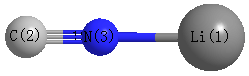 More geometry information
Calculated Bond Angles
| atom1 |
atom2 |
atom3 |
angle |
|
atom1 |
atom2 |
atom3 |
angle |
| Li1 |
C2 |
N3 |
0.000 |
|
Li1 |
N3 |
C2 |
180.000 |
| C2 |
Li1 |
N3 |
0.000 |
|
Electronic energy levels
Charges, Dipole, Quadrupole and Polarizability
Charges from optimized geometry at BLYP/cc-pCVTZ
Charges (e)
| Number |
Element |
Mulliken |
CHELPG |
AIM |
ESP |
| 1 |
Li |
0.331 |
|
|
|
| 2 |
C |
-0.202 |
|
|
|
| 3 |
N |
-0.129 |
|
|
|
Electric dipole moments
Electric dipole components in Debye
(What's a Debye? See section
VII.A.3)
| |
x |
y |
z |
Total |
| |
0.000 |
0.000 |
8.686 |
8.686 |
| CHELPG |
|
|
|
|
| AIM |
|
|
|
|
| ESP |
|
|
|
|
Electric Quadrupole moment
Quadrupole components in D Å
| Primitive |
|---|
| | x | y | z |
|---|
| x |
-14.550 |
0.000 |
0.000 |
| y |
0.000 |
-14.550 |
0.000 |
| z |
0.000 |
0.000 |
-2.832 |
|
| Traceless |
|---|
| | x | y | z |
|---|
| x |
-5.859 |
0.000 |
0.000 |
| y |
0.000 |
-5.859 |
0.000 |
| z |
0.000 |
0.000 |
11.718 |
|
| Polar |
|---|
| 3z2-r2 | 23.435 |
|---|
| x2-y2 | 0.000 |
|---|
| xy | 0.000 |
|---|
| xz | 0.000 |
|---|
| yz | 0.000 |
|---|
|
Polarizabilities
Components of the polarizability tensor.
Units are
Å
3 (Angstrom cubed)
Change units.
| |
x |
y |
z |
| x |
3.071 |
0.000 |
-0.000 |
| y |
0.000 |
3.071 |
0.000 |
| z |
-0.000 |
0.000 |
4.966 |
<r2> (average value of r
2) Å
2
| <r2> |
24.175 |
| (<r2>)1/2 |
4.917 |
