Jump to
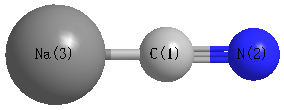
S1C2
Energy calculated at QCISD(T)=FULL/cc-pVQZ
| | hartrees |
|---|
| Energy at 0K | -254.685782 |
| Energy at 298.15K | -254.685519 |
| HF Energy | -254.218178 |
| Nuclear repulsion energy | 47.628522 |
The energy at 298.15K was derived from the energy at 0K
and an integrated heat capacity that used the calculated vibrational frequencies.
Geometric Data calculated at QCISD(T)=FULL/cc-pVQZ
Point Group is C∞v
Cartesians (Å)
| Atom |
x (Å) |
y (Å) |
z (Å) |
|---|
| C1 |
0.000 |
0.000 |
-0.642 |
| N2 |
0.000 |
0.000 |
-1.810 |
| Na3 |
0.000 |
0.000 |
1.502 |
Atom - Atom Distances (Å)
| |
C1 |
N2 |
Na3 |
| C1 | | 1.1674 | 2.1443 |
N2 | 1.1674 | | 3.3116 | Na3 | 2.1443 | 3.3116 | |
 More geometry information
Calculated Bond Angles
| atom1 |
atom2 |
atom3 |
angle |
|
atom1 |
atom2 |
atom3 |
angle |
| C1 |
N2 |
Na3 |
0.000 |
|
C1 |
Na3 |
N2 |
0.000 |
| N2 |
C1 |
Na3 |
180.000 |
|
Electronic energy levels
Charges, Dipole, Quadrupole and Polarizability
Jump to
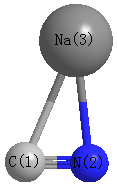
S1C1
Energy calculated at QCISD(T)=FULL/cc-pVQZ
| | hartrees |
|---|
| Energy at 0K | -254.686301 |
| Energy at 298.15K | -254.685953 |
| HF Energy | -254.226515 |
| Nuclear repulsion energy | 52.057794 |
The energy at 298.15K was derived from the energy at 0K
and an integrated heat capacity that used the calculated vibrational frequencies.
Geometric Data calculated at QCISD(T)=FULL/cc-pVQZ
Point Group is Cs
Cartesians (Å)
| Atom |
x (Å) |
y (Å) |
z (Å) |
|---|
| C1 |
1.073 |
0.619 |
0.000 |
| N2 |
0.000 |
1.105 |
0.000 |
| Na3 |
-0.585 |
-1.041 |
0.000 |
Atom - Atom Distances (Å)
| |
C1 |
N2 |
Na3 |
| C1 | | 1.1785 | 2.3465 |
N2 | 1.1785 | | 2.2245 | Na3 | 2.3465 | 2.2245 | |
 More geometry information
Calculated Bond Angles
| atom1 |
atom2 |
atom3 |
angle |
|
atom1 |
atom2 |
atom3 |
angle |
| C1 |
N2 |
Na3 |
80.881 |
|
C1 |
Na3 |
N2 |
29.728 |
| N2 |
C1 |
Na3 |
69.392 |
|
Electronic energy levels
Charges, Dipole, Quadrupole and Polarizability
