Jump to
S2C1
Energy calculated at CCD/cc-pVQZ
| | hartrees |
|---|
| Energy at 0K | -498.240571 |
| Energy at 298.15K | -498.240443 |
| HF Energy | -497.860567 |
| Nuclear repulsion energy | 38.864870 |
The energy at 298.15K was derived from the energy at 0K
and an integrated heat capacity that used the calculated vibrational frequencies.
Geometric Data calculated at CCD/cc-pVQZ
Point Group is Cs
Cartesians (Å)
| Atom |
x (Å) |
y (Å) |
z (Å) |
|---|
| C1 |
0.045 |
1.188 |
0.000 |
| Cl2 |
0.045 |
-0.503 |
0.000 |
| H3 |
-1.034 |
1.426 |
0.000 |
Atom - Atom Distances (Å)
| |
C1 |
Cl2 |
H3 |
| C1 | | 1.6909 | 1.1050 |
Cl2 | 1.6909 | | 2.2106 | H3 | 1.1050 | 2.2106 | |
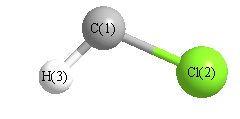 More geometry information
Calculated Bond Angles
| atom1 |
atom2 |
atom3 |
angle |
|
atom1 |
atom2 |
atom3 |
angle |
| Cl2 |
C1 |
H3 |
102.470 |
|
Electronic energy levels
Charges, Dipole, Quadrupole and Polarizability
Jump to
S1C1
Energy calculated at CCD/cc-pVQZ
| | hartrees |
|---|
| Energy at 0K | -498.233703 |
| Energy at 298.15K | -498.233561 |
| HF Energy | -497.885148 |
| Nuclear repulsion energy | 39.092682 |
The energy at 298.15K was derived from the energy at 0K
and an integrated heat capacity that used the calculated vibrational frequencies.
Geometric Data calculated at CCD/cc-pVQZ
Point Group is Cs
Cartesians (Å)
| Atom |
x (Å) |
y (Å) |
z (Å) |
|---|
| C1 |
0.036 |
1.150 |
0.000 |
| Cl2 |
0.036 |
-0.511 |
0.000 |
| H3 |
-0.829 |
1.794 |
0.000 |
Atom - Atom Distances (Å)
| |
C1 |
Cl2 |
H3 |
| C1 | | 1.6610 | 1.0787 |
Cl2 | 1.6610 | | 2.4625 | H3 | 1.0787 | 2.4625 | |
More geometry information
Calculated Bond Angles
| atom1 |
atom2 |
atom3 |
angle |
|
atom1 |
atom2 |
atom3 |
angle |
| Cl2 |
C1 |
H3 |
126.700 |
|
Electronic energy levels
Charges, Dipole, Quadrupole and Polarizability
