Jump to
S1C2
Energy calculated at QCISD/cc-pV(T+d)Z
| | hartrees |
|---|
| Energy at 0K | -1194.396126 |
| Energy at 298.15K | -1194.398531 |
| HF Energy | -1193.819018 |
| Nuclear repulsion energy | 196.094905 |
The energy at 298.15K was derived from the energy at 0K
and an integrated heat capacity that used the calculated vibrational frequencies.
Vibrational Frequencies calculated at QCISD/cc-pV(T+d)Z
| Mode Number |
Symmetry |
Frequency
(cm-1) |
Scaled Frequency
(cm-1) |
IR Intensities
(km mol-1) |
Raman Act
(Å4/u) |
Dep P |
Dep U |
|---|
| 1 |
A |
2699 |
2576 |
0.35 |
|
|
|
| 2 |
A |
901 |
860 |
0.09 |
|
|
|
| 3 |
A |
505 |
482 |
0.30 |
|
|
|
| 4 |
A |
313 |
298 |
19.17 |
|
|
|
| 5 |
A |
211 |
201 |
0.00 |
|
|
|
| 6 |
B |
2698 |
2576 |
1.62 |
|
|
|
| 7 |
B |
889 |
849 |
9.54 |
|
|
|
| 8 |
B |
510 |
487 |
17.20 |
|
|
|
| 9 |
B |
335 |
320 |
13.90 |
|
|
|
Unscaled Zero Point Vibrational Energy (zpe) 4529.2 cm
-1
Scaled (by 0.9547) Zero Point Vibrational Energy (zpe) 4324.1 cm
-1
See section
III.C.1 List or set vibrational scaling factors
to change the scale factors used here.
See section
III.C.2
Calculate a vibrational scaling factor for a given set of molecules
to determine the least squares best scaling factor.
Geometric Data calculated at QCISD/cc-pV(T+d)Z
Point Group is C2
Cartesians (Å)
| Atom |
x (Å) |
y (Å) |
z (Å) |
|---|
| S1 |
0.000 |
0.000 |
0.843 |
| S2 |
0.000 |
1.657 |
-0.386 |
| S3 |
0.000 |
-1.657 |
-0.386 |
| H4 |
-1.324 |
1.753 |
-0.568 |
| H5 |
1.324 |
-1.753 |
-0.568 |
Atom - Atom Distances (Å)
| |
S1 |
S2 |
S3 |
H4 |
H5 |
| S1 | | 2.0629 | 2.0629 | 2.6110 | 2.6110 |
S2 | 2.0629 | | 3.3131 | 1.3397 | 3.6619 | S3 | 2.0629 | 3.3131 | | 3.6619 | 1.3397 | H4 | 2.6110 | 1.3397 | 3.6619 | | 4.3931 | H5 | 2.6110 | 3.6619 | 1.3397 | 4.3931 | |
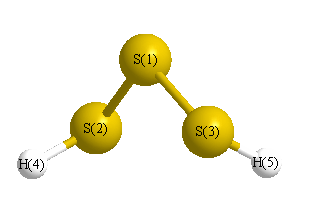 More geometry information
Calculated Bond Angles
| atom1 |
atom2 |
atom3 |
angle |
|
atom1 |
atom2 |
atom3 |
angle |
| S1 |
S2 |
H4 |
97.977 |
|
S1 |
S3 |
H5 |
97.977 |
| S2 |
S1 |
S3 |
106.838 |
|
Electronic energy levels
Charges, Dipole, Quadrupole and Polarizability
Jump to
S1C1
Energy calculated at QCISD/cc-pV(T+d)Z
| | hartrees |
|---|
| Energy at 0K | -1194.395970 |
| Energy at 298.15K | -1194.398386 |
| HF Energy | -1193.818774 |
| Nuclear repulsion energy | 196.132903 |
The energy at 298.15K was derived from the energy at 0K
and an integrated heat capacity that used the calculated vibrational frequencies.
Vibrational Frequencies calculated at QCISD/cc-pV(T+d)Z
| Mode Number |
Symmetry |
Frequency
(cm-1) |
Scaled Frequency
(cm-1) |
IR Intensities
(km mol-1) |
Raman Act
(Å4/u) |
Dep P |
Dep U |
|---|
| 1 |
A' |
2693 |
2571 |
3.57 |
|
|
|
| 2 |
A' |
903 |
862 |
3.82 |
|
|
|
| 3 |
A' |
505 |
482 |
0.33 |
|
|
|
| 4 |
A' |
335 |
320 |
14.76 |
|
|
|
| 5 |
A' |
211 |
202 |
0.05 |
|
|
|
| 6 |
A" |
2696 |
2574 |
0.36 |
|
|
|
| 7 |
A" |
891 |
851 |
6.65 |
|
|
|
| 8 |
A" |
511 |
488 |
18.56 |
|
|
|
| 9 |
A" |
320 |
305 |
8.59 |
|
|
|
Unscaled Zero Point Vibrational Energy (zpe) 4532.2 cm
-1
Scaled (by 0.9547) Zero Point Vibrational Energy (zpe) 4326.9 cm
-1
See section
III.C.1 List or set vibrational scaling factors
to change the scale factors used here.
See section
III.C.2
Calculate a vibrational scaling factor for a given set of molecules
to determine the least squares best scaling factor.
Geometric Data calculated at QCISD/cc-pV(T+d)Z
Point Group is Cs
Cartesians (Å)
| Atom |
x (Å) |
y (Å) |
z (Å) |
|---|
| S1 |
-0.053 |
0.842 |
0.000 |
| S2 |
-0.053 |
-0.389 |
1.655 |
| S3 |
-0.053 |
-0.389 |
-1.655 |
| H4 |
1.274 |
-0.513 |
1.792 |
| H5 |
1.274 |
-0.513 |
-1.792 |
Atom - Atom Distances (Å)
| |
S1 |
S2 |
S3 |
H4 |
H5 |
| S1 | | 2.0626 | 2.0626 | 2.6095 | 2.6095 |
S2 | 2.0626 | | 3.3107 | 1.3400 | 3.6964 | S3 | 2.0626 | 3.3107 | | 3.6964 | 1.3400 | H4 | 2.6095 | 1.3400 | 3.6964 | | 3.5847 | H5 | 2.6095 | 3.6964 | 1.3400 | 3.5847 | |
More geometry information
Calculated Bond Angles
| atom1 |
atom2 |
atom3 |
angle |
|
atom1 |
atom2 |
atom3 |
angle |
| S1 |
S2 |
H4 |
97.900 |
|
S1 |
S3 |
H5 |
97.900 |
| S2 |
S1 |
S3 |
106.753 |
|
Electronic energy levels
Charges, Dipole, Quadrupole and Polarizability
