All results from a given calculation for FSSF (Difluorodisulfane)
using model chemistry: CCSD(T)=FULL/aug-cc-pV(T+d)Z
19 10 17 12 22
States and conformations
| State |
Conformation |
minimum conformation |
conformer description |
state description |
| 1 |
1 |
yes |
C2 |
1A |
Energy calculated at CCSD(T)=FULL/aug-cc-pV(T+d)Z
| | hartrees |
|---|
| Energy at 0K | -995.181600 |
| Energy at 298.15K | |
| HF Energy | -994.009032 |
| Nuclear repulsion energy | 229.652023 |
The energy at 298.15K was derived from the energy at 0K
and an integrated heat capacity that used the calculated vibrational frequencies.
Vibrational Frequencies calculated at CCSD(T)=FULL/aug-cc-pV(T+d)Z
Geometric Data calculated at CCSD(T)=FULL/aug-cc-pV(T+d)Z
Point Group is C2
Cartesians (Å)
| Atom |
x (Å) |
y (Å) |
z (Å) |
|---|
| S1 |
-0.388 |
0.866 |
-0.405 |
| S2 |
0.388 |
-0.866 |
-0.405 |
| F3 |
0.388 |
1.764 |
0.720 |
| F4 |
-0.388 |
-1.764 |
0.720 |
Atom - Atom Distances (Å)
| |
S1 |
S2 |
F3 |
F4 |
| S1 | | 1.8990 | 1.6356 | 2.8609 |
S2 | 1.8990 | | 2.8609 | 1.6356 | F3 | 1.6356 | 2.8609 | | 3.6121 | F4 | 2.8609 | 1.6356 | 3.6121 | |
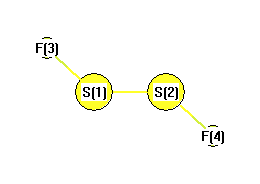 More geometry information
Calculated Bond Angles
| atom1 |
atom2 |
atom3 |
angle |
|
atom1 |
atom2 |
atom3 |
angle |
| S1 |
S2 |
F4 |
107.846 |
|
S2 |
S1 |
F3 |
107.846 |
Electronic energy levels
Charges, Dipole, Quadrupole and Polarizability
