All results from a given calculation for SF5Cl (sulfur chloropentafluoride)
using model chemistry: MP2=FULL/aug-cc-pV(T+d)Z
19 10 17 12 22
States and conformations
| State |
Conformation |
minimum conformation |
conformer description |
state description |
| 1 |
1 |
yes |
C4V |
1A1 |
Energy calculated at MP2=FULL/aug-cc-pV(T+d)Z
| | hartrees |
|---|
| Energy at 0K | -1356.308725 |
| Energy at 298.15K | |
| HF Energy | -1354.340635 |
| Nuclear repulsion energy | 642.950897 |
The energy at 298.15K was derived from the energy at 0K
and an integrated heat capacity that used the calculated vibrational frequencies.
Vibrational Frequencies calculated at MP2=FULL/aug-cc-pV(T+d)Z
Geometric Data calculated at MP2=FULL/aug-cc-pV(T+d)Z
Point Group is C4v
Cartesians (Å)
| Atom |
x (Å) |
y (Å) |
z (Å) |
|---|
| S1 |
0.000 |
0.000 |
-0.255 |
| Cl2 |
0.000 |
0.000 |
1.782 |
| F3 |
0.000 |
1.572 |
-0.272 |
| F4 |
1.572 |
0.000 |
-0.272 |
| F5 |
0.000 |
-1.572 |
-0.272 |
| F6 |
-1.572 |
0.000 |
-0.272 |
| F7 |
0.000 |
0.000 |
-1.822 |
Atom - Atom Distances (Å)
| |
S1 |
Cl2 |
F3 |
F4 |
F5 |
F6 |
F7 |
| S1 | | 2.0370 | 1.5720 | 1.5720 | 1.5720 | 1.5720 | 1.5666 |
Cl2 | 2.0370 | | 2.5864 | 2.5864 | 2.5864 | 2.5864 | 3.6037 | F3 | 1.5720 | 2.5864 | | 2.2230 | 3.1438 | 2.2230 | 2.2073 | F4 | 1.5720 | 2.5864 | 2.2230 | | 2.2230 | 3.1438 | 2.2073 | F5 | 1.5720 | 2.5864 | 3.1438 | 2.2230 | | 2.2230 | 2.2073 | F6 | 1.5720 | 2.5864 | 2.2230 | 3.1438 | 2.2230 | | 2.2073 | F7 | 1.5666 | 3.6037 | 2.2073 | 2.2073 | 2.2073 | 2.2073 | |
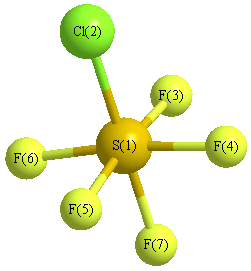 More geometry information
Calculated Bond Angles
| atom1 |
atom2 |
atom3 |
angle |
|
atom1 |
atom2 |
atom3 |
angle |
| Cl2 |
S1 |
F3 |
90.618 |
|
Cl2 |
S1 |
F4 |
90.618 |
| Cl2 |
S1 |
F5 |
90.618 |
|
Cl2 |
S1 |
F6 |
90.618 |
| Cl2 |
S1 |
F7 |
180.000 |
|
F3 |
S1 |
F4 |
89.993 |
| F3 |
S1 |
F5 |
178.764 |
|
F3 |
S1 |
F6 |
89.993 |
| F3 |
S1 |
F7 |
89.382 |
|
F4 |
S1 |
F5 |
89.993 |
| F4 |
S1 |
F6 |
178.764 |
|
F4 |
S1 |
F7 |
89.382 |
| F5 |
S1 |
F6 |
89.993 |
|
F5 |
S1 |
F7 |
89.382 |
| F6 |
S1 |
F7 |
89.382 |
|
Electronic energy levels
Charges, Dipole, Quadrupole and Polarizability
