return to home page Computational Chemistry Comparison and Benchmark DataBase Release 22 (May 2022) Standard Reference Database 101 National Institute of Standards and Technology
You are here: Calculated > Energy > Optimized > Energy

All results from a given calculation for C6H4Cl2 (1,4-dichlorobenzene)

using model chemistry: B2PLYP=FULLultrafine/6-31G**

19 10 17 12 22

States and conformations

State Conformation minimum conformation conformer description state description
1 1 yes D2H 1AG
Energy calculated at B2PLYP=FULLultrafine/6-31G**
 hartrees
Energy at 0K-1150.889669
Energy at 298.15K 
HF Energy-1150.527200
Nuclear repulsion energy448.265392
The energy at 298.15K was derived from the energy at 0K and an integrated heat capacity that used the calculated vibrational frequencies.
Vibrational Frequencies calculated at B2PLYP=FULLultrafine/6-31G**
Mode Number Symmetry Frequency
(cm-1)
Scaled Frequency
(cm-1)
IR Intensities
(km mol-1)
Raman Act
(Å4/u)
Dep P Dep U
1 Ag 3263 3263 0.00      
2 Ag 1647 1647 0.00      
3 Ag 1213 1213 0.00      
4 Ag 1125 1125 0.00      
5 Ag 764 764 0.00      
6 Ag 333 333 0.00      
7 Au 953 953 0.00      
8 Au 419 419 0.00      
9 B1g 830 830 0.00      
10 B1u 3248 3248 1.36      
11 B1u 1531 1531 100.59      
12 B1u 1124 1124 102.56      
13 B1u 1030 1030 56.79      
14 B1u 554 554 32.34      
15 B2g 929 929 0.00      
16 B2g 655 655 0.00      
17 B2g 298 298 0.00      
18 B2u 3261 3261 2.02      
19 B2u 1443 1443 5.62      
20 B2u 1355 1355 0.01      
21 B2u 1138 1138 4.31      
22 B2u 223 223 1.11      
23 B3g 3249 3249 0.00      
24 B3g 1637 1637 0.00      
25 B3g 1330 1330 0.00      
26 B3g 643 643 0.00      
27 B3g 359 359 0.00      
28 B3u 823 823 52.13      
29 B3u 491 491 12.12      
30 B3u 103 103 0.69      

Unscaled Zero Point Vibrational Energy (zpe) 17984.8 cm-1
Scaled (by 1) Zero Point Vibrational Energy (zpe) 17984.8 cm-1
See section III.C.1 List or set vibrational scaling factors to change the scale factors used here.
See section III.C.2 Calculate a vibrational scaling factor for a given set of molecules to determine the least squares best scaling factor.
Rotational Constants (cm-1) from geometry optimized at B2PLYP=FULLultrafine/6-31G**
ABC
0.18911 0.02214 0.01982

See section I.F.4 to change rotational constant units
Geometric Data calculated at B2PLYP=FULLultrafine/6-31G**

Point Group is D2h

Cartesians (Å)
Atom x (Å) y (Å) z (Å)
C1 0.000 0.000 1.384
C2 0.000 0.000 -1.384
C3 0.000 1.213 0.697
C4 0.000 -1.213 0.697
C5 0.000 -1.213 -0.697
C6 0.000 1.213 -0.697
Cl7 0.000 0.000 3.132
Cl8 0.000 0.000 -3.132
H9 0.000 2.146 1.243
H10 0.000 -2.146 1.243
H11 0.000 -2.146 -1.243
H12 0.000 2.146 -1.243

Atom - Atom Distances (Å)
  C1 C2 C3 C4 C5 C6 Cl7 Cl8 H9 H10 H11 H12
C12.76701.39351.39352.40792.40791.74814.51512.15062.15063.39193.3919
C22.76702.40792.40791.39351.39354.51511.74813.39193.39192.15062.1506
C31.39352.40792.42512.79701.39352.72004.01581.08163.40273.87862.1529
C41.39352.40792.42511.39352.79702.72004.01583.40271.08162.15293.8786
C52.40791.39352.79701.39352.42514.01582.72003.87862.15291.08163.4027
C62.40791.39351.39352.79702.42514.01582.72002.15293.87863.40271.0816
Cl71.74814.51512.72002.72004.01584.01586.26322.85852.85854.87284.8728
Cl84.51511.74814.01584.01582.72002.72006.26324.87284.87282.85852.8585
H92.15063.39191.08163.40273.87862.15292.85854.87284.29204.96022.4865
H102.15063.39193.40271.08162.15293.87862.85854.87284.29202.48654.9602
H113.39192.15063.87862.15291.08163.40274.87282.85854.96022.48654.2920
H123.39192.15062.15293.87863.40271.08164.87282.85852.48654.96024.2920

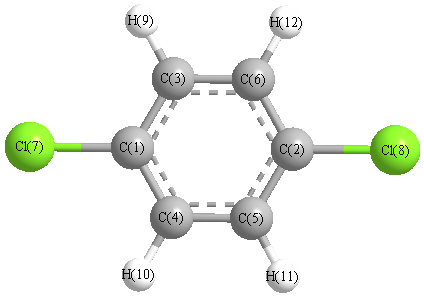
picture of 1,4-dichlorobenzene state 1 conformation 1
More geometry information
Calculated Bond Angles
atom1 atom2 atom3 angle atom1 atom2 atom3 angle
C1 C3 C6 119.526 C1 C3 H9 120.126
C1 C4 C5 119.526 C1 C4 H10 120.126
C2 C5 C4 119.526 C2 C5 H11 120.126
C2 C6 C3 119.526 C2 C6 H12 120.126
C3 C1 C4 120.948 C3 C1 Cl7 119.526
C3 C6 H12 120.348 C4 C1 Cl7 119.526
C4 C5 H11 120.348 C5 C2 C6 120.948
C5 C2 Cl8 119.526 C5 C4 H10 120.348
C6 C2 Cl8 119.526 C6 C3 H9 120.348
Electronic energy levels
Charges, Dipole, Quadrupole and Polarizability