Jump to
S1C2
Energy calculated at LSDA/6-31G**
| | hartrees |
|---|
| Energy at 0K | -1192.623501 |
| Energy at 298.15K | -1192.625834 |
| HF Energy | -1192.623501 |
| Nuclear repulsion energy | 194.301195 |
The energy at 298.15K was derived from the energy at 0K
and an integrated heat capacity that used the calculated vibrational frequencies.
Vibrational Frequencies calculated at LSDA/6-31G**
| Mode Number |
Symmetry |
Frequency
(cm-1) |
Scaled Frequency
(cm-1) |
IR Intensities
(km mol-1) |
Raman Act
(Å4/u) |
Dep P |
Dep U |
|---|
| 1 |
A |
2571 |
2523 |
0.73 |
|
|
|
| 2 |
A |
837 |
822 |
1.22 |
|
|
|
| 3 |
A |
486 |
477 |
0.50 |
|
|
|
| 4 |
A |
336 |
330 |
33.38 |
|
|
|
| 5 |
A |
198 |
194 |
0.11 |
|
|
|
| 6 |
B |
2569 |
2521 |
10.80 |
|
|
|
| 7 |
B |
819 |
804 |
16.76 |
|
|
|
| 8 |
B |
461 |
452 |
44.07 |
|
|
|
| 9 |
B |
361 |
354 |
23.93 |
|
|
|
Unscaled Zero Point Vibrational Energy (zpe) 4319.7 cm
-1
Scaled (by 0.9813) Zero Point Vibrational Energy (zpe) 4239.0 cm
-1
See section
III.C.1 List or set vibrational scaling factors
to change the scale factors used here.
See section
III.C.2
Calculate a vibrational scaling factor for a given set of molecules
to determine the least squares best scaling factor.
Geometric Data calculated at LSDA/6-31G**
Point Group is C2
Cartesians (Å)
| Atom |
x (Å) |
y (Å) |
z (Å) |
|---|
| S1 |
0.000 |
0.000 |
0.822 |
| S2 |
0.000 |
1.690 |
-0.375 |
| S3 |
0.000 |
-1.690 |
-0.375 |
| H4 |
-1.346 |
1.815 |
-0.568 |
| H5 |
1.346 |
-1.815 |
-0.568 |
Atom - Atom Distances (Å)
| |
S1 |
S2 |
S3 |
H4 |
H5 |
| S1 | | 2.0710 | 2.0710 | 2.6529 | 2.6529 |
S2 | 2.0710 | | 3.3805 | 1.3656 | 3.7601 | S3 | 2.0710 | 3.3805 | | 3.7601 | 1.3656 | H4 | 2.6529 | 1.3656 | 3.7601 | | 4.5200 | H5 | 2.6529 | 3.7601 | 1.3656 | 4.5200 | |
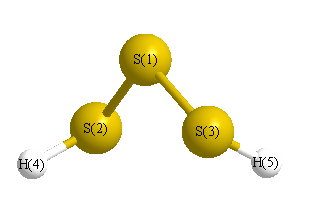 More geometry information
Calculated Bond Angles
| atom1 |
atom2 |
atom3 |
angle |
|
atom1 |
atom2 |
atom3 |
angle |
| S1 |
S2 |
H4 |
98.988 |
|
S1 |
S3 |
H5 |
98.988 |
| S2 |
S1 |
S3 |
109.398 |
|
Electronic energy levels
Charges, Dipole, Quadrupole and Polarizability
Charges from optimized geometry at LSDA/6-31G**
Charges (e)
| Number |
Element |
Mulliken |
CHELPG |
AIM |
ESP |
| 1 |
S |
-0.067 |
|
|
|
| 2 |
S |
-0.089 |
|
|
|
| 3 |
S |
-0.089 |
|
|
|
| 4 |
H |
0.123 |
|
|
|
| 5 |
H |
0.123 |
|
|
|
Electric dipole moments
Electric dipole components in Debye
(What's a Debye? See section
VII.A.3)
| |
x |
y |
z |
Total |
| |
0.000 |
0.000 |
-0.737 |
0.737 |
| CHELPG |
|
|
|
|
| AIM |
|
|
|
|
| ESP |
|
|
|
|
Electric Quadrupole moment
Quadrupole components in D Å
| Primitive |
|---|
| | x | y | z |
|---|
| x |
-37.170 |
-4.753 |
0.000 |
| y |
-4.753 |
-39.463 |
0.000 |
| z |
0.000 |
0.000 |
-41.877 |
|
| Traceless |
|---|
| | x | y | z |
|---|
| x |
3.500 |
-4.753 |
0.000 |
| y |
-4.753 |
0.060 |
0.000 |
| z |
0.000 |
0.000 |
-3.560 |
|
| Polar |
|---|
| 3z2-r2 | -7.120 |
|---|
| x2-y2 | 2.293 |
|---|
| xy | -4.753 |
|---|
| xz | 0.000 |
|---|
| yz | 0.000 |
|---|
|
Polarizabilities
Components of the polarizability tensor.
Units are
Å
3 (Angstrom cubed)
Change units.
| |
x |
y |
z |
| x |
5.596 |
-0.771 |
0.000 |
| y |
-0.771 |
11.775 |
0.000 |
| z |
0.000 |
0.000 |
5.898 |
<r2> (average value of r
2) Å
2
| <r2> |
142.258 |
| (<r2>)1/2 |
11.927 |
Jump to
S1C1
Energy calculated at LSDA/6-31G**
| | hartrees |
|---|
| Energy at 0K | -1192.623058 |
| Energy at 298.15K | -1192.625404 |
| HF Energy | -1192.623058 |
| Nuclear repulsion energy | 194.357887 |
The energy at 298.15K was derived from the energy at 0K
and an integrated heat capacity that used the calculated vibrational frequencies.
Vibrational Frequencies calculated at LSDA/6-31G**
| Mode Number |
Symmetry |
Frequency
(cm-1) |
Scaled Frequency
(cm-1) |
IR Intensities
(km mol-1) |
Raman Act
(Å4/u) |
Dep P |
Dep U |
|---|
| 1 |
A' |
2561 |
2513 |
16.82 |
|
|
|
| 2 |
A' |
838 |
822 |
5.42 |
|
|
|
| 3 |
A' |
487 |
478 |
0.71 |
|
|
|
| 4 |
A' |
359 |
353 |
24.57 |
|
|
|
| 5 |
A' |
198 |
195 |
0.24 |
|
|
|
| 6 |
A" |
2562 |
2514 |
0.63 |
|
|
|
| 7 |
A" |
825 |
810 |
12.73 |
|
|
|
| 8 |
A" |
463 |
455 |
52.05 |
|
|
|
| 9 |
A" |
346 |
339 |
9.82 |
|
|
|
Unscaled Zero Point Vibrational Energy (zpe) 4319.7 cm
-1
Scaled (by 0.9813) Zero Point Vibrational Energy (zpe) 4238.9 cm
-1
See section
III.C.1 List or set vibrational scaling factors
to change the scale factors used here.
See section
III.C.2
Calculate a vibrational scaling factor for a given set of molecules
to determine the least squares best scaling factor.
Geometric Data calculated at LSDA/6-31G**
Point Group is Cs
Cartesians (Å)
| Atom |
x (Å) |
y (Å) |
z (Å) |
|---|
| S1 |
-0.054 |
0.819 |
0.000 |
| S2 |
-0.054 |
-0.378 |
1.689 |
| S3 |
-0.054 |
-0.378 |
-1.689 |
| H4 |
1.295 |
-0.507 |
1.860 |
| H5 |
1.295 |
-0.507 |
-1.860 |
Atom - Atom Distances (Å)
| |
S1 |
S2 |
S3 |
H4 |
H5 |
| S1 | | 2.0700 | 2.0700 | 2.6530 | 2.6530 |
S2 | 2.0700 | | 3.3788 | 1.3664 | 3.7994 | S3 | 2.0700 | 3.3788 | | 3.7994 | 1.3664 | H4 | 2.6530 | 1.3664 | 3.7994 | | 3.7197 | H5 | 2.6530 | 3.7994 | 1.3664 | 3.7197 | |
More geometry information
Calculated Bond Angles
| atom1 |
atom2 |
atom3 |
angle |
|
atom1 |
atom2 |
atom3 |
angle |
| S1 |
S2 |
H4 |
99.017 |
|
S1 |
S3 |
H5 |
99.017 |
| S2 |
S1 |
S3 |
109.401 |
|
Electronic energy levels
Charges, Dipole, Quadrupole and Polarizability
Charges from optimized geometry at LSDA/6-31G**
Charges (e)
| Number |
Element |
Mulliken |
CHELPG |
AIM |
ESP |
| 1 |
S |
-0.067 |
|
|
|
| 2 |
S |
-0.081 |
|
|
|
| 3 |
S |
-0.081 |
|
|
|
| 4 |
H |
0.115 |
|
|
|
| 5 |
H |
0.115 |
|
|
|
Electric dipole moments
Electric dipole components in Debye
(What's a Debye? See section
VII.A.3)
| |
x |
y |
z |
Total |
| |
2.243 |
-0.620 |
0.000 |
2.327 |
| CHELPG |
|
|
|
|
| AIM |
|
|
|
|
| ESP |
|
|
|
|
Electric Quadrupole moment
Quadrupole components in D Å
| Primitive |
|---|
| | x | y | z |
|---|
| x |
-37.463 |
-1.537 |
0.000 |
| y |
-1.537 |
-42.023 |
0.000 |
| z |
0.000 |
0.000 |
-39.177 |
|
| Traceless |
|---|
| | x | y | z |
|---|
| x |
3.137 |
-1.537 |
0.000 |
| y |
-1.537 |
-3.703 |
0.000 |
| z |
0.000 |
0.000 |
0.566 |
|
| Polar |
|---|
| 3z2-r2 | 1.132 |
|---|
| x2-y2 | 4.560 |
|---|
| xy | -1.537 |
|---|
| xz | 0.000 |
|---|
| yz | 0.000 |
|---|
|
Polarizabilities
Components of the polarizability tensor.
Units are
Å
3 (Angstrom cubed)
Change units.
| |
x |
y |
z |
| x |
5.564 |
-0.337 |
0.000 |
| y |
-0.337 |
5.859 |
0.000 |
| z |
0.000 |
0.000 |
11.813 |
<r2> (average value of r
2) Å
2
| <r2> |
142.248 |
| (<r2>)1/2 |
11.927 |
