Jump to
S1C2
S1C3
Energy calculated at TPSSh/6-31G**
| | hartrees |
|---|
| Energy at 0K | -255.135671 |
| Energy at 298.15K | -255.135062 |
| HF Energy | -255.135671 |
| Nuclear repulsion energy | 46.472583 |
The energy at 298.15K was derived from the energy at 0K
and an integrated heat capacity that used the calculated vibrational frequencies.
Geometric Data calculated at TPSSh/6-31G**
Point Group is C∞v
Cartesians (Å)
| Atom |
x (Å) |
y (Å) |
z (Å) |
|---|
| C1 |
0.000 |
0.000 |
-0.682 |
| N2 |
0.000 |
0.000 |
-1.857 |
| Na3 |
0.000 |
0.000 |
1.554 |
Atom - Atom Distances (Å)
| |
C1 |
N2 |
Na3 |
| C1 | | 1.1757 | 2.2354 |
N2 | 1.1757 | | 3.4111 | Na3 | 2.2354 | 3.4111 | |
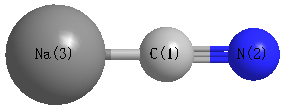 More geometry information
Calculated Bond Angles
| atom1 |
atom2 |
atom3 |
angle |
|
atom1 |
atom2 |
atom3 |
angle |
| C1 |
N2 |
Na3 |
0.000 |
|
C1 |
Na3 |
N2 |
0.000 |
| N2 |
C1 |
Na3 |
180.000 |
|
Electronic energy levels
Charges, Dipole, Quadrupole and Polarizability
Charges from optimized geometry at TPSSh/6-31G**
Charges (e)
| Number |
Element |
Mulliken |
CHELPG |
AIM |
ESP |
| 1 |
C |
-0.108 |
|
|
|
| 2 |
N |
-0.467 |
|
|
|
| 3 |
Na |
0.575 |
|
|
|
Electric dipole moments
Electric dipole components in Debye
(What's a Debye? See section
VII.A.3)
| |
x |
y |
z |
Total |
| |
0.000 |
0.000 |
10.262 |
10.262 |
| CHELPG |
|
|
|
|
| AIM |
|
|
|
|
| ESP |
|
|
|
|
Electric Quadrupole moment
Quadrupole components in D Å
Polarizabilities
Components of the polarizability tensor.
Units are
Å
3 (Angstrom cubed)
Change units.
| |
x |
y |
z |
| x |
2.824 |
0.000 |
0.000 |
| y |
0.000 |
2.824 |
0.000 |
| z |
0.000 |
0.000 |
6.009 |
<r2> (average value of r
2) Å
2
| <r2> |
63.284 |
| (<r2>)1/2 |
7.955 |
Jump to
S1C1
S1C3
Energy calculated at TPSSh/6-31G**
| | hartrees |
|---|
| Energy at 0K | -255.140653 |
| Energy at 298.15K | -255.140413 |
| HF Energy | -255.140653 |
| Nuclear repulsion energy | 51.686099 |
The energy at 298.15K was derived from the energy at 0K
and an integrated heat capacity that used the calculated vibrational frequencies.
Geometric Data calculated at TPSSh/6-31G**
Point Group is Cs
Cartesians (Å)
| Atom |
x (Å) |
y (Å) |
z (Å) |
|---|
| C1 |
1.116 |
0.667 |
0.000 |
| N2 |
0.000 |
1.076 |
0.000 |
| Na3 |
-0.609 |
-1.048 |
0.000 |
Atom - Atom Distances (Å)
| |
C1 |
N2 |
Na3 |
| C1 | | 1.1882 | 2.4322 |
N2 | 1.1882 | | 2.2095 | Na3 | 2.4322 | 2.2095 | |
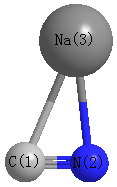 More geometry information
Calculated Bond Angles
| atom1 |
atom2 |
atom3 |
angle |
|
atom1 |
atom2 |
atom3 |
angle |
| C1 |
N2 |
Na3 |
85.868 |
|
C1 |
Na3 |
N2 |
29.162 |
| N2 |
C1 |
Na3 |
64.970 |
|
Electronic energy levels
Charges, Dipole, Quadrupole and Polarizability
Charges from optimized geometry at TPSSh/6-31G**
Charges (e)
| Number |
Element |
Mulliken |
CHELPG |
AIM |
ESP |
| 1 |
C |
-0.058 |
|
|
|
| 2 |
N |
-0.444 |
|
|
|
| 3 |
Na |
0.502 |
|
|
|
Electric dipole moments
Electric dipole components in Debye
(What's a Debye? See section
VII.A.3)
| |
x |
y |
z |
Total |
| |
-4.452 |
-7.130 |
0.000 |
8.406 |
| CHELPG |
|
|
|
|
| AIM |
|
|
|
|
| ESP |
|
|
|
|
Electric Quadrupole moment
Quadrupole components in D Å
Polarizabilities
Components of the polarizability tensor.
Units are
Å
3 (Angstrom cubed)
Change units.
| |
x |
y |
z |
| x |
4.050 |
-0.063 |
0.000 |
| y |
-0.063 |
3.721 |
0.000 |
| z |
0.000 |
0.000 |
2.943 |
<r2> (average value of r
2) Å
2
| <r2> |
44.529 |
| (<r2>)1/2 |
6.673 |
Jump to
S1C1
S1C2
Energy calculated at TPSSh/6-31G**
| | hartrees |
|---|
| Energy at 0K | -255.134164 |
| Energy at 298.15K | |
| HF Energy | -255.134164 |
| Nuclear repulsion energy | 48.683761 |
The energy at 298.15K was derived from the energy at 0K
and an integrated heat capacity that used the calculated vibrational frequencies.
Geometric Data calculated at TPSSh/6-31G**
Point Group is C∞v
Cartesians (Å)
| Atom |
x (Å) |
y (Å) |
z (Å) |
|---|
| C1 |
0.000 |
0.000 |
-1.855 |
| N2 |
0.000 |
0.000 |
-0.669 |
| Na3 |
0.000 |
0.000 |
1.438 |
Atom - Atom Distances (Å)
| |
C1 |
N2 |
Na3 |
| C1 | | 1.1864 | 3.2929 |
N2 | 1.1864 | | 2.1065 | Na3 | 3.2929 | 2.1065 | |
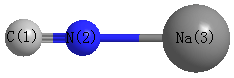 More geometry information
Calculated Bond Angles
| atom1 |
atom2 |
atom3 |
angle |
|
atom1 |
atom2 |
atom3 |
angle |
| C1 |
N2 |
Na3 |
180.000 |
|
C1 |
Na3 |
N2 |
0.000 |
| N2 |
C1 |
Na3 |
0.000 |
|
Electronic energy levels
Charges, Dipole, Quadrupole and Polarizability
Charges from optimized geometry at TPSSh/6-31G**
Charges (e)
| Number |
Element |
Mulliken |
CHELPG |
AIM |
ESP |
| 1 |
C |
-0.122 |
|
|
|
| 2 |
N |
-0.526 |
|
|
|
| 3 |
Na |
0.648 |
|
|
|
Electric dipole moments
Electric dipole components in Debye
(What's a Debye? See section
VII.A.3)
| |
x |
y |
z |
Total |
| |
0.000 |
0.000 |
10.287 |
10.287 |
| CHELPG |
|
|
|
|
| AIM |
|
|
|
|
| ESP |
|
|
|
|
Electric Quadrupole moment
Quadrupole components in D Å
Polarizabilities
Components of the polarizability tensor.
Units are
Å
3 (Angstrom cubed)
Change units.
| |
x |
y |
z |
| x |
2.737 |
0.000 |
0.000 |
| y |
0.000 |
2.737 |
0.000 |
| z |
0.000 |
0.000 |
6.160 |
<r2> (average value of r
2) Å
2
| <r2> |
56.740 |
| (<r2>)1/2 |
7.533 |
