Jump to
S1C2
Energy calculated at MP2/6-31G**
| | hartrees |
|---|
| Energy at 0K | -417.625740 |
| Energy at 298.15K | -417.629889 |
| HF Energy | -417.324056 |
| Nuclear repulsion energy | 61.376115 |
The energy at 298.15K was derived from the energy at 0K
and an integrated heat capacity that used the calculated vibrational frequencies.
Vibrational Frequencies calculated at MP2/6-31G**
| Mode Number |
Symmetry |
Frequency
(cm-1) |
Scaled Frequency
(cm-1) |
IR Intensities
(km mol-1) |
Raman Act
(Å4/u) |
Dep P |
Dep U |
|---|
| 1 |
A' |
3893 |
3646 |
49.16 |
|
|
|
| 2 |
A' |
2465 |
2309 |
135.08 |
|
|
|
| 3 |
A' |
1199 |
1122 |
29.00 |
|
|
|
| 4 |
A' |
1158 |
1085 |
64.54 |
|
|
|
| 5 |
A' |
940 |
880 |
69.53 |
|
|
|
| 6 |
A' |
820 |
768 |
140.97 |
|
|
|
| 7 |
A" |
2470 |
2313 |
191.85 |
|
|
|
| 8 |
A" |
921 |
862 |
26.29 |
|
|
|
| 9 |
A" |
436 |
408 |
122.39 |
|
|
|
Unscaled Zero Point Vibrational Energy (zpe) 7151.1 cm
-1
Scaled (by 0.9365) Zero Point Vibrational Energy (zpe) 6697.0 cm
-1
See section
III.C.1 List or set vibrational scaling factors
to change the scale factors used here.
See section
III.C.2
Calculate a vibrational scaling factor for a given set of molecules
to determine the least squares best scaling factor.
Geometric Data calculated at MP2/6-31G**
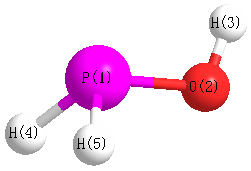
Point Group is Cs
Cartesians (Å)
| Atom |
x (Å) |
y (Å) |
z (Å) |
|---|
| P1 |
-0.106 |
-0.571 |
0.000 |
| O2 |
-0.106 |
1.100 |
0.000 |
| H3 |
0.780 |
1.481 |
0.000 |
| H4 |
0.829 |
-0.857 |
1.022 |
| H5 |
0.829 |
-0.857 |
-1.022 |
Atom - Atom Distances (Å)
| |
P1 |
O2 |
H3 |
H4 |
H5 |
| P1 | | 1.6706 | 2.2353 | 1.4149 | 1.4149 |
O2 | 1.6706 | | 0.9647 | 2.3977 | 2.3977 | H3 | 2.2353 | 0.9647 | | 2.5527 | 2.5527 | H4 | 1.4149 | 2.3977 | 2.5527 | | 2.0448 | H5 | 1.4149 | 2.3977 | 2.5527 | 2.0448 | |
 More geometry information
Calculated Bond Angles
| atom1 |
atom2 |
atom3 |
angle |
|
atom1 |
atom2 |
atom3 |
angle |
| P1 |
O2 |
H3 |
113.307 |
|
O2 |
P1 |
H4 |
101.671 |
| O2 |
P1 |
H5 |
101.671 |
|
H4 |
P1 |
H5 |
92.538 |
Electronic energy levels
Charges, Dipole, Quadrupole and Polarizability
Jump to
S1C1
Energy calculated at MP2/6-31G**
| | hartrees |
|---|
| Energy at 0K | -417.626702 |
| Energy at 298.15K | -417.630681 |
| HF Energy | -417.324118 |
| Nuclear repulsion energy | 61.290500 |
The energy at 298.15K was derived from the energy at 0K
and an integrated heat capacity that used the calculated vibrational frequencies.
Vibrational Frequencies calculated at MP2/6-31G**
| Mode Number |
Symmetry |
Frequency
(cm-1) |
Scaled Frequency
(cm-1) |
IR Intensities
(km mol-1) |
Raman Act
(Å4/u) |
Dep P |
Dep U |
|---|
| 1 |
A' |
3922 |
3673 |
94.62 |
|
|
|
| 2 |
A' |
2515 |
2355 |
108.30 |
|
|
|
| 3 |
A' |
1203 |
1126 |
43.17 |
|
|
|
| 4 |
A' |
1185 |
1110 |
140.89 |
|
|
|
| 5 |
A' |
944 |
884 |
20.12 |
|
|
|
| 6 |
A' |
812 |
760 |
111.04 |
|
|
|
| 7 |
A" |
2517 |
2357 |
145.09 |
|
|
|
| 8 |
A" |
950 |
889 |
2.94 |
|
|
|
| 9 |
A" |
272 |
255 |
103.79 |
|
|
|
Unscaled Zero Point Vibrational Energy (zpe) 7159.2 cm
-1
Scaled (by 0.9365) Zero Point Vibrational Energy (zpe) 6704.6 cm
-1
See section
III.C.1 List or set vibrational scaling factors
to change the scale factors used here.
See section
III.C.2
Calculate a vibrational scaling factor for a given set of molecules
to determine the least squares best scaling factor.
Geometric Data calculated at MP2/6-31G**
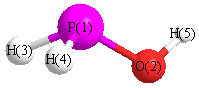
Point Group is Cs
Cartesians (Å)
| Atom |
x (Å) |
y (Å) |
z (Å) |
|---|
| P1 |
0.037 |
-0.576 |
0.000 |
| O2 |
0.037 |
1.105 |
0.000 |
| H3 |
0.954 |
1.400 |
0.000 |
| H4 |
-0.904 |
-0.798 |
1.023 |
| H5 |
-0.904 |
-0.798 |
-1.023 |
Atom - Atom Distances (Å)
| |
P1 |
O2 |
H3 |
H4 |
H5 |
| P1 | | 1.6810 | 2.1782 | 1.4076 | 1.4076 |
O2 | 1.6810 | | 0.9634 | 2.3562 | 2.3562 | H3 | 2.1782 | 0.9634 | | 3.0541 | 3.0541 | H4 | 1.4076 | 2.3562 | 3.0541 | | 2.0459 | H5 | 1.4076 | 2.3562 | 3.0541 | 2.0459 | |
 More geometry information
Calculated Bond Angles
| atom1 |
atom2 |
atom3 |
angle |
|
atom1 |
atom2 |
atom3 |
angle |
| P1 |
O2 |
H3 |
107.811 |
|
O2 |
P1 |
H4 |
99.048 |
| O2 |
P1 |
H5 |
99.048 |
|
H4 |
P1 |
H5 |
93.223 |
Electronic energy levels
Charges, Dipole, Quadrupole and Polarizability
