Jump to
S1C2
S2C1
S2C2
Energy calculated at B2PLYP/6-31G**
| | hartrees |
|---|
| Energy at 0K | -131.289116 |
| Energy at 298.15K | -131.288542 |
| HF Energy | -131.170187 |
| Nuclear repulsion energy | 47.205175 |
The energy at 298.15K was derived from the energy at 0K
and an integrated heat capacity that used the calculated vibrational frequencies.
Vibrational Frequencies calculated at B2PLYP/6-31G**
| Mode Number |
Symmetry |
Frequency
(cm-1) |
Scaled Frequency
(cm-1) |
IR Intensities
(km mol-1) |
Raman Act
(Å4/u) |
Dep P |
Dep U |
|---|
| 1 |
A' |
3399 |
3399 |
26.40 |
|
|
|
| 2 |
A' |
1903 |
1903 |
19.13 |
|
|
|
| 3 |
A' |
1188 |
1188 |
13.38 |
|
|
|
| 4 |
A' |
604 |
604 |
35.03 |
|
|
|
| 5 |
A' |
408 |
408 |
6.78 |
|
|
|
| 6 |
A" |
457 |
457 |
3.26 |
|
|
|
Unscaled Zero Point Vibrational Energy (zpe) 3979.7 cm
-1
Scaled (by 1) Zero Point Vibrational Energy (zpe) 3979.7 cm
-1
See section
III.C.1 List or set vibrational scaling factors
to change the scale factors used here.
See section
III.C.2
Calculate a vibrational scaling factor for a given set of molecules
to determine the least squares best scaling factor.
Geometric Data calculated at B2PLYP/6-31G**
Point Group is Cs
Cartesians (Å)
| Atom |
x (Å) |
y (Å) |
z (Å) |
|---|
| C1 |
0.009 |
-1.236 |
0.000 |
| C2 |
0.000 |
0.092 |
0.000 |
| N3 |
-0.097 |
1.282 |
0.000 |
| H4 |
0.628 |
-2.110 |
0.000 |
Atom - Atom Distances (Å)
| |
C1 |
C2 |
N3 |
H4 |
| C1 | | 1.3283 | 2.5198 | 1.0712 |
C2 | 1.3283 | | 1.1934 | 2.2903 | N3 | 2.5198 | 1.1934 | | 3.4686 | H4 | 1.0712 | 2.2903 | 3.4686 | |
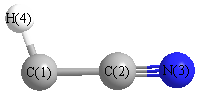 More geometry information
Calculated Bond Angles
| atom1 |
atom2 |
atom3 |
angle |
|
atom1 |
atom2 |
atom3 |
angle |
| C1 |
C2 |
N3 |
175.707 |
|
C2 |
C1 |
H4 |
145.085 |
Electronic energy levels
Charges, Dipole, Quadrupole and Polarizability
Jump to
S1C1
S2C1
S2C2
Energy calculated at B2PLYP/6-31G**
| | hartrees |
|---|
| Energy at 0K | -131.287402 |
| Energy at 298.15K | |
| HF Energy | -131.169296 |
| Nuclear repulsion energy | 47.332220 |
The energy at 298.15K was derived from the energy at 0K
and an integrated heat capacity that used the calculated vibrational frequencies.
Vibrational Frequencies calculated at B2PLYP/6-31G**
| Mode Number |
Symmetry |
Frequency
(cm-1) |
Scaled Frequency
(cm-1) |
IR Intensities
(km mol-1) |
Raman Act
(Å4/u) |
Dep P |
Dep U |
|---|
| 1 |
Σ |
3488 |
3488 |
73.76 |
|
|
|
| 2 |
Σ |
1725 |
1725 |
30.09 |
|
|
|
| 3 |
Σ |
1276 |
1276 |
9.99 |
|
|
|
| 4 |
Π |
458 |
458 |
0.88 |
|
|
|
| 4 |
Π |
458 |
458 |
0.88 |
|
|
|
| 5 |
Π |
396i |
396i |
52.71 |
|
|
|
| 5 |
Π |
396i |
396i |
52.71 |
|
|
|
Unscaled Zero Point Vibrational Energy (zpe) 3306.5 cm
-1
Scaled (by 1) Zero Point Vibrational Energy (zpe) 3306.5 cm
-1
See section
III.C.1 List or set vibrational scaling factors
to change the scale factors used here.
See section
III.C.2
Calculate a vibrational scaling factor for a given set of molecules
to determine the least squares best scaling factor.
Geometric Data calculated at B2PLYP/6-31G**
Point Group is C∞v
Cartesians (Å)
| Atom |
x (Å) |
y (Å) |
z (Å) |
|---|
| C1 |
0.000 |
0.000 |
-1.212 |
| C2 |
0.000 |
0.000 |
0.084 |
| N3 |
0.000 |
0.000 |
1.292 |
| H4 |
0.000 |
0.000 |
-2.276 |
Atom - Atom Distances (Å)
| |
C1 |
C2 |
N3 |
H4 |
| C1 | | 1.2965 | 2.5046 | 1.0640 |
C2 | 1.2965 | | 1.2081 | 2.3605 | N3 | 2.5046 | 1.2081 | | 3.5686 | H4 | 1.0640 | 2.3605 | 3.5686 | |
More geometry information
Calculated Bond Angles
| atom1 |
atom2 |
atom3 |
angle |
|
atom1 |
atom2 |
atom3 |
angle |
| C1 |
C2 |
N3 |
180.000 |
|
C2 |
C1 |
H4 |
180.000 |
Electronic energy levels
Charges, Dipole, Quadrupole and Polarizability
Charges from optimized geometry at B2PLYP/6-31G**
Charges (e)
| Number |
Element |
Mulliken |
CHELPG |
AIM |
ESP |
| 1 |
C |
-0.055 |
|
|
|
| 2 |
C |
0.269 |
|
|
|
| 3 |
N |
-0.436 |
|
|
|
| 4 |
H |
0.222 |
|
|
|
Electric dipole moments
Electric dipole components in Debye
(What's a Debye? See section
VII.A.3)
| |
x |
y |
z |
Total |
| |
0.000 |
0.000 |
-3.352 |
3.352 |
| CHELPG |
|
|
|
|
| AIM |
|
|
|
|
| ESP |
|
|
|
|
Electric Quadrupole moment
Quadrupole components in D Å
| Primitive |
|---|
| | x | y | z |
|---|
| x |
-16.952 |
0.000 |
0.000 |
| y |
0.000 |
-16.952 |
0.000 |
| z |
0.000 |
0.000 |
-15.376 |
|
| Traceless |
|---|
| | x | y | z |
|---|
| x |
-0.788 |
0.000 |
0.000 |
| y |
0.000 |
-0.788 |
0.000 |
| z |
0.000 |
0.000 |
1.577 |
|
| Polar |
|---|
| 3z2-r2 | 3.153 |
|---|
| x2-y2 | 0.000 |
|---|
| xy | 0.000 |
|---|
| xz | 0.000 |
|---|
| yz | 0.000 |
|---|
|
Polarizabilities
Components of the polarizability tensor.
Units are
Å
3 (Angstrom cubed)
Change units.
| |
x |
y |
z |
| x |
1.620 |
0.000 |
0.000 |
| y |
0.000 |
1.620 |
0.000 |
| z |
0.000 |
0.000 |
6.099 |
<r2> (average value of r
2) Å
2
| <r2> |
35.992 |
| (<r2>)1/2 |
5.999 |
Jump to
S1C1
S1C2
S2C2
Energy calculated at B2PLYP/6-31G**
| | hartrees |
|---|
| Energy at 0K | -131.267437 |
| Energy at 298.15K | -131.266867 |
| HF Energy | -131.132702 |
| Nuclear repulsion energy | 46.740234 |
The energy at 298.15K was derived from the energy at 0K
and an integrated heat capacity that used the calculated vibrational frequencies.
Vibrational Frequencies calculated at B2PLYP/6-31G**
| Mode Number |
Symmetry |
Frequency
(cm-1) |
Scaled Frequency
(cm-1) |
IR Intensities
(km mol-1) |
Raman Act
(Å4/u) |
Dep P |
Dep U |
|---|
| 1 |
A' |
3109 |
3109 |
14.73 |
|
|
|
| 2 |
A' |
2098 |
2098 |
21.83 |
|
|
|
| 3 |
A' |
1085 |
1085 |
42.30 |
|
|
|
| 4 |
A' |
956 |
956 |
37.80 |
|
|
|
| 5 |
A' |
426 |
426 |
20.45 |
|
|
|
| 6 |
A" |
325 |
325 |
10.39 |
|
|
|
Unscaled Zero Point Vibrational Energy (zpe) 3998.9 cm
-1
Scaled (by 1) Zero Point Vibrational Energy (zpe) 3998.9 cm
-1
See section
III.C.1 List or set vibrational scaling factors
to change the scale factors used here.
See section
III.C.2
Calculate a vibrational scaling factor for a given set of molecules
to determine the least squares best scaling factor.
Geometric Data calculated at B2PLYP/6-31G**
Point Group is Cs
Cartesians (Å)
| Atom |
x (Å) |
y (Å) |
z (Å) |
|---|
| C1 |
0.138 |
-1.284 |
0.000 |
| C2 |
0.000 |
0.092 |
0.000 |
| N3 |
-0.290 |
1.245 |
0.000 |
| H4 |
1.200 |
-1.566 |
0.000 |
Atom - Atom Distances (Å)
| |
C1 |
C2 |
N3 |
H4 |
| C1 | | 1.3825 | 2.5649 | 1.0983 |
C2 | 1.3825 | | 1.1893 | 2.0462 | N3 | 2.5649 | 1.1893 | | 3.1813 | H4 | 1.0983 | 2.0462 | 3.1813 | |
More geometry information
Electronic energy levels
Charges, Dipole, Quadrupole and Polarizability
Charges from optimized geometry at B2PLYP/6-31G**
Charges (e)
| Number |
Element |
Mulliken |
CHELPG |
AIM |
ESP |
| 1 |
C |
-0.061 |
|
|
|
| 2 |
C |
0.272 |
|
|
|
| 3 |
N |
-0.366 |
|
|
|
| 4 |
H |
0.155 |
|
|
|
Electric dipole moments
Electric dipole components in Debye
(What's a Debye? See section
VII.A.3)
| |
x |
y |
z |
Total |
| |
1.801 |
-1.305 |
0.000 |
2.224 |
| CHELPG |
|
|
|
|
| AIM |
|
|
|
|
| ESP |
|
|
|
|
Electric Quadrupole moment
Quadrupole components in D Å
| Primitive |
|---|
| | x | y | z |
|---|
| x |
-16.567 |
-2.082 |
0.000 |
| y |
-2.082 |
-21.138 |
0.000 |
| z |
0.000 |
0.000 |
-15.587 |
|
| Traceless |
|---|
| | x | y | z |
|---|
| x |
1.795 |
-2.082 |
0.000 |
| y |
-2.082 |
-5.061 |
0.000 |
| z |
0.000 |
0.000 |
3.266 |
|
| Polar |
|---|
| 3z2-r2 | 6.531 |
|---|
| x2-y2 | 4.571 |
|---|
| xy | -2.082 |
|---|
| xz | 0.000 |
|---|
| yz | 0.000 |
|---|
|
Polarizabilities
Components of the polarizability tensor.
Units are
Å
3 (Angstrom cubed)
Change units.
| |
x |
y |
z |
| x |
2.486 |
-0.957 |
0.000 |
| y |
-0.957 |
5.932 |
0.000 |
| z |
0.000 |
0.000 |
2.164 |
<r2> (average value of r
2) Å
2
| <r2> |
36.481 |
| (<r2>)1/2 |
6.040 |
Jump to
S1C1
S1C2
S2C1
Energy calculated at B2PLYP/6-31G**
| | hartrees |
|---|
| Energy at 0K | -131.267437 |
| Energy at 298.15K | -131.266867 |
| HF Energy | -131.132702 |
| Nuclear repulsion energy | 46.740234 |
The energy at 298.15K was derived from the energy at 0K
and an integrated heat capacity that used the calculated vibrational frequencies.
Vibrational Frequencies calculated at B2PLYP/6-31G**
Geometric Data calculated at B2PLYP/6-31G**
Point Group is Cs
Electronic energy levels
Charges, Dipole, Quadrupole and Polarizability
