Jump to
S1C2
S2C1
S2C2
Energy calculated at TPSSh/6-31G**
| | hartrees |
|---|
| Energy at 0K | -131.432662 |
| Energy at 298.15K | -131.432008 |
| HF Energy | -131.432662 |
| Nuclear repulsion energy | 47.106299 |
The energy at 298.15K was derived from the energy at 0K
and an integrated heat capacity that used the calculated vibrational frequencies.
Vibrational Frequencies calculated at TPSSh/6-31G**
| Mode Number |
Symmetry |
Frequency
(cm-1) |
Scaled Frequency
(cm-1) |
IR Intensities
(km mol-1) |
Raman Act
(Å4/u) |
Dep P |
Dep U |
|---|
| 1 |
A' |
3391 |
3251 |
29.19 |
|
|
|
| 2 |
A' |
1819 |
1744 |
33.59 |
|
|
|
| 3 |
A' |
1220 |
1170 |
7.66 |
|
|
|
| 4 |
A' |
514 |
493 |
36.48 |
|
|
|
| 5 |
A' |
399 |
383 |
10.35 |
|
|
|
| 6 |
A" |
441 |
423 |
1.46 |
|
|
|
Unscaled Zero Point Vibrational Energy (zpe) 3892.0 cm
-1
Scaled (by 0.9587) Zero Point Vibrational Energy (zpe) 3731.3 cm
-1
See section
III.C.1 List or set vibrational scaling factors
to change the scale factors used here.
See section
III.C.2
Calculate a vibrational scaling factor for a given set of molecules
to determine the least squares best scaling factor.
Geometric Data calculated at TPSSh/6-31G**
Point Group is Cs
Cartesians (Å)
| Atom |
x (Å) |
y (Å) |
z (Å) |
|---|
| C1 |
0.105 |
-1.226 |
0.000 |
| C2 |
0.000 |
0.087 |
0.000 |
| N3 |
-0.193 |
1.277 |
0.000 |
| H4 |
0.719 |
-2.105 |
0.000 |
Atom - Atom Distances (Å)
| |
C1 |
C2 |
N3 |
H4 |
| C1 | | 1.3171 | 2.5209 | 1.0723 |
C2 | 1.3171 | | 1.2058 | 2.3073 | N3 | 2.5209 | 1.2058 | | 3.5034 | H4 | 1.0723 | 2.3073 | 3.5034 | |
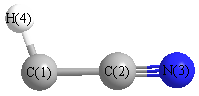 More geometry information
Calculated Bond Angles
| atom1 |
atom2 |
atom3 |
angle |
|
atom1 |
atom2 |
atom3 |
angle |
| C1 |
C2 |
N3 |
175.377 |
|
C2 |
C1 |
H4 |
149.690 |
Electronic energy levels
Charges, Dipole, Quadrupole and Polarizability
Jump to
S1C1
S2C1
S2C2
Energy calculated at TPSSh/6-31G**
| | hartrees |
|---|
| Energy at 0K | -131.431696 |
| Energy at 298.15K | |
| HF Energy | -131.431696 |
| Nuclear repulsion energy | 47.176476 |
The energy at 298.15K was derived from the energy at 0K
and an integrated heat capacity that used the calculated vibrational frequencies.
Vibrational Frequencies calculated at TPSSh/6-31G**
| Mode Number |
Symmetry |
Frequency
(cm-1) |
Scaled Frequency
(cm-1) |
IR Intensities
(km mol-1) |
Raman Act
(Å4/u) |
Dep P |
Dep U |
|---|
| 1 |
Σ |
3462 |
3319 |
66.40 |
|
|
|
| 2 |
Σ |
1747 |
1675 |
36.92 |
|
|
|
| 3 |
Σ |
1266 |
1214 |
5.15 |
|
|
|
| 4 |
Π |
446 |
427 |
0.54 |
|
|
|
| 4 |
Π |
446 |
427 |
0.54 |
|
|
|
| 5 |
Π |
330i |
317i |
50.75 |
|
|
|
| 5 |
Π |
330i |
317i |
50.75 |
|
|
|
Unscaled Zero Point Vibrational Energy (zpe) 3352.8 cm
-1
Scaled (by 0.9587) Zero Point Vibrational Energy (zpe) 3214.3 cm
-1
See section
III.C.1 List or set vibrational scaling factors
to change the scale factors used here.
See section
III.C.2
Calculate a vibrational scaling factor for a given set of molecules
to determine the least squares best scaling factor.
Geometric Data calculated at TPSSh/6-31G**
Point Group is C∞v
Cartesians (Å)
| Atom |
x (Å) |
y (Å) |
z (Å) |
|---|
| C1 |
0.000 |
0.000 |
-1.215 |
| C2 |
0.000 |
0.000 |
0.082 |
| N3 |
0.000 |
0.000 |
1.297 |
| H4 |
0.000 |
0.000 |
-2.282 |
Atom - Atom Distances (Å)
| |
C1 |
C2 |
N3 |
H4 |
| C1 | | 1.2968 | 2.5123 | 1.0668 |
C2 | 1.2968 | | 1.2155 | 2.3637 | N3 | 2.5123 | 1.2155 | | 3.5791 | H4 | 1.0668 | 2.3637 | 3.5791 | |
More geometry information
Calculated Bond Angles
| atom1 |
atom2 |
atom3 |
angle |
|
atom1 |
atom2 |
atom3 |
angle |
| C1 |
C2 |
N3 |
180.000 |
|
C2 |
C1 |
H4 |
180.000 |
Electronic energy levels
Charges, Dipole, Quadrupole and Polarizability
Charges from optimized geometry at TPSSh/6-31G**
Charges (e)
| Number |
Element |
Mulliken |
CHELPG |
AIM |
ESP |
| 1 |
C |
-0.046 |
|
|
|
| 2 |
C |
0.301 |
|
|
|
| 3 |
N |
-0.492 |
|
|
|
| 4 |
H |
0.237 |
|
|
|
Electric dipole moments
Electric dipole components in Debye
(What's a Debye? See section
VII.A.3)
| |
x |
y |
z |
Total |
| |
0.000 |
0.000 |
-3.285 |
3.285 |
| CHELPG |
|
|
|
|
| AIM |
|
|
|
|
| ESP |
|
|
|
|
Electric Quadrupole moment
Quadrupole components in D Å
Polarizabilities
Components of the polarizability tensor.
Units are
Å
3 (Angstrom cubed)
Change units.
| |
x |
y |
z |
| x |
1.642 |
0.000 |
0.000 |
| y |
0.000 |
1.642 |
0.000 |
| z |
0.000 |
0.000 |
6.213 |
<r2> (average value of r
2) Å
2
| <r2> |
36.052 |
| (<r2>)1/2 |
6.004 |
Jump to
S1C1
S1C2
S2C2
Energy calculated at TPSSh/6-31G**
| | hartrees |
|---|
| Energy at 0K | -131.401126 |
| Energy at 298.15K | -131.400546 |
| HF Energy | -131.401126 |
| Nuclear repulsion energy | 46.777841 |
The energy at 298.15K was derived from the energy at 0K
and an integrated heat capacity that used the calculated vibrational frequencies.
Vibrational Frequencies calculated at TPSSh/6-31G**
| Mode Number |
Symmetry |
Frequency
(cm-1) |
Scaled Frequency
(cm-1) |
IR Intensities
(km mol-1) |
Raman Act
(Å4/u) |
Dep P |
Dep U |
|---|
| 1 |
A' |
3065 |
2938 |
16.46 |
|
|
|
| 2 |
A' |
2081 |
1995 |
18.58 |
|
|
|
| 3 |
A' |
1093 |
1048 |
37.67 |
|
|
|
| 4 |
A' |
935 |
897 |
48.50 |
|
|
|
| 5 |
A' |
439 |
421 |
22.37 |
|
|
|
| 6 |
A" |
309 |
296 |
8.35 |
|
|
|
Unscaled Zero Point Vibrational Energy (zpe) 3960.3 cm
-1
Scaled (by 0.9587) Zero Point Vibrational Energy (zpe) 3796.7 cm
-1
See section
III.C.1 List or set vibrational scaling factors
to change the scale factors used here.
See section
III.C.2
Calculate a vibrational scaling factor for a given set of molecules
to determine the least squares best scaling factor.
Geometric Data calculated at TPSSh/6-31G**
Point Group is Cs
Cartesians (Å)
| Atom |
x (Å) |
y (Å) |
z (Å) |
|---|
| C1 |
0.219 |
-1.268 |
0.000 |
| C2 |
0.000 |
0.092 |
0.000 |
| N3 |
-0.373 |
1.222 |
0.000 |
| H4 |
1.296 |
-1.499 |
0.000 |
Atom - Atom Distances (Å)
| |
C1 |
C2 |
N3 |
H4 |
| C1 | | 1.3779 | 2.5596 | 1.1017 |
C2 | 1.3779 | | 1.1898 | 2.0524 | N3 | 2.5596 | 1.1898 | | 3.1923 | H4 | 1.1017 | 2.0524 | 3.1923 | |
More geometry information
Electronic energy levels
Charges, Dipole, Quadrupole and Polarizability
Charges from optimized geometry at TPSSh/6-31G**
Charges (e)
| Number |
Element |
Mulliken |
CHELPG |
AIM |
ESP |
| 1 |
C |
-0.086 |
|
|
|
| 2 |
C |
0.331 |
|
|
|
| 3 |
N |
-0.416 |
|
|
|
| 4 |
H |
0.171 |
|
|
|
Electric dipole moments
Electric dipole components in Debye
(What's a Debye? See section
VII.A.3)
| |
x |
y |
z |
Total |
| |
1.873 |
-1.174 |
0.000 |
2.210 |
| CHELPG |
|
|
|
|
| AIM |
|
|
|
|
| ESP |
|
|
|
|
Electric Quadrupole moment
Quadrupole components in D Å
Polarizabilities
Components of the polarizability tensor.
Units are
Å
3 (Angstrom cubed)
Change units.
| |
x |
y |
z |
| x |
2.660 |
-1.203 |
0.000 |
| y |
-1.203 |
5.973 |
0.000 |
| z |
0.000 |
0.000 |
2.176 |
<r2> (average value of r
2) Å
2
| <r2> |
36.331 |
| (<r2>)1/2 |
6.027 |
Jump to
S1C1
S1C2
S2C1
Energy calculated at TPSSh/6-31G**
| | hartrees |
|---|
| Energy at 0K | -131.401126 |
| Energy at 298.15K | -131.400546 |
| HF Energy | -131.401126 |
| Nuclear repulsion energy | 46.777841 |
The energy at 298.15K was derived from the energy at 0K
and an integrated heat capacity that used the calculated vibrational frequencies.
Vibrational Frequencies calculated at TPSSh/6-31G**
Geometric Data calculated at TPSSh/6-31G**
Point Group is Cs
Electronic energy levels
Charges, Dipole, Quadrupole and Polarizability
