return to home page Computational Chemistry Comparison and Benchmark DataBase Release 22 (May 2022) Standard Reference Database 101 National Institute of Standards and Technology
You are here: Calculated > Energy > Optimized > Energy

All results from a given calculation for C2H4O3 (trioxolane124)

using model chemistry: QCISD/6-31G**

19 10 17 12 22

States and conformations

State Conformation minimum conformation conformer description state description
1 1 yes C2 1A
Energy calculated at QCISD/6-31G**
 hartrees
Energy at 0K-303.374438
Energy at 298.15K-303.381222
HF Energy-302.524662
Nuclear repulsion energy195.886080
The energy at 298.15K was derived from the energy at 0K and an integrated heat capacity that used the calculated vibrational frequencies.
Vibrational Frequencies calculated at QCISD/6-31G**
Mode Number Symmetry Frequency
(cm-1)
Scaled Frequency
(cm-1)
IR Intensities
(km mol-1)
Raman Act
(Å4/u)
Dep P Dep U
1 A 3199 3011 1.38      
2 A 3115 2932 0.60      
3 A 1598 1504 0.03      
4 A 1470 1384 20.60      
5 A 1258 1184 3.28      
6 A 1183 1113 0.05      
7 A 1089 1025 37.34      
8 A 1004 945 52.51      
9 A 870 819 13.04      
10 A 766 721 0.53      
11 A 389 366 6.23      
12 B 3199 3012 58.06      
13 B 3112 2929 130.14      
14 B 1585 1492 11.17      
15 B 1403 1320 3.15      
16 B 1247 1174 6.09      
17 B 1176 1107 15.32      
18 B 1144 1077 191.43      
19 B 991 933 2.73      
20 B 723 680 3.07      
21 B 169 159 18.47      

Unscaled Zero Point Vibrational Energy (zpe) 15342.3 cm-1
Scaled (by 0.9414) Zero Point Vibrational Energy (zpe) 14443.3 cm-1
See section III.C.1 List or set vibrational scaling factors to change the scale factors used here.
See section III.C.2 Calculate a vibrational scaling factor for a given set of molecules to determine the least squares best scaling factor.
Rotational Constants (cm-1) from geometry optimized at QCISD/6-31G**
ABC
0.27394 0.27023 0.15279

See section I.F.4 to change rotational constant units
Geometric Data calculated at QCISD/6-31G**

Point Group is C2

Cartesians (Å)
Atom x (Å) y (Å) z (Å)
O1 0.000 0.000 1.189
C2 0.000 1.123 0.321
C3 0.000 -1.123 0.321
O4 -0.386 -0.622 -0.948
O5 0.386 0.622 -0.948
H6 -0.998 1.566 0.281
H7 0.998 -1.566 0.281
H8 0.756 1.847 0.620
H9 -0.756 -1.847 0.620

Atom - Atom Distances (Å)
  O1 C2 C3 O4 O5 H6 H7 H8 H9
O11.41901.41902.25932.25932.06692.06692.07522.0752
C21.41902.24532.19221.41801.09272.86791.08903.0788
C31.41902.24531.41802.19222.86791.09273.07881.0890
O42.25932.19221.41801.46472.58332.07753.14032.0238
O52.25931.41802.19221.46472.07752.58332.02383.1403
H62.06691.09272.86792.58332.07753.71351.80883.4378
H72.06692.86791.09272.07752.58333.71353.43781.8088
H82.07521.08903.07883.14032.02381.80883.43783.9914
H92.07523.07881.08902.02383.14033.43781.80883.9914

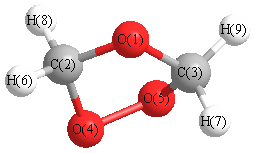
picture of trioxolane124 state 1 conformation 1
More geometry information
Calculated Bond Angles
atom1 atom2 atom3 angle atom1 atom2 atom3 angle
O1 C2 O4 74.000 O1 C2 H6 110.081
O1 C2 H8 110.993 O1 C3 O5 74.000
O1 C3 H7 110.081 O1 C3 H9 110.993
C2 O1 C3 104.589 C2 O4 O5 39.708
C3 O5 O4 39.708 O4 C2 H6 98.087
O4 C2 H8 144.152 O5 C3 H7 98.087
O5 C3 H9 144.152 H6 C2 H8 112.016
H7 C3 H9 112.016
Electronic energy levels
Charges, Dipole, Quadrupole and Polarizability