Jump to
S1C2
Energy calculated at B3PW91/6-31G**
| | hartrees |
|---|
| Energy at 0K | -958.915908 |
| Energy at 298.15K | |
| HF Energy | -958.915908 |
| Nuclear repulsion energy | 125.542261 |
The energy at 298.15K was derived from the energy at 0K
and an integrated heat capacity that used the calculated vibrational frequencies.
Vibrational Frequencies calculated at B3PW91/6-31G**
| Mode Number |
Symmetry |
Frequency
(cm-1) |
Scaled Frequency
(cm-1) |
IR Intensities
(km mol-1) |
Raman Act
(Å4/u) |
Dep P |
Dep U |
|---|
| 1 |
A1 |
3290 |
3153 |
0.11 |
|
|
|
| 2 |
A1 |
764 |
732 |
10.41 |
|
|
|
| 3 |
A1 |
316 |
303 |
0.40 |
|
|
|
| 4 |
B1 |
328i |
314i |
58.17 |
|
|
|
| 5 |
B2 |
1258 |
1205 |
53.16 |
|
|
|
| 6 |
B2 |
937 |
898 |
160.73 |
|
|
|
Unscaled Zero Point Vibrational Energy (zpe) 3118.4 cm
-1
Scaled (by 0.9584) Zero Point Vibrational Energy (zpe) 2988.7 cm
-1
See section
III.C.1 List or set vibrational scaling factors
to change the scale factors used here.
See section
III.C.2
Calculate a vibrational scaling factor for a given set of molecules
to determine the least squares best scaling factor.
Geometric Data calculated at B3PW91/6-31G**
Point Group is C2v
Cartesians (Å)
| Atom |
x (Å) |
y (Å) |
z (Å) |
|---|
| C1 |
0.000 |
0.000 |
0.668 |
| H2 |
0.000 |
0.000 |
1.748 |
| Cl3 |
0.000 |
1.480 |
-0.169 |
| Cl4 |
0.000 |
-1.480 |
-0.169 |
Atom - Atom Distances (Å)
| |
C1 |
H2 |
Cl3 |
Cl4 |
| C1 | | 1.0796 | 1.7003 | 1.7003 |
H2 | 1.0796 | | 2.4219 | 2.4219 | Cl3 | 1.7003 | 2.4219 | | 2.9591 | Cl4 | 1.7003 | 2.4219 | 2.9591 | |
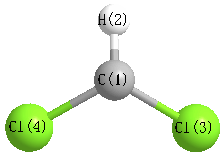 More geometry information
Calculated Bond Angles
| atom1 |
atom2 |
atom3 |
angle |
|
atom1 |
atom2 |
atom3 |
angle |
| Cl3 |
C1 |
H2 |
119.519 |
|
Cl3 |
C1 |
Cl4 |
120.962 |
| Cl4 |
C1 |
H2 |
119.519 |
|
Electronic energy levels
Charges, Dipole, Quadrupole and Polarizability
Charges from optimized geometry at B3PW91/6-31G**
Charges (e)
| Number |
Element |
Mulliken |
CHELPG |
AIM |
ESP |
| 1 |
C |
-0.354 |
|
|
|
| 2 |
H |
0.217 |
|
|
|
| 3 |
Cl |
0.069 |
|
|
|
| 4 |
Cl |
0.069 |
|
|
|
Electric dipole moments
Electric dipole components in Debye
(What's a Debye? See section
VII.A.3)
| |
x |
y |
z |
Total |
| |
0.000 |
0.000 |
0.999 |
0.999 |
| CHELPG |
|
|
|
|
| AIM |
|
|
|
|
| ESP |
|
|
|
|
Electric Quadrupole moment
Quadrupole components in D Å
| Primitive |
|---|
| | x | y | z |
|---|
| x |
-31.631 |
0.000 |
0.000 |
| y |
0.000 |
-30.824 |
0.000 |
| z |
0.000 |
0.000 |
-28.594 |
|
| Traceless |
|---|
| | x | y | z |
|---|
| x |
-1.922 |
0.000 |
0.000 |
| y |
0.000 |
-0.712 |
0.000 |
| z |
0.000 |
0.000 |
2.634 |
|
| Polar |
|---|
| 3z2-r2 | 5.267 |
|---|
| x2-y2 | -0.807 |
|---|
| xy | 0.000 |
|---|
| xz | 0.000 |
|---|
| yz | 0.000 |
|---|
|
Polarizabilities
Components of the polarizability tensor.
Units are
Å
3 (Angstrom cubed)
Change units.
| |
x |
y |
z |
| x |
2.262 |
0.000 |
0.000 |
| y |
0.000 |
6.544 |
0.000 |
| z |
0.000 |
0.000 |
3.654 |
<r2> (average value of r
2) Å
2
| <r2> |
100.097 |
| (<r2>)1/2 |
10.005 |
Jump to
S1C1
Energy calculated at B3PW91/6-31G**
| | hartrees |
|---|
| Energy at 0K | -958.916437 |
| Energy at 298.15K | -958.917202 |
| HF Energy | -958.916437 |
| Nuclear repulsion energy | 125.401824 |
The energy at 298.15K was derived from the energy at 0K
and an integrated heat capacity that used the calculated vibrational frequencies.
Vibrational Frequencies calculated at B3PW91/6-31G**
| Mode Number |
Symmetry |
Frequency
(cm-1) |
Scaled Frequency
(cm-1) |
IR Intensities
(km mol-1) |
Raman Act
(Å4/u) |
Dep P |
Dep U |
|---|
| 1 |
A' |
3255 |
3120 |
1.48 |
|
|
|
| 2 |
A' |
768 |
736 |
15.29 |
|
|
|
| 3 |
A' |
441 |
423 |
33.38 |
|
|
|
| 4 |
A' |
309 |
296 |
1.28 |
|
|
|
| 5 |
A" |
1262 |
1209 |
45.41 |
|
|
|
| 6 |
A" |
910 |
872 |
182.42 |
|
|
|
Unscaled Zero Point Vibrational Energy (zpe) 3472.5 cm
-1
Scaled (by 0.9584) Zero Point Vibrational Energy (zpe) 3328.1 cm
-1
See section
III.C.1 List or set vibrational scaling factors
to change the scale factors used here.
See section
III.C.2
Calculate a vibrational scaling factor for a given set of molecules
to determine the least squares best scaling factor.
Geometric Data calculated at B3PW91/6-31G**
Point Group is Cs
Cartesians (Å)
| Atom |
x (Å) |
y (Å) |
z (Å) |
|---|
| C1 |
0.011 |
0.688 |
0.000 |
| H2 |
-0.444 |
1.670 |
0.000 |
| Cl3 |
0.011 |
-0.171 |
1.477 |
| Cl4 |
0.011 |
-0.171 |
-1.477 |
Atom - Atom Distances (Å)
| |
C1 |
H2 |
Cl3 |
Cl4 |
| C1 | | 1.0824 | 1.7081 | 1.7081 |
H2 | 1.0824 | | 2.4033 | 2.4033 | Cl3 | 1.7081 | 2.4033 | | 2.9534 | Cl4 | 1.7081 | 2.4033 | 2.9534 | |
More geometry information
Calculated Bond Angles
| atom1 |
atom2 |
atom3 |
angle |
|
atom1 |
atom2 |
atom3 |
angle |
| Cl3 |
C1 |
H2 |
117.133 |
|
Cl3 |
C1 |
Cl4 |
119.654 |
| Cl4 |
C1 |
H2 |
117.133 |
|
Electronic energy levels
Charges, Dipole, Quadrupole and Polarizability
Charges from optimized geometry at B3PW91/6-31G**
Charges (e)
| Number |
Element |
Mulliken |
CHELPG |
AIM |
ESP |
| 1 |
C |
-0.336 |
|
|
|
| 2 |
H |
0.214 |
|
|
|
| 3 |
Cl |
0.061 |
|
|
|
| 4 |
Cl |
0.061 |
|
|
|
Electric dipole moments
Electric dipole components in Debye
(What's a Debye? See section
VII.A.3)
| |
x |
y |
z |
Total |
| |
-0.494 |
0.918 |
0.000 |
1.043 |
| CHELPG |
|
|
|
|
| AIM |
|
|
|
|
| ESP |
|
|
|
|
Electric Quadrupole moment
Quadrupole components in D Å
| Primitive |
|---|
| | x | y | z |
|---|
| x |
-31.390 |
-0.858 |
0.000 |
| y |
-0.858 |
-28.989 |
0.000 |
| z |
0.000 |
0.000 |
-30.962 |
|
| Traceless |
|---|
| | x | y | z |
|---|
| x |
-1.414 |
-0.858 |
0.000 |
| y |
-0.858 |
2.187 |
0.000 |
| z |
0.000 |
0.000 |
-0.773 |
|
| Polar |
|---|
| 3z2-r2 | -1.546 |
|---|
| x2-y2 | -2.401 |
|---|
| xy | -0.858 |
|---|
| xz | 0.000 |
|---|
| yz | 0.000 |
|---|
|
Polarizabilities
Components of the polarizability tensor.
Units are
Å
3 (Angstrom cubed)
Change units.
| |
x |
y |
z |
| x |
2.347 |
-0.186 |
0.000 |
| y |
-0.186 |
3.654 |
0.000 |
| z |
0.000 |
0.000 |
6.611 |
<r2> (average value of r
2) Å
2
| <r2> |
99.977 |
| (<r2>)1/2 |
9.999 |
