Jump to
S1C2
Energy calculated at QCISD/6-31G**
| | hartrees |
|---|
| Energy at 0K | -957.768938 |
| Energy at 298.15K | |
| HF Energy | -957.358370 |
| Nuclear repulsion energy | 125.458954 |
The energy at 298.15K was derived from the energy at 0K
and an integrated heat capacity that used the calculated vibrational frequencies.
Vibrational Frequencies calculated at QCISD/6-31G**
| Mode Number |
Symmetry |
Frequency
(cm-1) |
Scaled Frequency
(cm-1) |
IR Intensities
(km mol-1) |
Raman Act
(Å4/u) |
Dep P |
Dep U |
|---|
| 1 |
A1 |
3347 |
3151 |
0.04 |
|
|
|
| 2 |
A1 |
775 |
729 |
9.66 |
|
|
|
| 3 |
A1 |
319 |
301 |
0.58 |
|
|
|
| 4 |
B1 |
398i |
375i |
50.63 |
|
|
|
| 5 |
B2 |
1306 |
1229 |
63.62 |
|
|
|
| 6 |
B2 |
966 |
909 |
122.52 |
|
|
|
Unscaled Zero Point Vibrational Energy (zpe) 3157.5 cm
-1
Scaled (by 0.9414) Zero Point Vibrational Energy (zpe) 2972.5 cm
-1
See section
III.C.1 List or set vibrational scaling factors
to change the scale factors used here.
See section
III.C.2
Calculate a vibrational scaling factor for a given set of molecules
to determine the least squares best scaling factor.
Geometric Data calculated at QCISD/6-31G**
Point Group is C2v
Cartesians (Å)
| Atom |
x (Å) |
y (Å) |
z (Å) |
|---|
| C1 |
0.000 |
0.000 |
0.671 |
| H2 |
0.000 |
0.000 |
1.746 |
| Cl3 |
0.000 |
1.480 |
-0.170 |
| Cl4 |
0.000 |
-1.480 |
-0.170 |
Atom - Atom Distances (Å)
| |
C1 |
H2 |
Cl3 |
Cl4 |
| C1 | | 1.0745 | 1.7025 | 1.7025 |
H2 | 1.0745 | | 2.4209 | 2.4209 | Cl3 | 1.7025 | 2.4209 | | 2.9602 | Cl4 | 1.7025 | 2.4209 | 2.9602 | |
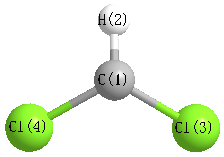 More geometry information
Calculated Bond Angles
| atom1 |
atom2 |
atom3 |
angle |
|
atom1 |
atom2 |
atom3 |
angle |
| Cl3 |
C1 |
H2 |
119.614 |
|
Cl3 |
C1 |
Cl4 |
120.772 |
| Cl4 |
C1 |
H2 |
119.614 |
|
Electronic energy levels
Charges, Dipole, Quadrupole and Polarizability
Jump to
S1C1
Energy calculated at QCISD/6-31G**
| | hartrees |
|---|
| Energy at 0K | -957.769843 |
| Energy at 298.15K | -957.770691 |
| HF Energy | -957.359749 |
| Nuclear repulsion energy | 125.345844 |
The energy at 298.15K was derived from the energy at 0K
and an integrated heat capacity that used the calculated vibrational frequencies.
Vibrational Frequencies calculated at QCISD/6-31G**
| Mode Number |
Symmetry |
Frequency
(cm-1) |
Scaled Frequency
(cm-1) |
IR Intensities
(km mol-1) |
Raman Act
(Å4/u) |
Dep P |
Dep U |
|---|
| 1 |
A' |
3308 |
3115 |
2.69 |
|
|
|
| 2 |
A' |
782 |
736 |
14.80 |
|
|
|
| 3 |
A' |
520 |
489 |
23.48 |
|
|
|
| 4 |
A' |
313 |
295 |
0.68 |
|
|
|
| 5 |
A" |
1310 |
1233 |
53.60 |
|
|
|
| 6 |
A" |
938 |
883 |
145.57 |
|
|
|
Unscaled Zero Point Vibrational Energy (zpe) 3585.6 cm
-1
Scaled (by 0.9414) Zero Point Vibrational Energy (zpe) 3375.5 cm
-1
See section
III.C.1 List or set vibrational scaling factors
to change the scale factors used here.
See section
III.C.2
Calculate a vibrational scaling factor for a given set of molecules
to determine the least squares best scaling factor.
Geometric Data calculated at QCISD/6-31G**
Point Group is Cs
Cartesians (Å)
| Atom |
x (Å) |
y (Å) |
z (Å) |
|---|
| C1 |
0.012 |
0.695 |
0.000 |
| H2 |
-0.476 |
1.656 |
0.000 |
| Cl3 |
0.012 |
-0.171 |
1.476 |
| Cl4 |
0.012 |
-0.171 |
-1.476 |
Atom - Atom Distances (Å)
| |
C1 |
H2 |
Cl3 |
Cl4 |
| C1 | | 1.0778 | 1.7112 | 1.7112 |
H2 | 1.0778 | | 2.3988 | 2.3988 | Cl3 | 1.7112 | 2.3988 | | 2.9516 | Cl4 | 1.7112 | 2.3988 | 2.9516 | |
More geometry information
Calculated Bond Angles
| atom1 |
atom2 |
atom3 |
angle |
|
atom1 |
atom2 |
atom3 |
angle |
| Cl3 |
C1 |
H2 |
116.822 |
|
Cl3 |
C1 |
Cl4 |
119.186 |
| Cl4 |
C1 |
H2 |
116.822 |
|
Electronic energy levels
Charges, Dipole, Quadrupole and Polarizability
