Jump to
S1C2
Energy calculated at PBE1PBE/6-31G**
| | hartrees |
|---|
| Energy at 0K | -958.658469 |
| Energy at 298.15K | |
| HF Energy | -958.658469 |
| Nuclear repulsion energy | 125.901970 |
The energy at 298.15K was derived from the energy at 0K
and an integrated heat capacity that used the calculated vibrational frequencies.
Vibrational Frequencies calculated at PBE1PBE/6-31G**
| Mode Number |
Symmetry |
Frequency
(cm-1) |
Scaled Frequency
(cm-1) |
IR Intensities
(km mol-1) |
Raman Act
(Å4/u) |
Dep P |
Dep U |
|---|
| 1 |
A1 |
3314 |
3158 |
0.16 |
|
|
|
| 2 |
A1 |
776 |
740 |
10.52 |
|
|
|
| 3 |
A1 |
320 |
305 |
0.42 |
|
|
|
| 4 |
B1 |
330i |
314i |
59.66 |
|
|
|
| 5 |
B2 |
1275 |
1215 |
55.56 |
|
|
|
| 6 |
B2 |
957 |
912 |
156.19 |
|
|
|
Unscaled Zero Point Vibrational Energy (zpe) 3155.4 cm
-1
Scaled (by 0.9531) Zero Point Vibrational Energy (zpe) 3007.4 cm
-1
See section
III.C.1 List or set vibrational scaling factors
to change the scale factors used here.
See section
III.C.2
Calculate a vibrational scaling factor for a given set of molecules
to determine the least squares best scaling factor.
Geometric Data calculated at PBE1PBE/6-31G**
Point Group is C2v
Cartesians (Å)
| Atom |
x (Å) |
y (Å) |
z (Å) |
|---|
| C1 |
0.000 |
0.000 |
0.667 |
| H2 |
0.000 |
0.000 |
1.746 |
| Cl3 |
0.000 |
1.475 |
-0.169 |
| Cl4 |
0.000 |
-1.475 |
-0.169 |
Atom - Atom Distances (Å)
| |
C1 |
H2 |
Cl3 |
Cl4 |
| C1 | | 1.0799 | 1.6952 | 1.6952 |
H2 | 1.0799 | | 2.4175 | 2.4175 | Cl3 | 1.6952 | 2.4175 | | 2.9501 | Cl4 | 1.6952 | 2.4175 | 2.9501 | |
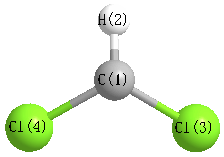 More geometry information
Calculated Bond Angles
| atom1 |
atom2 |
atom3 |
angle |
|
atom1 |
atom2 |
atom3 |
angle |
| Cl3 |
C1 |
H2 |
119.529 |
|
Cl3 |
C1 |
Cl4 |
120.942 |
| Cl4 |
C1 |
H2 |
119.529 |
|
Electronic energy levels
Charges, Dipole, Quadrupole and Polarizability
Charges from optimized geometry at PBE1PBE/6-31G**
Charges (e)
| Number |
Element |
Mulliken |
CHELPG |
AIM |
ESP |
| 1 |
C |
-0.404 |
|
|
|
| 2 |
H |
0.259 |
|
|
|
| 3 |
Cl |
0.073 |
|
|
|
| 4 |
Cl |
0.073 |
|
|
|
Electric dipole moments
Electric dipole components in Debye
(What's a Debye? See section
VII.A.3)
| |
x |
y |
z |
Total |
| |
0.000 |
0.000 |
1.013 |
1.013 |
| CHELPG |
|
|
|
|
| AIM |
|
|
|
|
| ESP |
|
|
|
|
Electric Quadrupole moment
Quadrupole components in D Å
| Primitive |
|---|
| | x | y | z |
|---|
| x |
-31.715 |
0.000 |
0.000 |
| y |
0.000 |
-30.908 |
0.000 |
| z |
0.000 |
0.000 |
-28.639 |
|
| Traceless |
|---|
| | x | y | z |
|---|
| x |
-1.941 |
0.000 |
0.000 |
| y |
0.000 |
-0.731 |
0.000 |
| z |
0.000 |
0.000 |
2.672 |
|
| Polar |
|---|
| 3z2-r2 | 5.344 |
|---|
| x2-y2 | -0.807 |
|---|
| xy | 0.000 |
|---|
| xz | 0.000 |
|---|
| yz | 0.000 |
|---|
|
Polarizabilities
Components of the polarizability tensor.
Units are
Å
3 (Angstrom cubed)
Change units.
| |
x |
y |
z |
| x |
2.248 |
0.000 |
0.000 |
| y |
0.000 |
6.450 |
0.000 |
| z |
0.000 |
0.000 |
3.620 |
<r2> (average value of r
2) Å
2
| <r2> |
99.662 |
| (<r2>)1/2 |
9.983 |
Jump to
S1C1
Energy calculated at PBE1PBE/6-31G**
| | hartrees |
|---|
| Energy at 0K | -958.659001 |
| Energy at 298.15K | -958.659784 |
| HF Energy | -958.659001 |
| Nuclear repulsion energy | 125.782780 |
The energy at 298.15K was derived from the energy at 0K
and an integrated heat capacity that used the calculated vibrational frequencies.
Vibrational Frequencies calculated at PBE1PBE/6-31G**
| Mode Number |
Symmetry |
Frequency
(cm-1) |
Scaled Frequency
(cm-1) |
IR Intensities
(km mol-1) |
Raman Act
(Å4/u) |
Dep P |
Dep U |
|---|
| 1 |
A' |
3280 |
3126 |
1.51 |
|
|
|
| 2 |
A' |
781 |
744 |
15.28 |
|
|
|
| 3 |
A' |
446 |
425 |
33.99 |
|
|
|
| 4 |
A' |
312 |
297 |
1.46 |
|
|
|
| 5 |
A" |
1280 |
1220 |
47.78 |
|
|
|
| 6 |
A" |
931 |
888 |
177.89 |
|
|
|
Unscaled Zero Point Vibrational Energy (zpe) 3515.1 cm
-1
Scaled (by 0.9531) Zero Point Vibrational Energy (zpe) 3350.2 cm
-1
See section
III.C.1 List or set vibrational scaling factors
to change the scale factors used here.
See section
III.C.2
Calculate a vibrational scaling factor for a given set of molecules
to determine the least squares best scaling factor.
Geometric Data calculated at PBE1PBE/6-31G**
Point Group is Cs
Cartesians (Å)
| Atom |
x (Å) |
y (Å) |
z (Å) |
|---|
| C1 |
0.011 |
0.686 |
0.000 |
| H2 |
-0.441 |
1.669 |
0.000 |
| Cl3 |
0.011 |
-0.170 |
1.472 |
| Cl4 |
0.011 |
-0.170 |
-1.472 |
Atom - Atom Distances (Å)
| |
C1 |
H2 |
Cl3 |
Cl4 |
| C1 | | 1.0824 | 1.7027 | 1.7027 |
H2 | 1.0824 | | 2.3989 | 2.3989 | Cl3 | 1.7027 | 2.3989 | | 2.9439 | Cl4 | 1.7027 | 2.3989 | 2.9439 | |
More geometry information
Calculated Bond Angles
| atom1 |
atom2 |
atom3 |
angle |
|
atom1 |
atom2 |
atom3 |
angle |
| Cl3 |
C1 |
H2 |
117.181 |
|
Cl3 |
C1 |
Cl4 |
119.646 |
| Cl4 |
C1 |
H2 |
117.181 |
|
Electronic energy levels
Charges, Dipole, Quadrupole and Polarizability
Charges from optimized geometry at PBE1PBE/6-31G**
Charges (e)
| Number |
Element |
Mulliken |
CHELPG |
AIM |
ESP |
| 1 |
C |
-0.385 |
|
|
|
| 2 |
H |
0.255 |
|
|
|
| 3 |
Cl |
0.065 |
|
|
|
| 4 |
Cl |
0.065 |
|
|
|
Electric dipole moments
Electric dipole components in Debye
(What's a Debye? See section
VII.A.3)
| |
x |
y |
z |
Total |
| |
-0.496 |
0.930 |
0.000 |
1.055 |
| CHELPG |
|
|
|
|
| AIM |
|
|
|
|
| ESP |
|
|
|
|
Electric Quadrupole moment
Quadrupole components in D Å
| Primitive |
|---|
| | x | y | z |
|---|
| x |
-31.470 |
-0.863 |
0.000 |
| y |
-0.863 |
-29.040 |
0.000 |
| z |
0.000 |
0.000 |
-31.043 |
|
| Traceless |
|---|
| | x | y | z |
|---|
| x |
-1.428 |
-0.863 |
0.000 |
| y |
-0.863 |
2.216 |
0.000 |
| z |
0.000 |
0.000 |
-0.788 |
|
| Polar |
|---|
| 3z2-r2 | -1.576 |
|---|
| x2-y2 | -2.430 |
|---|
| xy | -0.863 |
|---|
| xz | 0.000 |
|---|
| yz | 0.000 |
|---|
|
Polarizabilities
Components of the polarizability tensor.
Units are
Å
3 (Angstrom cubed)
Change units.
| |
x |
y |
z |
| x |
2.331 |
-0.182 |
0.000 |
| y |
-0.182 |
3.620 |
0.000 |
| z |
0.000 |
0.000 |
6.509 |
<r2> (average value of r
2) Å
2
| <r2> |
99.518 |
| (<r2>)1/2 |
9.976 |
