Jump to
S1C2
Energy calculated at QCISD/6-31G**
| | hartrees |
|---|
| Energy at 0K | -151.504142 |
| Energy at 298.15K | |
| HF Energy | -151.082305 |
| Nuclear repulsion energy | 52.077541 |
The energy at 298.15K was derived from the energy at 0K
and an integrated heat capacity that used the calculated vibrational frequencies.
Vibrational Frequencies calculated at QCISD/6-31G**
| Mode Number |
Symmetry |
Frequency
(cm-1) |
Scaled Frequency
(cm-1) |
IR Intensities
(km mol-1) |
Raman Act
(Å4/u) |
Dep P |
Dep U |
|---|
| 1 |
Σ |
3534 |
3327 |
107.63 |
|
|
|
| 2 |
Σ |
2112 |
1988 |
134.55 |
|
|
|
| 3 |
Σ |
1306 |
1230 |
20.22 |
|
|
|
| 4 |
Π |
547 |
515 |
0.00 |
|
|
|
| 4 |
Π |
503 |
474 |
4.81 |
|
|
|
| 5 |
Π |
300 |
283 |
33.29 |
|
|
|
| 5 |
Π |
451i |
424i |
131.59 |
|
|
|
Unscaled Zero Point Vibrational Energy (zpe) 3926.1 cm
-1
Scaled (by 0.9414) Zero Point Vibrational Energy (zpe) 3696.0 cm
-1
See section
III.C.1 List or set vibrational scaling factors
to change the scale factors used here.
See section
III.C.2
Calculate a vibrational scaling factor for a given set of molecules
to determine the least squares best scaling factor.
Geometric Data calculated at QCISD/6-31G**
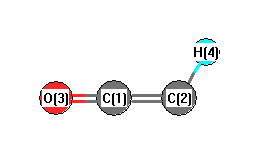
Point Group is C∞v
Cartesians (Å)
| Atom |
x (Å) |
y (Å) |
z (Å) |
|---|
| C1 |
0.000 |
0.000 |
0.015 |
| C2 |
0.000 |
0.000 |
-1.250 |
| O3 |
0.000 |
0.000 |
1.215 |
| H4 |
0.000 |
0.000 |
-2.312 |
Atom - Atom Distances (Å)
| |
C1 |
C2 |
O3 |
H4 |
| C1 | | 1.2659 | 1.1998 | 2.3273 |
C2 | 1.2659 | | 2.4657 | 1.0614 | O3 | 1.1998 | 2.4657 | | 3.5271 | H4 | 2.3273 | 1.0614 | 3.5271 | |
 More geometry information
Calculated Bond Angles
| atom1 |
atom2 |
atom3 |
angle |
|
atom1 |
atom2 |
atom3 |
angle |
| C1 |
C2 |
H4 |
180.000 |
|
C2 |
C1 |
O3 |
180.000 |
Electronic energy levels
Charges, Dipole, Quadrupole and Polarizability
Jump to
S1C1
Energy calculated at QCISD/6-31G**
| | hartrees |
|---|
| Energy at 0K | -151.507194 |
| Energy at 298.15K | |
| HF Energy | -151.080857 |
| Nuclear repulsion energy | 51.936933 |
The energy at 298.15K was derived from the energy at 0K
and an integrated heat capacity that used the calculated vibrational frequencies.
Vibrational Frequencies calculated at QCISD/6-31G**
| Mode Number |
Symmetry |
Frequency
(cm-1) |
Scaled Frequency
(cm-1) |
IR Intensities
(km mol-1) |
Raman Act
(Å4/u) |
Dep P |
Dep U |
|---|
| 1 |
A' |
3424 |
3224 |
29.89 |
|
|
|
| 2 |
A' |
2084 |
1961 |
239.19 |
|
|
|
| 3 |
A' |
1256 |
1183 |
6.76 |
|
|
|
| 4 |
A' |
532 |
501 |
66.09 |
|
|
|
| 5 |
A' |
528 |
497 |
174.38 |
|
|
|
| 6 |
A" |
478 |
450 |
5.16 |
|
|
|
Unscaled Zero Point Vibrational Energy (zpe) 4151.2 cm
-1
Scaled (by 0.9414) Zero Point Vibrational Energy (zpe) 3907.9 cm
-1
See section
III.C.1 List or set vibrational scaling factors
to change the scale factors used here.
See section
III.C.2
Calculate a vibrational scaling factor for a given set of molecules
to determine the least squares best scaling factor.
Geometric Data calculated at QCISD/6-31G**
Point Group is Cs
Cartesians (Å)
| Atom |
x (Å) |
y (Å) |
z (Å) |
|---|
| C1 |
0.000 |
0.062 |
0.000 |
| C2 |
1.166 |
-0.521 |
0.000 |
| O3 |
-1.147 |
0.367 |
0.000 |
| H4 |
2.183 |
-0.186 |
0.000 |
Atom - Atom Distances (Å)
| |
C1 |
C2 |
O3 |
H4 |
| C1 | | 1.3030 | 1.1871 | 2.1968 |
C2 | 1.3030 | | 2.4773 | 1.0706 | O3 | 1.1871 | 2.4773 | | 3.3755 | H4 | 2.1968 | 1.0706 | 3.3755 | |
More geometry information
Calculated Bond Angles
| atom1 |
atom2 |
atom3 |
angle |
|
atom1 |
atom2 |
atom3 |
angle |
| C1 |
C2 |
H4 |
135.264 |
|
C2 |
C1 |
O3 |
168.377 |
Electronic energy levels
Charges, Dipole, Quadrupole and Polarizability
