Jump to
S1C2
Energy calculated at B2PLYP=FULLultrafine/6-31G**
| | hartrees |
|---|
| Energy at 0K | -151.781156 |
| Energy at 298.15K | |
| HF Energy | -151.640144 |
| Nuclear repulsion energy | 52.222166 |
The energy at 298.15K was derived from the energy at 0K
and an integrated heat capacity that used the calculated vibrational frequencies.
Vibrational Frequencies calculated at B2PLYP=FULLultrafine/6-31G**
| Mode Number |
Symmetry |
Frequency
(cm-1) |
Scaled Frequency
(cm-1) |
IR Intensities
(km mol-1) |
Raman Act
(Å4/u) |
Dep P |
Dep U |
|---|
| 1 |
Σ |
3525 |
3525 |
124.83 |
43.42 |
0.22 |
0.37 |
| 2 |
Σ |
2159 |
2159 |
230.74 |
0.44 |
0.16 |
0.28 |
| 3 |
Σ |
1311 |
1311 |
24.78 |
24.42 |
0.24 |
0.39 |
| 4 |
Π |
560 |
560 |
0.15 |
1.83 |
0.75 |
0.86 |
| 4 |
Π |
519 |
519 |
9.09 |
1.61 |
0.75 |
0.86 |
| 5 |
Π |
412 |
412 |
26.42 |
0.01 |
0.75 |
0.86 |
| 5 |
Π |
417i |
417i |
136.54 |
3.90 |
0.75 |
0.86 |
Unscaled Zero Point Vibrational Energy (zpe) 4034.7 cm
-1
Scaled (by 1) Zero Point Vibrational Energy (zpe) 4034.7 cm
-1
See section
III.C.1 List or set vibrational scaling factors
to change the scale factors used here.
See section
III.C.2
Calculate a vibrational scaling factor for a given set of molecules
to determine the least squares best scaling factor.
Geometric Data calculated at B2PLYP=FULLultrafine/6-31G**
Point Group is C∞v
Cartesians (Å)
| Atom |
x (Å) |
y (Å) |
z (Å) |
|---|
| C1 |
0.000 |
0.000 |
0.017 |
| C2 |
0.000 |
0.000 |
-1.248 |
| O3 |
0.000 |
0.000 |
1.211 |
| H4 |
0.000 |
0.000 |
-2.309 |
Atom - Atom Distances (Å)
| |
C1 |
C2 |
O3 |
H4 |
| C1 | | 1.2650 | 1.1940 | 2.3262 |
C2 | 1.2650 | | 2.4590 | 1.0612 | O3 | 1.1940 | 2.4590 | | 3.5202 | H4 | 2.3262 | 1.0612 | 3.5202 | |
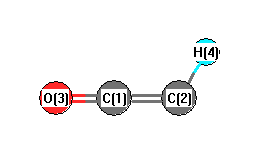 More geometry information
Calculated Bond Angles
| atom1 |
atom2 |
atom3 |
angle |
|
atom1 |
atom2 |
atom3 |
angle |
| C1 |
C2 |
H4 |
180.000 |
|
C2 |
C1 |
O3 |
180.000 |
Electronic energy levels
Charges, Dipole, Quadrupole and Polarizability
Jump to
S1C1
Energy calculated at B2PLYP=FULLultrafine/6-31G**
| | hartrees |
|---|
| Energy at 0K | -151.784253 |
| Energy at 298.15K | |
| HF Energy | -151.640748 |
| Nuclear repulsion energy | 52.040717 |
The energy at 298.15K was derived from the energy at 0K
and an integrated heat capacity that used the calculated vibrational frequencies.
Vibrational Frequencies calculated at B2PLYP=FULLultrafine/6-31G**
| Mode Number |
Symmetry |
Frequency
(cm-1) |
Scaled Frequency
(cm-1) |
IR Intensities
(km mol-1) |
Raman Act
(Å4/u) |
Dep P |
Dep U |
|---|
| 1 |
A' |
3394 |
3394 |
34.46 |
77.41 |
0.30 |
0.47 |
| 2 |
A' |
2126 |
2126 |
298.60 |
0.27 |
0.38 |
0.56 |
| 3 |
A' |
1252 |
1252 |
6.94 |
25.79 |
0.31 |
0.48 |
| 4 |
A' |
550 |
550 |
144.91 |
10.22 |
0.29 |
0.45 |
| 5 |
A' |
533 |
533 |
92.86 |
3.71 |
0.18 |
0.30 |
| 6 |
A" |
496 |
496 |
3.07 |
0.61 |
0.75 |
0.86 |
Unscaled Zero Point Vibrational Energy (zpe) 4176.0 cm
-1
Scaled (by 1) Zero Point Vibrational Energy (zpe) 4176.0 cm
-1
See section
III.C.1 List or set vibrational scaling factors
to change the scale factors used here.
See section
III.C.2
Calculate a vibrational scaling factor for a given set of molecules
to determine the least squares best scaling factor.
Geometric Data calculated at B2PLYP=FULLultrafine/6-31G**
Point Group is Cs
Cartesians (Å)
| Atom |
x (Å) |
y (Å) |
z (Å) |
|---|
| C1 |
0.000 |
0.055 |
0.000 |
| C2 |
1.139 |
-0.574 |
0.000 |
| O3 |
-1.125 |
0.423 |
0.000 |
| H4 |
2.166 |
-0.268 |
0.000 |
Atom - Atom Distances (Å)
| |
C1 |
C2 |
O3 |
H4 |
| C1 | | 1.3012 | 1.1835 | 2.1901 |
C2 | 1.3012 | | 2.4737 | 1.0721 | O3 | 1.1835 | 2.4737 | | 3.3628 | H4 | 2.1901 | 1.0721 | 3.3628 | |
More geometry information
Calculated Bond Angles
| atom1 |
atom2 |
atom3 |
angle |
|
atom1 |
atom2 |
atom3 |
angle |
| C1 |
C2 |
H4 |
134.456 |
|
C2 |
C1 |
O3 |
169.182 |
Electronic energy levels
Charges, Dipole, Quadrupole and Polarizability
