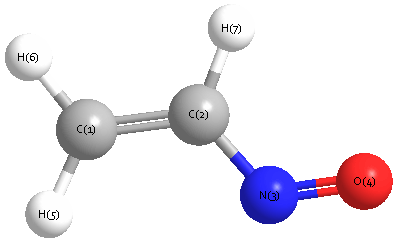
Vibrational Frequencies calculated at TPSSh/6-31G**
| Mode Number |
Symmetry |
Frequency
(cm-1) |
Scaled Frequency
(cm-1) |
IR Intensities
(km mol-1) |
Raman Act
(Å4/u) |
Dep P |
Dep U |
|---|
| 1 |
A' |
3274 |
3139 |
2.23 |
66.16 |
0.69 |
0.82 |
| 2 |
A' |
3181 |
3050 |
5.39 |
165.18 |
0.14 |
0.25 |
| 3 |
A' |
3163 |
3032 |
7.07 |
20.57 |
0.75 |
0.85 |
| 4 |
A' |
1684 |
1615 |
0.96 |
21.31 |
0.14 |
0.25 |
| 5 |
A' |
1572 |
1507 |
107.69 |
47.39 |
0.30 |
0.46 |
| 6 |
A' |
1428 |
1369 |
19.73 |
23.65 |
0.37 |
0.54 |
| 7 |
A' |
1289 |
1236 |
0.92 |
7.69 |
0.51 |
0.67 |
| 8 |
A' |
1147 |
1099 |
69.69 |
22.57 |
0.51 |
0.67 |
| 9 |
A' |
892 |
855 |
28.84 |
0.12 |
0.26 |
0.41 |
| 10 |
A' |
601 |
576 |
1.61 |
7.59 |
0.27 |
0.42 |
| 11 |
A' |
332 |
318 |
1.37 |
0.73 |
0.67 |
0.80 |
| 12 |
A" |
1016 |
974 |
43.33 |
0.04 |
0.75 |
0.86 |
| 13 |
A" |
1000 |
959 |
9.32 |
1.33 |
0.75 |
0.86 |
| 14 |
A" |
675 |
647 |
0.35 |
7.80 |
0.75 |
0.86 |
| 15 |
A" |
181 |
174 |
0.09 |
1.40 |
0.75 |
0.86 |
Unscaled Zero Point Vibrational Energy (zpe) 10717.2 cm
-1
Scaled (by 0.9587) Zero Point Vibrational Energy (zpe) 10274.6 cm
-1
See section
III.C.1 List or set vibrational scaling factors
to change the scale factors used here.
See section
III.C.2
Calculate a vibrational scaling factor for a given set of molecules
to determine the least squares best scaling factor.
Charges, Dipole, Quadrupole and Polarizability
Charges from optimized geometry at TPSSh/6-31G**
Charges (e)
| Number |
Element |
Mulliken |
CHELPG |
AIM |
ESP |
| 1 |
C |
-0.248 |
|
|
|
| 2 |
C |
0.072 |
|
|
|
| 3 |
N |
-0.008 |
|
|
|
| 4 |
O |
-0.280 |
|
|
|
| 5 |
H |
0.165 |
|
|
|
| 6 |
H |
0.156 |
|
|
|
| 7 |
H |
0.143 |
|
|
|
Electric dipole moments
Electric dipole components in Debye
(What's a Debye? See section
VII.A.3)
| |
x |
y |
z |
Total |
| |
1.399 |
2.904 |
0.000 |
3.223 |
| CHELPG |
|
|
|
|
| AIM |
|
|
|
|
| ESP |
|
|
|
|
Electric Quadrupole moment
Quadrupole components in D Å
Polarizabilities
Components of the polarizability tensor.
Units are
Å
3 (Angstrom cubed)
Change units.
| |
x |
y |
z |
| x |
6.389 |
2.151 |
0.000 |
| y |
2.151 |
6.016 |
0.000 |
| z |
0.000 |
0.000 |
2.019 |
<r2> (average value of r
2) Å
2
| <r2> |
76.123 |
| (<r2>)1/2 |
8.725 |