Jump to
S2C1
Energy calculated at HF/TZVP
| | hartrees |
|---|
| Energy at 0K | -150.512733 |
| Energy at 298.15K | -150.511298 |
| HF Energy | -150.512733 |
| Nuclear repulsion energy | 46.911332 |
The energy at 298.15K was derived from the energy at 0K
and an integrated heat capacity that used the calculated vibrational frequencies.
Geometric Data calculated at HF/TZVP
Point Group is C∞v
Cartesians (Å)
| Atom |
x (Å) |
y (Å) |
z (Å) |
|---|
| C1 |
0.000 |
0.000 |
-1.393 |
| C2 |
0.000 |
0.000 |
-0.048 |
| O3 |
0.000 |
0.000 |
1.081 |
Atom - Atom Distances (Å)
| |
C1 |
C2 |
O3 |
| C1 | | 1.3452 | 2.4748 |
C2 | 1.3452 | | 1.1296 | O3 | 2.4748 | 1.1296 | |
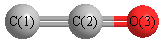 More geometry information
Calculated Bond Angles
| atom1 |
atom2 |
atom3 |
angle |
|
atom1 |
atom2 |
atom3 |
angle |
| C1 |
C2 |
O3 |
180.000 |
|
Electronic energy levels
Charges, Dipole, Quadrupole and Polarizability
Charges from optimized geometry at HF/TZVP
Charges (e)
| Number |
Element |
Mulliken |
CHELPG |
AIM |
ESP |
| 1 |
C |
-0.226 |
|
|
|
| 2 |
C |
0.447 |
|
|
|
| 3 |
O |
-0.221 |
|
|
|
Electric dipole moments
Electric dipole components in Debye
(What's a Debye? See section
VII.A.3)
| |
x |
y |
z |
Total |
| |
0.000 |
0.000 |
1.597 |
1.597 |
| CHELPG |
|
|
|
|
| AIM |
|
|
|
|
| ESP |
|
|
|
|
Electric Quadrupole moment
Quadrupole components in D Å
| Primitive |
|---|
| | x | y | z |
|---|
| x |
-15.878 |
0.000 |
0.000 |
| y |
0.000 |
-15.878 |
0.000 |
| z |
0.000 |
0.000 |
-23.763 |
|
| Traceless |
|---|
| | x | y | z |
|---|
| x |
3.942 |
0.000 |
0.000 |
| y |
0.000 |
3.942 |
0.000 |
| z |
0.000 |
0.000 |
-7.885 |
|
| Polar |
|---|
| 3z2-r2 | -15.770 |
|---|
| x2-y2 | 0.000 |
|---|
| xy | 0.000 |
|---|
| xz | 0.000 |
|---|
| yz | 0.000 |
|---|
|
Polarizabilities
Components of the polarizability tensor.
Units are
Å
3 (Angstrom cubed)
Change units.
| |
x |
y |
z |
| x |
2.604 |
0.000 |
0.000 |
| y |
0.000 |
2.604 |
0.000 |
| z |
0.000 |
0.000 |
5.714 |
<r2> (average value of r
2) Å
2
| <r2> |
32.577 |
| (<r2>)1/2 |
5.708 |
Jump to
S1C1
Energy calculated at HF/TZVP
| | hartrees |
|---|
| Energy at 0K | -150.453123 |
| Energy at 298.15K | -150.451729 |
| HF Energy | -150.453123 |
| Nuclear repulsion energy | 46.811530 |
The energy at 298.15K was derived from the energy at 0K
and an integrated heat capacity that used the calculated vibrational frequencies.
Geometric Data calculated at HF/TZVP
Point Group is C∞v
Cartesians (Å)
| Atom |
x (Å) |
y (Å) |
z (Å) |
|---|
| C1 |
0.000 |
0.000 |
-1.395 |
| C2 |
0.000 |
0.000 |
-0.051 |
| O3 |
0.000 |
0.000 |
1.084 |
Atom - Atom Distances (Å)
| |
C1 |
C2 |
O3 |
| C1 | | 1.3439 | 2.4785 |
C2 | 1.3439 | | 1.1346 | O3 | 2.4785 | 1.1346 | |
More geometry information
Calculated Bond Angles
| atom1 |
atom2 |
atom3 |
angle |
|
atom1 |
atom2 |
atom3 |
angle |
| C1 |
C2 |
O3 |
180.000 |
|
Electronic energy levels
Charges, Dipole, Quadrupole and Polarizability
Charges from optimized geometry at HF/TZVP
Charges (e)
| Number |
Element |
Mulliken |
CHELPG |
AIM |
ESP |
| 1 |
C |
-0.184 |
|
|
|
| 2 |
C |
0.427 |
|
|
|
| 3 |
O |
-0.243 |
|
|
|
Electric dipole moments
Electric dipole components in Debye
(What's a Debye? See section
VII.A.3)
| |
x |
y |
z |
Total |
| |
0.000 |
0.000 |
1.048 |
1.048 |
| CHELPG |
|
|
|
|
| AIM |
|
|
|
|
| ESP |
|
|
|
|
Electric Quadrupole moment
Quadrupole components in D Å
| Primitive |
|---|
| | x | y | z |
|---|
| x |
-14.165 |
0.000 |
0.000 |
| y |
0.000 |
-17.868 |
0.000 |
| z |
0.000 |
0.000 |
-23.340 |
|
| Traceless |
|---|
| | x | y | z |
|---|
| x |
6.439 |
0.000 |
0.000 |
| y |
0.000 |
0.885 |
0.000 |
| z |
0.000 |
0.000 |
-7.324 |
|
| Polar |
|---|
| 3z2-r2 | -14.648 |
|---|
| x2-y2 | 3.703 |
|---|
| xy | 0.000 |
|---|
| xz | 0.000 |
|---|
| yz | 0.000 |
|---|
|
Polarizabilities
Components of the polarizability tensor.
Units are
Å
3 (Angstrom cubed)
Change units.
| |
x |
y |
z |
| x |
2.182 |
0.000 |
0.000 |
| y |
0.000 |
2.088 |
0.000 |
| z |
0.000 |
0.000 |
5.352 |
<r2> (average value of r
2) Å
2
| <r2> |
32.611 |
| (<r2>)1/2 |
5.711 |
