Jump to
S1C2
S2C1
S2C2
Energy calculated at CCSD(T)/TZVP
| | hartrees |
|---|
| Energy at 0K | -39.057196 |
| Energy at 298.15K | -39.057011 |
| HF Energy | -38.937515 |
| Nuclear repulsion energy | 6.152542 |
The energy at 298.15K was derived from the energy at 0K
and an integrated heat capacity that used the calculated vibrational frequencies.
Geometric Data calculated at CCSD(T)/TZVP
Point Group is C2v
Cartesians (Å)
| Atom |
x (Å) |
y (Å) |
z (Å) |
|---|
| C1 |
0.000 |
0.000 |
0.108 |
| H2 |
0.000 |
0.989 |
-0.324 |
| H3 |
0.000 |
-0.989 |
-0.324 |
Atom - Atom Distances (Å)
| |
C1 |
H2 |
H3 |
| C1 | | 1.0791 | 1.0791 |
H2 | 1.0791 | | 1.9777 | H3 | 1.0791 | 1.9777 | |
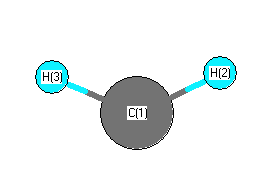 More geometry information
Calculated Bond Angles
| atom1 |
atom2 |
atom3 |
angle |
|
atom1 |
atom2 |
atom3 |
angle |
| H2 |
C1 |
H3 |
132.806 |
|
Electronic energy levels
Charges, Dipole, Quadrupole and Polarizability
Jump to
S1C1
S2C1
S2C2
Energy calculated at CCSD(T)/TZVP
| | hartrees |
|---|
| Energy at 0K | -39.046698 |
| Energy at 298.15K | |
| HF Energy | -38.925795 |
| Nuclear repulsion energy | 6.191342 |
The energy at 298.15K was derived from the energy at 0K
and an integrated heat capacity that used the calculated vibrational frequencies.
Geometric Data calculated at CCSD(T)/TZVP
Point Group is D∞h
Cartesians (Å)
| Atom |
x (Å) |
y (Å) |
z (Å) |
|---|
| C1 |
0.000 |
0.000 |
0.000 |
| H2 |
0.000 |
0.000 |
1.068 |
| H3 |
0.000 |
0.000 |
-1.068 |
Atom - Atom Distances (Å)
| |
C1 |
H2 |
H3 |
| C1 | | 1.0678 | 1.0678 |
H2 | 1.0678 | | 2.1357 | H3 | 1.0678 | 2.1357 | |
More geometry information
Calculated Bond Angles
| atom1 |
atom2 |
atom3 |
angle |
|
atom1 |
atom2 |
atom3 |
angle |
| H2 |
C1 |
H3 |
180.000 |
|
Electronic energy levels
Charges, Dipole, Quadrupole and Polarizability
Jump to
S1C1
S1C2
S2C2
Energy calculated at CCSD(T)/TZVP
| | hartrees |
|---|
| Energy at 0K | -39.036488 |
| Energy at 298.15K | -39.036324 |
| HF Energy | -38.890517 |
| Nuclear repulsion energy | 6.021630 |
The energy at 298.15K was derived from the energy at 0K
and an integrated heat capacity that used the calculated vibrational frequencies.
Geometric Data calculated at CCSD(T)/TZVP
Point Group is C2v
Cartesians (Å)
| Atom |
x (Å) |
y (Å) |
z (Å) |
|---|
| C1 |
0.000 |
0.000 |
0.176 |
| H2 |
0.000 |
0.860 |
-0.528 |
| H3 |
0.000 |
-0.860 |
-0.528 |
Atom - Atom Distances (Å)
| |
C1 |
H2 |
H3 |
| C1 | | 1.1113 | 1.1113 |
H2 | 1.1113 | | 1.7195 | H3 | 1.1113 | 1.7195 | |
More geometry information
Electronic energy levels
Charges, Dipole, Quadrupole and Polarizability
Jump to
S1C1
S1C2
S2C1
Energy calculated at CCSD(T)/TZVP
| | hartrees |
|---|
| Energy at 0K | -39.036488 |
| Energy at 298.15K | -39.036324 |
| HF Energy | -38.890517 |
| Nuclear repulsion energy | 6.021630 |
The energy at 298.15K was derived from the energy at 0K
and an integrated heat capacity that used the calculated vibrational frequencies.
Vibrational Frequencies calculated at CCSD(T)/TZVP
Geometric Data calculated at CCSD(T)/TZVP
Point Group is C2v
Electronic energy levels
Charges, Dipole, Quadrupole and Polarizability
