Jump to
S1C2
S2C1
S2C2
Energy calculated at B3LYP/TZVP
| | hartrees |
|---|
| Energy at 0K | -131.468613 |
| Energy at 298.15K | -131.467826 |
| HF Energy | -131.468613 |
| Nuclear repulsion energy | 47.553277 |
The energy at 298.15K was derived from the energy at 0K
and an integrated heat capacity that used the calculated vibrational frequencies.
Vibrational Frequencies calculated at B3LYP/TZVP
| Mode Number |
Symmetry |
Frequency
(cm-1) |
Scaled Frequency
(cm-1) |
IR Intensities
(km mol-1) |
Raman Act
(Å4/u) |
Dep P |
Dep U |
|---|
| 1 |
A' |
3402 |
3284 |
51.68 |
|
|
|
| 2 |
A' |
1771 |
1710 |
27.92 |
|
|
|
| 3 |
A' |
1254 |
1211 |
5.64 |
|
|
|
| 4 |
A' |
447 |
431 |
5.59 |
|
|
|
| 5 |
A' |
315 |
304 |
49.19 |
|
|
|
| 6 |
A" |
441 |
426 |
0.66 |
|
|
|
Unscaled Zero Point Vibrational Energy (zpe) 3814.4 cm
-1
Scaled (by 0.9654) Zero Point Vibrational Energy (zpe) 3682.4 cm
-1
See section
III.C.1 List or set vibrational scaling factors
to change the scale factors used here.
See section
III.C.2
Calculate a vibrational scaling factor for a given set of molecules
to determine the least squares best scaling factor.
Geometric Data calculated at B3LYP/TZVP
Point Group is Cs
Cartesians (Å)
| Atom |
x (Å) |
y (Å) |
z (Å) |
|---|
| C1 |
0.096 |
-1.208 |
0.000 |
| C2 |
0.000 |
0.084 |
0.000 |
| N3 |
-0.164 |
1.272 |
0.000 |
| H4 |
0.570 |
-2.163 |
0.000 |
Atom - Atom Distances (Å)
| |
C1 |
C2 |
N3 |
H4 |
| C1 | | 1.2952 | 2.4933 | 1.0668 |
C2 | 1.2952 | | 1.1994 | 2.3186 | N3 | 2.4933 | 1.1994 | | 3.5131 | H4 | 1.0668 | 2.3186 | 3.5131 | |
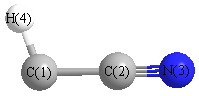 More geometry information
Calculated Bond Angles
| atom1 |
atom2 |
atom3 |
angle |
|
atom1 |
atom2 |
atom3 |
angle |
| C1 |
C2 |
N3 |
176.407 |
|
C2 |
C1 |
H4 |
157.900 |
Electronic energy levels
Charges, Dipole, Quadrupole and Polarizability
Jump to
S1C1
S2C1
S2C2
Energy calculated at B3LYP/TZVP
| | hartrees |
|---|
| Energy at 0K | -131.468386 |
| Energy at 298.15K | |
| HF Energy | -131.468386 |
| Nuclear repulsion energy | 47.590056 |
The energy at 298.15K was derived from the energy at 0K
and an integrated heat capacity that used the calculated vibrational frequencies.
Vibrational Frequencies calculated at B3LYP/TZVP
| Mode Number |
Symmetry |
Frequency
(cm-1) |
Scaled Frequency
(cm-1) |
IR Intensities
(km mol-1) |
Raman Act
(Å4/u) |
Dep P |
Dep U |
|---|
| 1 |
Σ |
3442 |
3323 |
75.25 |
|
|
|
| 2 |
Σ |
1735 |
1675 |
28.89 |
|
|
|
| 3 |
Σ |
1279 |
1235 |
4.12 |
|
|
|
| 4 |
Π |
437 |
422 |
0.11 |
|
|
|
| 4 |
Π |
437 |
422 |
0.11 |
|
|
|
| 5 |
Π |
230i |
222i |
58.03 |
|
|
|
| 5 |
Π |
230i |
222i |
58.03 |
|
|
|
Unscaled Zero Point Vibrational Energy (zpe) 3435.4 cm
-1
Scaled (by 0.9654) Zero Point Vibrational Energy (zpe) 3316.5 cm
-1
See section
III.C.1 List or set vibrational scaling factors
to change the scale factors used here.
See section
III.C.2
Calculate a vibrational scaling factor for a given set of molecules
to determine the least squares best scaling factor.
Geometric Data calculated at B3LYP/TZVP
Point Group is C∞v
Cartesians (Å)
| Atom |
x (Å) |
y (Å) |
z (Å) |
|---|
| C1 |
0.000 |
0.000 |
-1.203 |
| C2 |
0.000 |
0.000 |
0.081 |
| N3 |
0.000 |
0.000 |
1.286 |
| H4 |
0.000 |
0.000 |
-2.267 |
Atom - Atom Distances (Å)
| |
C1 |
C2 |
N3 |
H4 |
| C1 | | 1.2839 | 2.4890 | 1.0636 |
C2 | 1.2839 | | 1.2051 | 2.3475 | N3 | 2.4890 | 1.2051 | | 3.5526 | H4 | 1.0636 | 2.3475 | 3.5526 | |
More geometry information
Calculated Bond Angles
| atom1 |
atom2 |
atom3 |
angle |
|
atom1 |
atom2 |
atom3 |
angle |
| C1 |
C2 |
N3 |
180.000 |
|
C2 |
C1 |
H4 |
180.000 |
Electronic energy levels
Charges, Dipole, Quadrupole and Polarizability
Charges from optimized geometry at B3LYP/TZVP
Charges (e)
| Number |
Element |
Mulliken |
CHELPG |
AIM |
ESP |
| 1 |
C |
-0.186 |
|
|
|
| 2 |
C |
0.036 |
|
|
|
| 3 |
N |
-0.080 |
|
|
|
| 4 |
H |
0.230 |
|
|
|
Electric dipole moments
Electric dipole components in Debye
(What's a Debye? See section
VII.A.3)
| |
x |
y |
z |
Total |
| |
0.000 |
0.000 |
-3.303 |
3.303 |
| CHELPG |
|
|
|
|
| AIM |
|
|
|
|
| ESP |
|
|
|
|
Electric Quadrupole moment
Quadrupole components in D Å
| Primitive |
|---|
| | x | y | z |
|---|
| x |
-17.427 |
0.000 |
0.000 |
| y |
0.000 |
-17.427 |
0.000 |
| z |
0.000 |
0.000 |
-15.950 |
|
| Traceless |
|---|
| | x | y | z |
|---|
| x |
-0.739 |
0.000 |
0.000 |
| y |
0.000 |
-0.739 |
0.000 |
| z |
0.000 |
0.000 |
1.477 |
|
| Polar |
|---|
| 3z2-r2 | 2.955 |
|---|
| x2-y2 | 0.000 |
|---|
| xy | 0.000 |
|---|
| xz | 0.000 |
|---|
| yz | 0.000 |
|---|
|
Polarizabilities
Components of the polarizability tensor.
Units are
Å
3 (Angstrom cubed)
Change units.
| |
x |
y |
z |
| x |
2.123 |
0.000 |
0.000 |
| y |
0.000 |
2.123 |
0.000 |
| z |
0.000 |
0.000 |
6.831 |
<r2> (average value of r
2) Å
2
| <r2> |
36.014 |
| (<r2>)1/2 |
6.001 |
Jump to
S1C1
S1C2
S2C2
Energy calculated at B3LYP/TZVP
| | hartrees |
|---|
| Energy at 0K | -131.442654 |
| Energy at 298.15K | -131.442104 |
| HF Energy | -131.442654 |
| Nuclear repulsion energy | 47.207123 |
The energy at 298.15K was derived from the energy at 0K
and an integrated heat capacity that used the calculated vibrational frequencies.
Vibrational Frequencies calculated at B3LYP/TZVP
| Mode Number |
Symmetry |
Frequency
(cm-1) |
Scaled Frequency
(cm-1) |
IR Intensities
(km mol-1) |
Raman Act
(Å4/u) |
Dep P |
Dep U |
|---|
| 1 |
A' |
3071 |
2964 |
5.41 |
|
|
|
| 2 |
A' |
2097 |
2025 |
17.58 |
|
|
|
| 3 |
A' |
1092 |
1054 |
35.29 |
|
|
|
| 4 |
A' |
923 |
891 |
50.30 |
|
|
|
| 5 |
A' |
449 |
434 |
24.74 |
|
|
|
| 6 |
A" |
323 |
312 |
9.45 |
|
|
|
Unscaled Zero Point Vibrational Energy (zpe) 3977.6 cm
-1
Scaled (by 0.9654) Zero Point Vibrational Energy (zpe) 3839.9 cm
-1
See section
III.C.1 List or set vibrational scaling factors
to change the scale factors used here.
See section
III.C.2
Calculate a vibrational scaling factor for a given set of molecules
to determine the least squares best scaling factor.
Geometric Data calculated at B3LYP/TZVP
Point Group is Cs
Cartesians (Å)
| Atom |
x (Å) |
y (Å) |
z (Å) |
|---|
| C1 |
0.116 |
-1.271 |
0.000 |
| C2 |
0.000 |
0.093 |
0.000 |
| N3 |
-0.266 |
1.237 |
0.000 |
| H4 |
1.167 |
-1.588 |
0.000 |
Atom - Atom Distances (Å)
| |
C1 |
C2 |
N3 |
H4 |
| C1 | | 1.3687 | 2.5373 | 1.0972 |
C2 | 1.3687 | | 1.1751 | 2.0460 | N3 | 2.5373 | 1.1751 | | 3.1679 | H4 | 1.0972 | 2.0460 | 3.1679 | |
More geometry information
Electronic energy levels
Charges, Dipole, Quadrupole and Polarizability
Charges from optimized geometry at B3LYP/TZVP
Charges (e)
| Number |
Element |
Mulliken |
CHELPG |
AIM |
ESP |
| 1 |
C |
-0.164 |
|
|
|
| 2 |
C |
0.101 |
|
|
|
| 3 |
N |
-0.078 |
|
|
|
| 4 |
H |
0.142 |
|
|
|
Electric dipole moments
Electric dipole components in Debye
(What's a Debye? See section
VII.A.3)
| |
x |
y |
z |
Total |
| |
1.878 |
-1.347 |
0.000 |
2.311 |
| CHELPG |
|
|
|
|
| AIM |
|
|
|
|
| ESP |
|
|
|
|
Electric Quadrupole moment
Quadrupole components in D Å
| Primitive |
|---|
| | x | y | z |
|---|
| x |
-17.070 |
-2.402 |
0.000 |
| y |
-2.402 |
-21.724 |
0.000 |
| z |
0.000 |
0.000 |
-16.013 |
|
| Traceless |
|---|
| | x | y | z |
|---|
| x |
1.798 |
-2.402 |
0.000 |
| y |
-2.402 |
-5.182 |
0.000 |
| z |
0.000 |
0.000 |
3.384 |
|
| Polar |
|---|
| 3z2-r2 | 6.769 |
|---|
| x2-y2 | 4.654 |
|---|
| xy | -2.402 |
|---|
| xz | 0.000 |
|---|
| yz | 0.000 |
|---|
|
Polarizabilities
Components of the polarizability tensor.
Units are
Å
3 (Angstrom cubed)
Change units.
| |
x |
y |
z |
| x |
2.940 |
-0.765 |
0.000 |
| y |
-0.765 |
6.795 |
0.000 |
| z |
0.000 |
0.000 |
2.685 |
<r2> (average value of r
2) Å
2
| <r2> |
36.331 |
| (<r2>)1/2 |
6.028 |
Jump to
S1C1
S1C2
S2C1
Energy calculated at B3LYP/TZVP
| | hartrees |
|---|
| Energy at 0K | -131.442654 |
| Energy at 298.15K | -131.442104 |
| HF Energy | -131.442654 |
| Nuclear repulsion energy | 47.207123 |
The energy at 298.15K was derived from the energy at 0K
and an integrated heat capacity that used the calculated vibrational frequencies.
Vibrational Frequencies calculated at B3LYP/TZVP
Geometric Data calculated at B3LYP/TZVP
Point Group is Cs
Electronic energy levels
Charges, Dipole, Quadrupole and Polarizability
