Jump to
S1C2
Energy calculated at B1B95/TZVP
| | hartrees |
|---|
| Energy at 0K | -959.160624 |
| Energy at 298.15K | |
| HF Energy | -959.160624 |
| Nuclear repulsion energy | 125.872420 |
The energy at 298.15K was derived from the energy at 0K
and an integrated heat capacity that used the calculated vibrational frequencies.
Vibrational Frequencies calculated at B1B95/TZVP
| Mode Number |
Symmetry |
Frequency
(cm-1) |
Scaled Frequency
(cm-1) |
IR Intensities
(km mol-1) |
Raman Act
(Å4/u) |
Dep P |
Dep U |
|---|
| 1 |
A1 |
3292 |
3150 |
0.09 |
|
|
|
| 2 |
A1 |
766 |
733 |
10.17 |
|
|
|
| 3 |
A1 |
314 |
300 |
0.27 |
|
|
|
| 4 |
B1 |
345i |
331i |
59.88 |
|
|
|
| 5 |
B2 |
1251 |
1197 |
50.20 |
|
|
|
| 6 |
B2 |
935 |
895 |
174.62 |
|
|
|
Unscaled Zero Point Vibrational Energy (zpe) 3105.9 cm
-1
Scaled (by 0.9569) Zero Point Vibrational Energy (zpe) 2972.0 cm
-1
See section
III.C.1 List or set vibrational scaling factors
to change the scale factors used here.
See section
III.C.2
Calculate a vibrational scaling factor for a given set of molecules
to determine the least squares best scaling factor.
Geometric Data calculated at B1B95/TZVP
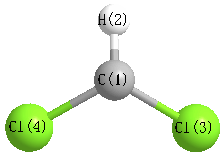
Point Group is C2v
Cartesians (Å)
| Atom |
x (Å) |
y (Å) |
z (Å) |
|---|
| C1 |
0.000 |
0.000 |
0.669 |
| H2 |
0.000 |
0.000 |
1.743 |
| Cl3 |
0.000 |
1.475 |
-0.169 |
| Cl4 |
0.000 |
-1.475 |
-0.169 |
Atom - Atom Distances (Å)
| |
C1 |
H2 |
Cl3 |
Cl4 |
| C1 | | 1.0742 | 1.6967 | 1.6967 |
H2 | 1.0742 | | 2.4155 | 2.4155 | Cl3 | 1.6967 | 2.4155 | | 2.9499 | Cl4 | 1.6967 | 2.4155 | 2.9499 | |
 More geometry information
Calculated Bond Angles
| atom1 |
atom2 |
atom3 |
angle |
|
atom1 |
atom2 |
atom3 |
angle |
| Cl3 |
C1 |
H2 |
119.624 |
|
Cl3 |
C1 |
Cl4 |
120.751 |
| Cl4 |
C1 |
H2 |
119.624 |
|
Electronic energy levels
Charges, Dipole, Quadrupole and Polarizability
Charges from optimized geometry at B1B95/TZVP
Charges (e)
| Number |
Element |
Mulliken |
CHELPG |
AIM |
ESP |
| 1 |
C |
-0.213 |
|
|
|
| 2 |
H |
0.211 |
|
|
|
| 3 |
Cl |
0.001 |
|
|
|
| 4 |
Cl |
0.001 |
|
|
|
Electric dipole moments
Electric dipole components in Debye
(What's a Debye? See section
VII.A.3)
| |
x |
y |
z |
Total |
| |
0.000 |
0.000 |
0.907 |
0.907 |
| CHELPG |
|
|
|
|
| AIM |
|
|
|
|
| ESP |
|
|
|
|
Electric Quadrupole moment
Quadrupole components in D Å
| Primitive |
|---|
| | x | y | z |
|---|
| x |
-31.800 |
0.000 |
0.000 |
| y |
0.000 |
-30.805 |
0.000 |
| z |
0.000 |
0.000 |
-28.796 |
|
| Traceless |
|---|
| | x | y | z |
|---|
| x |
-1.999 |
0.000 |
0.000 |
| y |
0.000 |
-0.507 |
0.000 |
| z |
0.000 |
0.000 |
2.506 |
|
| Polar |
|---|
| 3z2-r2 | 5.012 |
|---|
| x2-y2 | -0.995 |
|---|
| xy | 0.000 |
|---|
| xz | 0.000 |
|---|
| yz | 0.000 |
|---|
|
Polarizabilities
Components of the polarizability tensor.
Units are
Å
3 (Angstrom cubed)
Change units.
| |
x |
y |
z |
| x |
2.812 |
0.000 |
0.000 |
| y |
0.000 |
6.885 |
0.000 |
| z |
0.000 |
0.000 |
3.921 |
<r2> (average value of r
2) Å
2
| <r2> |
99.697 |
| (<r2>)1/2 |
9.985 |
Jump to
S1C1
Energy calculated at B1B95/TZVP
| | hartrees |
|---|
| Energy at 0K | -959.161273 |
| Energy at 298.15K | -959.162064 |
| HF Energy | -959.161273 |
| Nuclear repulsion energy | 125.728723 |
The energy at 298.15K was derived from the energy at 0K
and an integrated heat capacity that used the calculated vibrational frequencies.
Vibrational Frequencies calculated at B1B95/TZVP
| Mode Number |
Symmetry |
Frequency
(cm-1) |
Scaled Frequency
(cm-1) |
IR Intensities
(km mol-1) |
Raman Act
(Å4/u) |
Dep P |
Dep U |
|---|
| 1 |
A' |
3254 |
3114 |
1.24 |
|
|
|
| 2 |
A' |
770 |
736 |
15.33 |
|
|
|
| 3 |
A' |
464 |
444 |
30.35 |
|
|
|
| 4 |
A' |
307 |
293 |
0.96 |
|
|
|
| 5 |
A" |
1256 |
1202 |
43.73 |
|
|
|
| 6 |
A" |
907 |
868 |
196.70 |
|
|
|
Unscaled Zero Point Vibrational Energy (zpe) 3478.5 cm
-1
Scaled (by 0.9569) Zero Point Vibrational Energy (zpe) 3328.5 cm
-1
See section
III.C.1 List or set vibrational scaling factors
to change the scale factors used here.
See section
III.C.2
Calculate a vibrational scaling factor for a given set of molecules
to determine the least squares best scaling factor.
Geometric Data calculated at B1B95/TZVP
Point Group is Cs
Cartesians (Å)
| Atom |
x (Å) |
y (Å) |
z (Å) |
|---|
| C1 |
0.012 |
0.691 |
0.000 |
| H2 |
-0.462 |
1.658 |
0.000 |
| Cl3 |
0.012 |
-0.171 |
1.472 |
| Cl4 |
0.012 |
-0.171 |
-1.472 |
Atom - Atom Distances (Å)
| |
C1 |
H2 |
Cl3 |
Cl4 |
| C1 | | 1.0772 | 1.7052 | 1.7052 |
H2 | 1.0772 | | 2.3948 | 2.3948 | Cl3 | 1.7052 | 2.3948 | | 2.9432 | Cl4 | 1.7052 | 2.3948 | 2.9432 | |
More geometry information
Calculated Bond Angles
| atom1 |
atom2 |
atom3 |
angle |
|
atom1 |
atom2 |
atom3 |
angle |
| Cl3 |
C1 |
H2 |
116.985 |
|
Cl3 |
C1 |
Cl4 |
119.314 |
| Cl4 |
C1 |
H2 |
116.985 |
|
Electronic energy levels
Charges, Dipole, Quadrupole and Polarizability
Charges from optimized geometry at B1B95/TZVP
Charges (e)
| Number |
Element |
Mulliken |
CHELPG |
AIM |
ESP |
| 1 |
C |
-0.177 |
|
|
|
| 2 |
H |
0.192 |
|
|
|
| 3 |
Cl |
-0.008 |
|
|
|
| 4 |
Cl |
-0.008 |
|
|
|
Electric dipole moments
Electric dipole components in Debye
(What's a Debye? See section
VII.A.3)
| |
x |
y |
z |
Total |
| |
-0.508 |
0.829 |
0.000 |
0.972 |
| CHELPG |
|
|
|
|
| AIM |
|
|
|
|
| ESP |
|
|
|
|
Electric Quadrupole moment
Quadrupole components in D Å
| Primitive |
|---|
| | x | y | z |
|---|
| x |
-31.531 |
-0.915 |
0.000 |
| y |
-0.915 |
-29.207 |
0.000 |
| z |
0.000 |
0.000 |
-30.960 |
|
| Traceless |
|---|
| | x | y | z |
|---|
| x |
-1.448 |
-0.915 |
0.000 |
| y |
-0.915 |
2.038 |
0.000 |
| z |
0.000 |
0.000 |
-0.590 |
|
| Polar |
|---|
| 3z2-r2 | -1.181 |
|---|
| x2-y2 | -2.324 |
|---|
| xy | -0.915 |
|---|
| xz | 0.000 |
|---|
| yz | 0.000 |
|---|
|
Polarizabilities
Components of the polarizability tensor.
Units are
Å
3 (Angstrom cubed)
Change units.
| |
x |
y |
z |
| x |
2.878 |
-0.103 |
0.000 |
| y |
-0.103 |
3.970 |
0.000 |
| z |
0.000 |
0.000 |
6.930 |
<r2> (average value of r
2) Å
2
| <r2> |
99.545 |
| (<r2>)1/2 |
9.977 |
