Jump to
S1C2
Energy calculated at B2PLYP=FULLultrafine/TZVP
| | hartrees |
|---|
| Energy at 0K | -958.755096 |
| Energy at 298.15K | |
| HF Energy | -958.600802 |
| Nuclear repulsion energy | 125.040116 |
The energy at 298.15K was derived from the energy at 0K
and an integrated heat capacity that used the calculated vibrational frequencies.
Vibrational Frequencies calculated at B2PLYP=FULLultrafine/TZVP
| Mode Number |
Symmetry |
Frequency
(cm-1) |
Scaled Frequency
(cm-1) |
IR Intensities
(km mol-1) |
Raman Act
(Å4/u) |
Dep P |
Dep U |
|---|
| 1 |
A1 |
3298 |
3298 |
0.07 |
|
|
|
| 2 |
A1 |
752 |
752 |
9.96 |
|
|
|
| 3 |
A1 |
312 |
312 |
0.28 |
|
|
|
| 4 |
B1 |
402i |
402i |
57.92 |
|
|
|
| 5 |
B2 |
1266 |
1266 |
51.77 |
|
|
|
| 6 |
B2 |
915 |
915 |
166.70 |
|
|
|
Unscaled Zero Point Vibrational Energy (zpe) 3070.5 cm
-1
Scaled (by 1) Zero Point Vibrational Energy (zpe) 3070.5 cm
-1
See section
III.C.1 List or set vibrational scaling factors
to change the scale factors used here.
See section
III.C.2
Calculate a vibrational scaling factor for a given set of molecules
to determine the least squares best scaling factor.
Geometric Data calculated at B2PLYP=FULLultrafine/TZVP
Point Group is C2v
Cartesians (Å)
| Atom |
x (Å) |
y (Å) |
z (Å) |
|---|
| C1 |
0.000 |
0.000 |
0.674 |
| H2 |
0.000 |
0.000 |
1.748 |
| Cl3 |
0.000 |
1.485 |
-0.170 |
| Cl4 |
0.000 |
-1.485 |
-0.170 |
Atom - Atom Distances (Å)
| |
C1 |
H2 |
Cl3 |
Cl4 |
| C1 | | 1.0736 | 1.7085 | 1.7085 |
H2 | 1.0736 | | 2.4258 | 2.4258 | Cl3 | 1.7085 | 2.4258 | | 2.9706 | Cl4 | 1.7085 | 2.4258 | 2.9706 | |
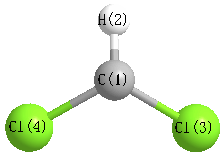 More geometry information
Calculated Bond Angles
| atom1 |
atom2 |
atom3 |
angle |
|
atom1 |
atom2 |
atom3 |
angle |
| Cl3 |
C1 |
H2 |
119.617 |
|
Cl3 |
C1 |
Cl4 |
120.766 |
| Cl4 |
C1 |
H2 |
119.617 |
|
Electronic energy levels
Charges, Dipole, Quadrupole and Polarizability
Jump to
S1C1
Energy calculated at B2PLYP=FULLultrafine/TZVP
| | hartrees |
|---|
| Energy at 0K | -958.756128 |
| Energy at 298.15K | |
| HF Energy | -958.601840 |
| Nuclear repulsion energy | 124.860380 |
The energy at 298.15K was derived from the energy at 0K
and an integrated heat capacity that used the calculated vibrational frequencies.
Vibrational Frequencies calculated at B2PLYP=FULLultrafine/TZVP
| Mode Number |
Symmetry |
Frequency
(cm-1) |
Scaled Frequency
(cm-1) |
IR Intensities
(km mol-1) |
Raman Act
(Å4/u) |
Dep P |
Dep U |
|---|
| 1 |
A' |
3255 |
3255 |
1.60 |
|
|
|
| 2 |
A' |
760 |
760 |
16.42 |
|
|
|
| 3 |
A' |
519 |
519 |
24.30 |
|
|
|
| 4 |
A' |
306 |
306 |
0.48 |
|
|
|
| 5 |
A" |
1269 |
1269 |
45.06 |
|
|
|
| 6 |
A" |
881 |
881 |
191.99 |
|
|
|
Unscaled Zero Point Vibrational Energy (zpe) 3495.2 cm
-1
Scaled (by 1) Zero Point Vibrational Energy (zpe) 3495.2 cm
-1
See section
III.C.1 List or set vibrational scaling factors
to change the scale factors used here.
See section
III.C.2
Calculate a vibrational scaling factor for a given set of molecules
to determine the least squares best scaling factor.
Geometric Data calculated at B2PLYP=FULLultrafine/TZVP
Point Group is Cs
Cartesians (Å)
| Atom |
x (Å) |
y (Å) |
z (Å) |
|---|
| C1 |
0.012 |
0.700 |
0.000 |
| H2 |
-0.498 |
1.648 |
0.000 |
| Cl3 |
0.012 |
-0.172 |
1.481 |
| Cl4 |
0.012 |
-0.172 |
-1.481 |
Atom - Atom Distances (Å)
| |
C1 |
H2 |
Cl3 |
Cl4 |
| C1 | | 1.0771 | 1.7189 | 1.7189 |
H2 | 1.0771 | | 2.4017 | 2.4017 | Cl3 | 1.7189 | 2.4017 | | 2.9627 | Cl4 | 1.7189 | 2.4017 | 2.9627 | |
More geometry information
Calculated Bond Angles
| atom1 |
atom2 |
atom3 |
angle |
|
atom1 |
atom2 |
atom3 |
angle |
| Cl3 |
C1 |
H2 |
116.524 |
|
Cl3 |
C1 |
Cl4 |
119.041 |
| Cl4 |
C1 |
H2 |
116.524 |
|
Electronic energy levels
Charges, Dipole, Quadrupole and Polarizability
