Jump to
S1C2
Energy calculated at B2PLYP=FULLultrafine/TZVP
| | hartrees |
|---|
| Energy at 0K | -151.856653 |
| Energy at 298.15K | |
| HF Energy | -151.696126 |
| Nuclear repulsion energy | 52.555543 |
The energy at 298.15K was derived from the energy at 0K
and an integrated heat capacity that used the calculated vibrational frequencies.
Vibrational Frequencies calculated at B2PLYP=FULLultrafine/TZVP
| Mode Number |
Symmetry |
Frequency
(cm-1) |
Scaled Frequency
(cm-1) |
IR Intensities
(km mol-1) |
Raman Act
(Å4/u) |
Dep P |
Dep U |
|---|
| 1 |
Σ |
3500 |
3500 |
134.66 |
40.55 |
0.21 |
0.34 |
| 2 |
Σ |
2138 |
2138 |
313.00 |
5.12 |
0.10 |
0.17 |
| 3 |
Σ |
1307 |
1307 |
26.40 |
30.98 |
0.19 |
0.32 |
| 4 |
Π |
557 |
557 |
0.36 |
0.92 |
0.75 |
0.86 |
| 4 |
Π |
512 |
512 |
6.46 |
1.95 |
0.75 |
0.86 |
| 5 |
Π |
404 |
404 |
34.40 |
1.76 |
0.75 |
0.86 |
| 5 |
Π |
423i |
423i |
158.02 |
14.04 |
0.75 |
0.86 |
Unscaled Zero Point Vibrational Energy (zpe) 3997.1 cm
-1
Scaled (by 1) Zero Point Vibrational Energy (zpe) 3997.1 cm
-1
See section
III.C.1 List or set vibrational scaling factors
to change the scale factors used here.
See section
III.C.2
Calculate a vibrational scaling factor for a given set of molecules
to determine the least squares best scaling factor.
Geometric Data calculated at B2PLYP=FULLultrafine/TZVP
Point Group is C∞v
Cartesians (Å)
| Atom |
x (Å) |
y (Å) |
z (Å) |
|---|
| C1 |
0.000 |
0.000 |
0.019 |
| C2 |
0.000 |
0.000 |
-1.240 |
| O3 |
0.000 |
0.000 |
1.203 |
| H4 |
0.000 |
0.000 |
-2.300 |
Atom - Atom Distances (Å)
| |
C1 |
C2 |
O3 |
H4 |
| C1 | | 1.2590 | 1.1840 | 2.3186 |
C2 | 1.2590 | | 2.4430 | 1.0596 | O3 | 1.1840 | 2.4430 | | 3.5026 | H4 | 2.3186 | 1.0596 | 3.5026 | |
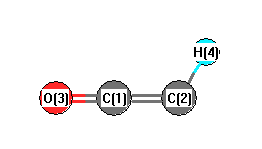 More geometry information
Calculated Bond Angles
| atom1 |
atom2 |
atom3 |
angle |
|
atom1 |
atom2 |
atom3 |
angle |
| C1 |
C2 |
H4 |
180.000 |
|
C2 |
C1 |
O3 |
180.000 |
Electronic energy levels
Charges, Dipole, Quadrupole and Polarizability
Jump to
S1C1
Energy calculated at B2PLYP=FULLultrafine/TZVP
| | hartrees |
|---|
| Energy at 0K | -151.858857 |
| Energy at 298.15K | |
| HF Energy | -151.696150 |
| Nuclear repulsion energy | 52.405194 |
The energy at 298.15K was derived from the energy at 0K
and an integrated heat capacity that used the calculated vibrational frequencies.
Vibrational Frequencies calculated at B2PLYP=FULLultrafine/TZVP
| Mode Number |
Symmetry |
Frequency
(cm-1) |
Scaled Frequency
(cm-1) |
IR Intensities
(km mol-1) |
Raman Act
(Å4/u) |
Dep P |
Dep U |
|---|
| 1 |
A' |
3382 |
3382 |
49.38 |
71.25 |
0.32 |
0.48 |
| 2 |
A' |
2114 |
2114 |
375.11 |
3.13 |
0.10 |
0.18 |
| 3 |
A' |
1258 |
1258 |
8.28 |
32.22 |
0.27 |
0.42 |
| 4 |
A' |
550 |
550 |
3.80 |
5.47 |
0.74 |
0.85 |
| 5 |
A' |
485 |
485 |
252.45 |
12.16 |
0.05 |
0.10 |
| 6 |
A" |
500 |
500 |
2.42 |
0.73 |
0.75 |
0.86 |
Unscaled Zero Point Vibrational Energy (zpe) 4143.8 cm
-1
Scaled (by 1) Zero Point Vibrational Energy (zpe) 4143.8 cm
-1
See section
III.C.1 List or set vibrational scaling factors
to change the scale factors used here.
See section
III.C.2
Calculate a vibrational scaling factor for a given set of molecules
to determine the least squares best scaling factor.
Geometric Data calculated at B2PLYP=FULLultrafine/TZVP
Point Group is Cs
Cartesians (Å)
| Atom |
x (Å) |
y (Å) |
z (Å) |
|---|
| C1 |
0.000 |
0.050 |
0.000 |
| C2 |
1.091 |
-0.639 |
0.000 |
| O3 |
-1.086 |
0.498 |
0.000 |
| H4 |
2.144 |
-0.454 |
0.000 |
Atom - Atom Distances (Å)
| |
C1 |
C2 |
O3 |
H4 |
| C1 | | 1.2897 | 1.1748 | 2.2020 |
C2 | 1.2897 | | 2.4555 | 1.0691 | O3 | 1.1748 | 2.4555 | | 3.3669 | H4 | 2.2020 | 1.0691 | 3.3669 | |
More geometry information
Calculated Bond Angles
| atom1 |
atom2 |
atom3 |
angle |
|
atom1 |
atom2 |
atom3 |
angle |
| C1 |
C2 |
H4 |
137.784 |
|
C2 |
C1 |
O3 |
170.171 |
Electronic energy levels
Charges, Dipole, Quadrupole and Polarizability
