Jump to
S1C2
Energy calculated at B3LYP/TZVP
| | hartrees |
|---|
| Energy at 0K | -93.997438 |
| Energy at 298.15K | -93.998723 |
| HF Energy | -93.997438 |
| Nuclear repulsion energy | 28.298472 |
The energy at 298.15K was derived from the energy at 0K
and an integrated heat capacity that used the calculated vibrational frequencies.
Vibrational Frequencies calculated at B3LYP/TZVP
| Mode Number |
Symmetry |
Frequency
(cm-1) |
Scaled Frequency
(cm-1) |
IR Intensities
(km mol-1) |
Raman Act
(Å4/u) |
Dep P |
Dep U |
|---|
| 1 |
A' |
3283 |
3170 |
3.62 |
|
|
|
| 2 |
A' |
2963 |
2860 |
52.18 |
|
|
|
| 3 |
A' |
1867 |
1802 |
33.38 |
|
|
|
| 4 |
A' |
988 |
954 |
123.25 |
|
|
|
| 5 |
A' |
853 |
823 |
141.97 |
|
|
|
| 6 |
A" |
908 |
876 |
6.60 |
|
|
|
Unscaled Zero Point Vibrational Energy (zpe) 5430.6 cm
-1
Scaled (by 0.9654) Zero Point Vibrational Energy (zpe) 5242.7 cm
-1
See section
III.C.1 List or set vibrational scaling factors
to change the scale factors used here.
See section
III.C.2
Calculate a vibrational scaling factor for a given set of molecules
to determine the least squares best scaling factor.
Geometric Data calculated at B3LYP/TZVP
Point Group is Cs
Cartesians (Å)
| Atom |
x (Å) |
y (Å) |
z (Å) |
|---|
| C1 |
0.109 |
0.636 |
0.000 |
| N2 |
0.109 |
-0.582 |
0.000 |
| H3 |
-0.675 |
1.404 |
0.000 |
| H4 |
-0.748 |
-1.147 |
0.000 |
Atom - Atom Distances (Å)
| |
C1 |
N2 |
H3 |
H4 |
| C1 | | 1.2175 | 1.0983 | 1.9785 |
N2 | 1.2175 | | 2.1353 | 1.0271 | H3 | 1.0983 | 2.1353 | | 2.5524 | H4 | 1.9785 | 1.0271 | 2.5524 | |
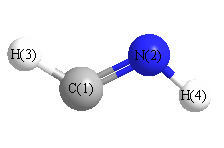 More geometry information
Calculated Bond Angles
| atom1 |
atom2 |
atom3 |
angle |
|
atom1 |
atom2 |
atom3 |
angle |
| C1 |
N2 |
H4 |
123.409 |
|
H3 |
C1 |
N2 |
134.388 |
Electronic energy levels
Charges, Dipole, Quadrupole and Polarizability
Charges from optimized geometry at B3LYP/TZVP
Charges (e)
| Number |
Element |
Mulliken |
CHELPG |
AIM |
ESP |
| 1 |
C |
-0.049 |
|
|
|
| 2 |
N |
-0.270 |
|
|
|
| 3 |
H |
0.115 |
|
|
|
| 4 |
H |
0.203 |
|
|
|
Electric dipole moments
Electric dipole components in Debye
(What's a Debye? See section
VII.A.3)
| |
x |
y |
z |
Total |
| |
-2.341 |
0.306 |
0.000 |
2.361 |
| CHELPG |
|
|
|
|
| AIM |
|
|
|
|
| ESP |
|
|
|
|
Electric Quadrupole moment
Quadrupole components in D Å
| Primitive |
|---|
| | x | y | z |
|---|
| x |
-12.501 |
0.641 |
0.000 |
| y |
0.641 |
-11.356 |
0.000 |
| z |
0.000 |
0.000 |
-12.788 |
|
| Traceless |
|---|
| | x | y | z |
|---|
| x |
-0.429 |
0.641 |
0.000 |
| y |
0.641 |
1.288 |
0.000 |
| z |
0.000 |
0.000 |
-0.860 |
|
| Polar |
|---|
| 3z2-r2 | -1.719 |
|---|
| x2-y2 | -1.145 |
|---|
| xy | 0.641 |
|---|
| xz | 0.000 |
|---|
| yz | 0.000 |
|---|
|
Polarizabilities
Components of the polarizability tensor.
Units are
Å
3 (Angstrom cubed)
Change units.
| |
x |
y |
z |
| x |
2.398 |
0.118 |
0.000 |
| y |
0.118 |
4.419 |
0.000 |
| z |
0.000 |
0.000 |
1.646 |
<r2> (average value of r
2) Å
2
| <r2> |
16.883 |
| (<r2>)1/2 |
4.109 |
Jump to
S1C1
Energy calculated at B3LYP/TZVP
| | hartrees |
|---|
| Energy at 0K | -94.005561 |
| Energy at 298.15K | -94.006902 |
| HF Energy | -94.005561 |
| Nuclear repulsion energy | 28.225227 |
The energy at 298.15K was derived from the energy at 0K
and an integrated heat capacity that used the calculated vibrational frequencies.
Vibrational Frequencies calculated at B3LYP/TZVP
| Mode Number |
Symmetry |
Frequency
(cm-1) |
Scaled Frequency
(cm-1) |
IR Intensities
(km mol-1) |
Raman Act
(Å4/u) |
Dep P |
Dep U |
|---|
| 1 |
A' |
3419 |
3301 |
5.28 |
|
|
|
| 2 |
A' |
3018 |
2913 |
25.89 |
|
|
|
| 3 |
A' |
1808 |
1745 |
30.85 |
|
|
|
| 4 |
A' |
1189 |
1147 |
11.44 |
|
|
|
| 5 |
A' |
902 |
871 |
226.17 |
|
|
|
| 6 |
A" |
977 |
943 |
124.10 |
|
|
|
Unscaled Zero Point Vibrational Energy (zpe) 5655.8 cm
-1
Scaled (by 0.9654) Zero Point Vibrational Energy (zpe) 5460.1 cm
-1
See section
III.C.1 List or set vibrational scaling factors
to change the scale factors used here.
See section
III.C.2
Calculate a vibrational scaling factor for a given set of molecules
to determine the least squares best scaling factor.
Geometric Data calculated at B3LYP/TZVP
Point Group is Cs
Cartesians (Å)
| Atom |
x (Å) |
y (Å) |
z (Å) |
|---|
| C1 |
-0.001 |
0.647 |
0.000 |
| N2 |
-0.001 |
-0.582 |
0.000 |
| H3 |
0.896 |
1.277 |
0.000 |
| H4 |
-0.888 |
-1.086 |
0.000 |
Atom - Atom Distances (Å)
| |
C1 |
N2 |
H3 |
H4 |
| C1 | | 1.2282 | 1.0960 | 1.9471 |
N2 | 1.2282 | | 2.0634 | 1.0210 | H3 | 1.0960 | 2.0634 | | 2.9611 | H4 | 1.9471 | 1.0210 | 2.9611 | |
More geometry information
Calculated Bond Angles
| atom1 |
atom2 |
atom3 |
angle |
|
atom1 |
atom2 |
atom3 |
angle |
| C1 |
N2 |
H4 |
119.640 |
|
H3 |
C1 |
N2 |
125.090 |
Electronic energy levels
Charges, Dipole, Quadrupole and Polarizability
Charges from optimized geometry at B3LYP/TZVP
Charges (e)
| Number |
Element |
Mulliken |
CHELPG |
AIM |
ESP |
| 1 |
C |
-0.094 |
|
|
|
| 2 |
N |
-0.263 |
|
|
|
| 3 |
H |
0.132 |
|
|
|
| 4 |
H |
0.226 |
|
|
|
Electric dipole moments
Electric dipole components in Debye
(What's a Debye? See section
VII.A.3)
| |
x |
y |
z |
Total |
| |
-0.481 |
0.124 |
0.000 |
0.496 |
| CHELPG |
|
|
|
|
| AIM |
|
|
|
|
| ESP |
|
|
|
|
Electric Quadrupole moment
Quadrupole components in D Å
| Primitive |
|---|
| | x | y | z |
|---|
| x |
-11.572 |
3.326 |
0.000 |
| y |
3.326 |
-11.760 |
0.000 |
| z |
0.000 |
0.000 |
-12.865 |
|
| Traceless |
|---|
| | x | y | z |
|---|
| x |
0.741 |
3.326 |
0.000 |
| y |
3.326 |
0.458 |
0.000 |
| z |
0.000 |
0.000 |
-1.199 |
|
| Polar |
|---|
| 3z2-r2 | -2.397 |
|---|
| x2-y2 | 0.189 |
|---|
| xy | 3.326 |
|---|
| xz | 0.000 |
|---|
| yz | 0.000 |
|---|
|
Polarizabilities
Components of the polarizability tensor.
Units are
Å
3 (Angstrom cubed)
Change units.
| |
x |
y |
z |
| x |
2.578 |
0.357 |
0.000 |
| y |
0.357 |
4.172 |
0.000 |
| z |
0.000 |
0.000 |
1.781 |
<r2> (average value of r
2) Å
2
| <r2> |
16.815 |
| (<r2>)1/2 |
4.101 |
