Jump to
S1C2
Energy calculated at QCISD/TZVP
| | hartrees |
|---|
| Energy at 0K | -189.381120 |
| Energy at 298.15K | -189.383848 |
| HF Energy | -188.835190 |
| Nuclear repulsion energy | 70.214450 |
The energy at 298.15K was derived from the energy at 0K
and an integrated heat capacity that used the calculated vibrational frequencies.
Vibrational Frequencies calculated at QCISD/TZVP
| Mode Number |
Symmetry |
Frequency
(cm-1) |
Scaled Frequency
(cm-1) |
IR Intensities
(km mol-1) |
Raman Act
(Å4/u) |
Dep P |
Dep U |
|---|
| 1 |
A' |
3802 |
3632 |
58.39 |
|
|
|
| 2 |
A' |
3132 |
2992 |
41.69 |
|
|
|
| 3 |
A' |
1840 |
1758 |
345.31 |
|
|
|
| 4 |
A' |
1456 |
1391 |
3.73 |
|
|
|
| 5 |
A' |
1340 |
1280 |
8.13 |
|
|
|
| 6 |
A' |
1151 |
1100 |
268.52 |
|
|
|
| 7 |
A' |
644 |
615 |
46.89 |
|
|
|
| 8 |
A" |
1067 |
1019 |
1.14 |
|
|
|
| 9 |
A" |
665 |
635 |
160.87 |
|
|
|
Unscaled Zero Point Vibrational Energy (zpe) 7547.7 cm
-1
Scaled (by 0.9553) Zero Point Vibrational Energy (zpe) 7210.3 cm
-1
See section
III.C.1 List or set vibrational scaling factors
to change the scale factors used here.
See section
III.C.2
Calculate a vibrational scaling factor for a given set of molecules
to determine the least squares best scaling factor.
Geometric Data calculated at QCISD/TZVP
Point Group is Cs
Cartesians (Å)
| Atom |
x (Å) |
y (Å) |
z (Å) |
|---|
| C1 |
0.000 |
0.423 |
0.000 |
| O2 |
-1.031 |
-0.443 |
0.000 |
| O3 |
1.159 |
0.111 |
0.000 |
| H4 |
-0.376 |
1.449 |
0.000 |
| H5 |
-0.648 |
-1.332 |
0.000 |
Atom - Atom Distances (Å)
| |
C1 |
O2 |
O3 |
H4 |
H5 |
| C1 | | 1.3460 | 1.2001 | 1.0933 | 1.8707 |
O2 | 1.3460 | | 2.2590 | 2.0022 | 0.9682 | O3 | 1.2001 | 2.2590 | | 2.0362 | 2.3130 | H4 | 1.0933 | 2.0022 | 2.0362 | | 2.7947 | H5 | 1.8707 | 0.9682 | 2.3130 | 2.7947 | |
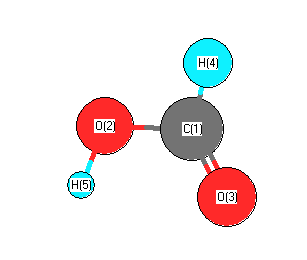 More geometry information
Calculated Bond Angles
| atom1 |
atom2 |
atom3 |
angle |
|
atom1 |
atom2 |
atom3 |
angle |
| C1 |
O2 |
H5 |
106.731 |
|
O2 |
C1 |
O3 |
124.953 |
| O2 |
C1 |
H4 |
109.903 |
|
O3 |
C1 |
H4 |
125.143 |
Electronic energy levels
Charges, Dipole, Quadrupole and Polarizability
Jump to
S1C1
Energy calculated at QCISD/TZVP
| | hartrees |
|---|
| Energy at 0K | -189.373515 |
| Energy at 298.15K | |
| HF Energy | -188.826451 |
| Nuclear repulsion energy | 69.976525 |
The energy at 298.15K was derived from the energy at 0K
and an integrated heat capacity that used the calculated vibrational frequencies.
Vibrational Frequencies calculated at QCISD/TZVP
| Mode Number |
Symmetry |
Frequency
(cm-1) |
Scaled Frequency
(cm-1) |
IR Intensities
(km mol-1) |
Raman Act
(Å4/u) |
Dep P |
Dep U |
|---|
| 1 |
A' |
3856 |
3684 |
57.18 |
|
|
|
| 2 |
A' |
3038 |
2902 |
76.95 |
|
|
|
| 3 |
A' |
1881 |
1797 |
277.59 |
|
|
|
| 4 |
A' |
1473 |
1407 |
0.57 |
|
|
|
| 5 |
A' |
1312 |
1253 |
308.36 |
|
|
|
| 6 |
A' |
1127 |
1076 |
61.42 |
|
|
|
| 7 |
A' |
670 |
640 |
12.06 |
|
|
|
| 8 |
A" |
1049 |
1002 |
0.50 |
|
|
|
| 9 |
A" |
496 |
473 |
99.26 |
|
|
|
Unscaled Zero Point Vibrational Energy (zpe) 7450.5 cm
-1
Scaled (by 0.9553) Zero Point Vibrational Energy (zpe) 7117.5 cm
-1
See section
III.C.1 List or set vibrational scaling factors
to change the scale factors used here.
See section
III.C.2
Calculate a vibrational scaling factor for a given set of molecules
to determine the least squares best scaling factor.
Geometric Data calculated at QCISD/TZVP
Point Group is Cs
Cartesians (Å)
| Atom |
x (Å) |
y (Å) |
z (Å) |
|---|
| C1 |
0.000 |
0.386 |
0.000 |
| O2 |
-0.898 |
-0.627 |
0.000 |
| O3 |
1.179 |
0.196 |
0.000 |
| H4 |
-0.460 |
1.385 |
0.000 |
| H5 |
-1.786 |
-0.253 |
0.000 |
Atom - Atom Distances (Å)
| |
C1 |
O2 |
O3 |
H4 |
H5 |
| C1 | | 1.3532 | 1.1936 | 1.1005 | 1.8965 |
O2 | 1.3532 | | 2.2335 | 2.0593 | 0.9636 | O3 | 1.1936 | 2.2335 | | 2.0246 | 2.9981 | H4 | 1.1005 | 2.0593 | 2.0246 | | 2.1072 | H5 | 1.8965 | 0.9636 | 2.9981 | 2.1072 | |
More geometry information
Calculated Bond Angles
| atom1 |
atom2 |
atom3 |
angle |
|
atom1 |
atom2 |
atom3 |
angle |
| C1 |
O2 |
H5 |
108.714 |
|
O2 |
C1 |
O3 |
122.439 |
| O2 |
C1 |
H4 |
113.719 |
|
O3 |
C1 |
H4 |
123.842 |
Electronic energy levels
Charges, Dipole, Quadrupole and Polarizability
