Jump to
S1C2
Energy calculated at MP3=FULL/TZVP
| | hartrees |
|---|
| Energy at 0K | -189.420652 |
| Energy at 298.15K | -189.423397 |
| HF Energy | -188.836374 |
| Nuclear repulsion energy | 70.614967 |
The energy at 298.15K was derived from the energy at 0K
and an integrated heat capacity that used the calculated vibrational frequencies.
Vibrational Frequencies calculated at MP3=FULL/TZVP
| Mode Number |
Symmetry |
Frequency
(cm-1) |
Scaled Frequency
(cm-1) |
IR Intensities
(km mol-1) |
Raman Act
(Å4/u) |
Dep P |
Dep U |
|---|
| 1 |
A' |
3872 |
3615 |
65.43 |
|
|
|
| 2 |
A' |
3160 |
2950 |
38.51 |
|
|
|
| 3 |
A' |
1907 |
1781 |
379.36 |
|
|
|
| 4 |
A' |
1479 |
1381 |
6.01 |
|
|
|
| 5 |
A' |
1360 |
1270 |
11.78 |
|
|
|
| 6 |
A' |
1181 |
1103 |
281.31 |
|
|
|
| 7 |
A' |
659 |
615 |
50.88 |
|
|
|
| 8 |
A" |
1088 |
1016 |
0.88 |
|
|
|
| 9 |
A" |
667 |
622 |
165.99 |
|
|
|
Unscaled Zero Point Vibrational Energy (zpe) 7685.8 cm
-1
Scaled (by 0.9337) Zero Point Vibrational Energy (zpe) 7176.3 cm
-1
See section
III.C.1 List or set vibrational scaling factors
to change the scale factors used here.
See section
III.C.2
Calculate a vibrational scaling factor for a given set of molecules
to determine the least squares best scaling factor.
Geometric Data calculated at MP3=FULL/TZVP
Point Group is Cs
Cartesians (Å)
| Atom |
x (Å) |
y (Å) |
z (Å) |
|---|
| C1 |
0.000 |
0.420 |
0.000 |
| O2 |
-1.024 |
-0.442 |
0.000 |
| O3 |
1.151 |
0.112 |
0.000 |
| H4 |
-0.373 |
1.446 |
0.000 |
| H5 |
-0.647 |
-1.329 |
0.000 |
Atom - Atom Distances (Å)
| |
C1 |
O2 |
O3 |
H4 |
H5 |
| C1 | | 1.3388 | 1.1918 | 1.0909 | 1.8656 |
O2 | 1.3388 | | 2.2446 | 1.9969 | 0.9641 | O3 | 1.1918 | 2.2446 | | 2.0251 | 2.3046 | H4 | 1.0909 | 1.9969 | 2.0251 | | 2.7886 | H5 | 1.8656 | 0.9641 | 2.3046 | 2.7886 | |
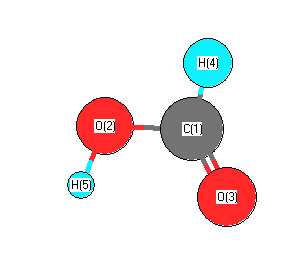 More geometry information
Calculated Bond Angles
| atom1 |
atom2 |
atom3 |
angle |
|
atom1 |
atom2 |
atom3 |
angle |
| C1 |
O2 |
H5 |
107.094 |
|
O2 |
C1 |
O3 |
124.895 |
| O2 |
C1 |
H4 |
110.129 |
|
O3 |
C1 |
H4 |
124.976 |
Electronic energy levels
Charges, Dipole, Quadrupole and Polarizability
Jump to
S1C1
Energy calculated at MP3=FULL/TZVP
| | hartrees |
|---|
| Energy at 0K | -189.413119 |
| Energy at 298.15K | |
| HF Energy | -188.827613 |
| Nuclear repulsion energy | 70.368293 |
The energy at 298.15K was derived from the energy at 0K
and an integrated heat capacity that used the calculated vibrational frequencies.
Vibrational Frequencies calculated at MP3=FULL/TZVP
| Mode Number |
Symmetry |
Frequency
(cm-1) |
Scaled Frequency
(cm-1) |
IR Intensities
(km mol-1) |
Raman Act
(Å4/u) |
Dep P |
Dep U |
|---|
| 1 |
A' |
3930 |
3670 |
71.82 |
|
|
|
| 2 |
A' |
3069 |
2866 |
70.54 |
|
|
|
| 3 |
A' |
1947 |
1817 |
312.27 |
|
|
|
| 4 |
A' |
1498 |
1399 |
1.38 |
|
|
|
| 5 |
A' |
1334 |
1245 |
336.51 |
|
|
|
| 6 |
A' |
1155 |
1078 |
55.78 |
|
|
|
| 7 |
A' |
686 |
641 |
12.40 |
|
|
|
| 8 |
A" |
1068 |
998 |
0.53 |
|
|
|
| 9 |
A" |
493 |
460 |
102.68 |
|
|
|
Unscaled Zero Point Vibrational Energy (zpe) 7589.8 cm
-1
Scaled (by 0.9337) Zero Point Vibrational Energy (zpe) 7086.6 cm
-1
See section
III.C.1 List or set vibrational scaling factors
to change the scale factors used here.
See section
III.C.2
Calculate a vibrational scaling factor for a given set of molecules
to determine the least squares best scaling factor.
Geometric Data calculated at MP3=FULL/TZVP
Point Group is Cs
Cartesians (Å)
| Atom |
x (Å) |
y (Å) |
z (Å) |
|---|
| C1 |
0.000 |
0.383 |
0.000 |
| O2 |
-0.891 |
-0.625 |
0.000 |
| O3 |
1.171 |
0.198 |
0.000 |
| H4 |
-0.459 |
1.381 |
0.000 |
| H5 |
-1.778 |
-0.259 |
0.000 |
Atom - Atom Distances (Å)
| |
C1 |
O2 |
O3 |
H4 |
H5 |
| C1 | | 1.3461 | 1.1855 | 1.0978 | 1.8901 |
O2 | 1.3461 | | 2.2206 | 2.0523 | 0.9593 | O3 | 1.1855 | 2.2206 | | 2.0135 | 2.9839 | H4 | 1.0978 | 2.0523 | 2.0135 | | 2.1043 | H5 | 1.8901 | 0.9593 | 2.9839 | 2.1043 | |
More geometry information
Calculated Bond Angles
| atom1 |
atom2 |
atom3 |
angle |
|
atom1 |
atom2 |
atom3 |
angle |
| C1 |
O2 |
H5 |
108.991 |
|
O2 |
C1 |
O3 |
122.474 |
| O2 |
C1 |
H4 |
113.843 |
|
O3 |
C1 |
H4 |
123.684 |
Electronic energy levels
Charges, Dipole, Quadrupole and Polarizability
