Jump to
S1C2
Energy calculated at B2PLYP=FULLultrafine/TZVP
| | hartrees |
|---|
| Energy at 0K | -499.283217 |
| Energy at 298.15K | |
| HF Energy | -499.182218 |
| Nuclear repulsion energy | 45.165215 |
The energy at 298.15K was derived from the energy at 0K
and an integrated heat capacity that used the calculated vibrational frequencies.
Vibrational Frequencies calculated at B2PLYP=FULLultrafine/TZVP
| Mode Number |
Symmetry |
Frequency
(cm-1) |
Scaled Frequency
(cm-1) |
IR Intensities
(km mol-1) |
Raman Act
(Å4/u) |
Dep P |
Dep U |
|---|
| 1 |
A' |
3212 |
3212 |
6.78 |
108.46 |
0.13 |
0.23 |
| 2 |
A' |
1445 |
1445 |
12.90 |
1.11 |
0.70 |
0.82 |
| 3 |
A' |
837 |
837 |
40.42 |
7.30 |
0.30 |
0.46 |
| 4 |
A' |
98 |
98 |
95.94 |
0.00 |
0.74 |
0.85 |
| 5 |
A" |
3370 |
3370 |
0.00 |
47.24 |
0.75 |
0.86 |
| 6 |
A" |
1016 |
1016 |
0.40 |
3.21 |
0.75 |
0.86 |
Unscaled Zero Point Vibrational Energy (zpe) 4988.5 cm
-1
Scaled (by 1) Zero Point Vibrational Energy (zpe) 4988.5 cm
-1
See section
III.C.1 List or set vibrational scaling factors
to change the scale factors used here.
See section
III.C.2
Calculate a vibrational scaling factor for a given set of molecules
to determine the least squares best scaling factor.
Geometric Data calculated at B2PLYP=FULLultrafine/TZVP
Point Group is Cs
Cartesians (Å)
| Atom |
x (Å) |
y (Å) |
z (Å) |
|---|
| C1 |
0.000 |
1.125 |
0.000 |
| Cl2 |
0.000 |
-0.588 |
0.000 |
| H3 |
-0.001 |
1.623 |
0.952 |
| H4 |
-0.001 |
1.623 |
-0.952 |
Atom - Atom Distances (Å)
| |
C1 |
Cl2 |
H3 |
H4 |
| C1 | | 1.7134 | 1.0742 | 1.0742 |
Cl2 | 1.7134 | | 2.4074 | 2.4074 | H3 | 1.0742 | 2.4074 | | 1.9039 | H4 | 1.0742 | 2.4074 | 1.9039 | |
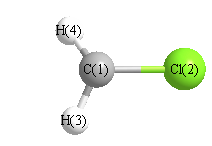 More geometry information
Calculated Bond Angles
| atom1 |
atom2 |
atom3 |
angle |
|
atom1 |
atom2 |
atom3 |
angle |
| Br2 |
C1 |
H3 |
117.605 |
|
Br2 |
C1 |
H4 |
117.605 |
| H3 |
C1 |
H4 |
124.790 |
|
Electronic energy levels
Charges, Dipole, Quadrupole and Polarizability
Jump to
S1C1
Energy calculated at B2PLYP=FULLultrafine/TZVP
| | hartrees |
|---|
| Energy at 0K | -499.283217 |
| Energy at 298.15K | |
| HF Energy | -499.182217 |
| Nuclear repulsion energy | 45.163993 |
The energy at 298.15K was derived from the energy at 0K
and an integrated heat capacity that used the calculated vibrational frequencies.
Vibrational Frequencies calculated at B2PLYP=FULLultrafine/TZVP
| Mode Number |
Symmetry |
Frequency
(cm-1) |
Scaled Frequency
(cm-1) |
IR Intensities
(km mol-1) |
Raman Act
(Å4/u) |
Dep P |
Dep U |
|---|
| 1 |
A1 |
3211 |
3211 |
6.78 |
108.53 |
0.13 |
0.23 |
| 2 |
A1 |
1445 |
1445 |
12.91 |
|
|
|
| 3 |
A1 |
837 |
837 |
40.38 |
|
|
|
| 4 |
B1 |
102 |
102 |
95.89 |
|
|
|
| 5 |
B2 |
3369 |
3369 |
0.01 |
|
|
|
| 6 |
B2 |
1016 |
1016 |
0.40 |
|
|
|
Unscaled Zero Point Vibrational Energy (zpe) 4990.5 cm
-1
Scaled (by 1) Zero Point Vibrational Energy (zpe) 4990.5 cm
-1
See section
III.C.1 List or set vibrational scaling factors
to change the scale factors used here.
See section
III.C.2
Calculate a vibrational scaling factor for a given set of molecules
to determine the least squares best scaling factor.
Geometric Data calculated at B2PLYP=FULLultrafine/TZVP
Point Group is C2v
Cartesians (Å)
| Atom |
x (Å) |
y (Å) |
z (Å) |
|---|
| C1 |
0.000 |
0.000 |
-1.125 |
| Cl2 |
0.000 |
0.000 |
0.588 |
| H3 |
0.000 |
0.952 |
-1.624 |
| H4 |
0.000 |
-0.952 |
-1.624 |
Atom - Atom Distances (Å)
| |
C1 |
Cl2 |
H3 |
H4 |
| C1 | | 1.7134 | 1.0743 | 1.0743 |
Cl2 | 1.7134 | | 2.4078 | 2.4078 | H3 | 1.0743 | 2.4078 | | 1.9035 | H4 | 1.0743 | 2.4078 | 1.9035 | |
More geometry information
Calculated Bond Angles
| atom1 |
atom2 |
atom3 |
angle |
|
atom1 |
atom2 |
atom3 |
angle |
| Br2 |
C1 |
H3 |
117.634 |
|
Br2 |
C1 |
H4 |
117.634 |
| H3 |
C1 |
H4 |
124.731 |
|
Electronic energy levels
Charges, Dipole, Quadrupole and Polarizability
