Jump to
S1C2
S1C3
Energy calculated at BLYP/daug-cc-pVTZ
| | hartrees |
|---|
| Energy at 0K | -1592.813167 |
| Energy at 298.15K | |
| HF Energy | -1592.813167 |
| Nuclear repulsion energy | 341.415439 |
The energy at 298.15K was derived from the energy at 0K
and an integrated heat capacity that used the calculated vibrational frequencies.
Vibrational Frequencies calculated at BLYP/daug-cc-pVTZ
| Mode Number |
Symmetry |
Frequency
(cm-1) |
Scaled Frequency
(cm-1) |
IR Intensities
(km mol-1) |
Raman Act
(Å4/u) |
Dep P |
Dep U |
|---|
| 1 |
A1 |
468 |
468 |
0.00 |
43.83 |
0.04 |
0.08 |
| 2 |
A1 |
189 |
189 |
0.00 |
1.10 |
0.72 |
0.84 |
| 3 |
B1 |
385 |
385 |
0.00 |
20.90 |
0.75 |
0.86 |
| 4 |
B2 |
277 |
277 |
0.08 |
9.23 |
0.75 |
0.86 |
| 5 |
E |
363 |
363 |
0.33 |
3.10 |
0.75 |
0.86 |
| 5 |
E |
363 |
363 |
0.33 |
3.10 |
0.75 |
0.86 |
Unscaled Zero Point Vibrational Energy (zpe) 1022.2 cm
-1
Scaled (by 1) Zero Point Vibrational Energy (zpe) 1022.2 cm
-1
See section
III.C.1 List or set vibrational scaling factors
to change the scale factors used here.
See section
III.C.2
Calculate a vibrational scaling factor for a given set of molecules
to determine the least squares best scaling factor.
Geometric Data calculated at BLYP/daug-cc-pVTZ
Point Group is D2d
Cartesians (Å)
| Atom |
x (Å) |
y (Å) |
z (Å) |
|---|
| S1 |
0.000 |
1.469 |
0.321 |
| S2 |
0.000 |
-1.469 |
0.321 |
| S3 |
-1.469 |
0.000 |
-0.321 |
| S4 |
1.469 |
0.000 |
-0.321 |
Atom - Atom Distances (Å)
| |
S1 |
S2 |
S3 |
S4 |
| S1 | | 2.9379 | 2.1745 | 2.1745 |
S2 | 2.9379 | | 2.1745 | 2.1745 | S3 | 2.1745 | 2.1745 | | 2.9379 | S4 | 2.1745 | 2.1745 | 2.9379 | |
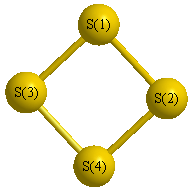 More geometry information
Calculated Bond Angles
| atom1 |
atom2 |
atom3 |
angle |
|
atom1 |
atom2 |
atom3 |
angle |
| S1 |
S2 |
S4 |
47.505 |
|
S1 |
S3 |
S4 |
47.505 |
| S2 |
S1 |
S3 |
47.505 |
|
S2 |
S4 |
S3 |
47.505 |
Electronic energy levels
Charges, Dipole, Quadrupole and Polarizability
Charges from optimized geometry at BLYP/daug-cc-pVTZ
Charges (e)
| Number |
Element |
Mulliken |
CHELPG |
AIM |
ESP |
| 1 |
S |
0.000 |
|
|
|
| 2 |
S |
0.000 |
|
|
|
| 3 |
S |
0.000 |
|
|
|
| 4 |
S |
0.000 |
|
|
|
Electric dipole moments
Electric dipole components in Debye
(What's a Debye? See section
VII.A.3)
| |
x |
y |
z |
Total |
| |
0.000 |
0.000 |
0.000 |
0.000 |
| CHELPG |
|
|
|
|
| AIM |
|
|
|
|
| ESP |
|
|
|
|
Electric Quadrupole moment
Quadrupole components in D Å
| Primitive |
|---|
| | x | y | z |
|---|
| x |
-49.549 |
0.000 |
0.000 |
| y |
0.000 |
-49.549 |
0.000 |
| z |
0.000 |
0.000 |
-54.931 |
|
| Traceless |
|---|
| | x | y | z |
|---|
| x |
2.691 |
0.000 |
0.000 |
| y |
0.000 |
2.691 |
0.000 |
| z |
0.000 |
0.000 |
-5.382 |
|
| Polar |
|---|
| 3z2-r2 | -10.764 |
|---|
| x2-y2 | 0.000 |
|---|
| xy | 0.000 |
|---|
| xz | 0.000 |
|---|
| yz | 0.000 |
|---|
|
Polarizabilities
Components of the polarizability tensor.
Units are
Å
3 (Angstrom cubed)
Change units.
| |
x |
y |
z |
| x |
13.873 |
0.000 |
0.000 |
| y |
0.000 |
13.873 |
0.000 |
| z |
0.000 |
0.000 |
9.726 |
<r2> (average value of r
2) Å
2
| <r2> |
176.775 |
| (<r2>)1/2 |
13.296 |
Jump to
S1C1
S1C3
Energy calculated at BLYP/daug-cc-pVTZ
| | hartrees |
|---|
| Energy at 0K | -1592.857374 |
| Energy at 298.15K | |
| HF Energy | -1592.857374 |
| Nuclear repulsion energy | 323.295415 |
The energy at 298.15K was derived from the energy at 0K
and an integrated heat capacity that used the calculated vibrational frequencies.
Vibrational Frequencies calculated at BLYP/daug-cc-pVTZ
| Mode Number |
Symmetry |
Frequency
(cm-1) |
Scaled Frequency
(cm-1) |
IR Intensities
(km mol-1) |
Raman Act
(Å4/u) |
Dep P |
Dep U |
|---|
| 1 |
A1 |
643 |
643 |
2.91 |
34.16 |
0.07 |
0.14 |
| 2 |
A1 |
277 |
277 |
4.50 |
30.87 |
0.15 |
0.26 |
| 3 |
A1 |
81 |
81 |
1.58 |
6.73 |
0.41 |
0.58 |
| 4 |
A2 |
201 |
201 |
0.00 |
0.05 |
0.75 |
0.86 |
| 5 |
B2 |
616 |
616 |
94.97 |
2.48 |
0.75 |
0.86 |
| 6 |
B2 |
305 |
305 |
0.00 |
8.76 |
0.75 |
0.86 |
Unscaled Zero Point Vibrational Energy (zpe) 1060.8 cm
-1
Scaled (by 1) Zero Point Vibrational Energy (zpe) 1060.8 cm
-1
See section
III.C.1 List or set vibrational scaling factors
to change the scale factors used here.
See section
III.C.2
Calculate a vibrational scaling factor for a given set of molecules
to determine the least squares best scaling factor.
Geometric Data calculated at BLYP/daug-cc-pVTZ
Point Group is C2v
Cartesians (Å)
| Atom |
x (Å) |
y (Å) |
z (Å) |
|---|
| S1 |
0.000 |
1.138 |
0.944 |
| S2 |
0.000 |
-1.138 |
0.944 |
| S3 |
0.000 |
1.589 |
-0.944 |
| S4 |
0.000 |
-1.589 |
-0.944 |
Atom - Atom Distances (Å)
| |
S1 |
S2 |
S3 |
S4 |
| S1 | | 2.2770 | 1.9420 | 3.3179 |
S2 | 2.2770 | | 3.3179 | 1.9420 | S3 | 1.9420 | 3.3179 | | 3.1782 | S4 | 3.3179 | 1.9420 | 3.1782 | |
More geometry information
Calculated Bond Angles
| atom1 |
atom2 |
atom3 |
angle |
|
atom1 |
atom2 |
atom3 |
angle |
| S1 |
S2 |
S4 |
103.417 |
|
S1 |
S3 |
S4 |
76.583 |
| S2 |
S1 |
S3 |
103.417 |
|
S2 |
S4 |
S3 |
76.583 |
Electronic energy levels
Charges, Dipole, Quadrupole and Polarizability
Charges from optimized geometry at BLYP/daug-cc-pVTZ
Charges (e)
| Number |
Element |
Mulliken |
CHELPG |
AIM |
ESP |
| 1 |
S |
0.201 |
|
|
|
| 2 |
S |
0.201 |
|
|
|
| 3 |
S |
-0.201 |
|
|
|
| 4 |
S |
-0.201 |
|
|
|
Electric dipole moments
Electric dipole components in Debye
(What's a Debye? See section
VII.A.3)
| |
x |
y |
z |
Total |
| |
0.000 |
0.000 |
1.007 |
1.007 |
| CHELPG |
|
|
|
|
| AIM |
|
|
|
|
| ESP |
|
|
|
|
Electric Quadrupole moment
Quadrupole components in D Å
| Primitive |
|---|
| | x | y | z |
|---|
| x |
-52.007 |
0.000 |
0.000 |
| y |
0.000 |
-53.532 |
0.000 |
| z |
0.000 |
0.000 |
-48.972 |
|
| Traceless |
|---|
| | x | y | z |
|---|
| x |
-0.755 |
0.000 |
0.000 |
| y |
0.000 |
-3.043 |
0.000 |
| z |
0.000 |
0.000 |
3.797 |
|
| Polar |
|---|
| 3z2-r2 | 7.595 |
|---|
| x2-y2 | 1.525 |
|---|
| xy | 0.000 |
|---|
| xz | 0.000 |
|---|
| yz | 0.000 |
|---|
|
Polarizabilities
Components of the polarizability tensor.
Units are
Å
3 (Angstrom cubed)
Change units.
| |
x |
y |
z |
| x |
8.718 |
0.000 |
0.000 |
| y |
0.000 |
20.882 |
0.000 |
| z |
0.000 |
0.000 |
14.247 |
<r2> (average value of r
2) Å
2
| <r2> |
211.548 |
| (<r2>)1/2 |
14.545 |
Jump to
S1C1
S1C2
Energy calculated at BLYP/daug-cc-pVTZ
| | hartrees |
|---|
| Energy at 0K | -1592.856112 |
| Energy at 298.15K | |
| HF Energy | -1592.856112 |
| Nuclear repulsion energy | 325.888184 |
The energy at 298.15K was derived from the energy at 0K
and an integrated heat capacity that used the calculated vibrational frequencies.
Vibrational Frequencies calculated at BLYP/daug-cc-pVTZ
| Mode Number |
Symmetry |
Frequency
(cm-1) |
Scaled Frequency
(cm-1) |
IR Intensities
(km mol-1) |
Raman Act
(Å4/u) |
Dep P |
Dep U |
|---|
| 1 |
Ag |
669 |
669 |
0.00 |
37.53 |
0.09 |
0.17 |
| 2 |
Ag |
251 |
251 |
0.00 |
29.41 |
0.17 |
0.29 |
| 3 |
Au |
222 |
222 |
0.00 |
0.00 |
0.00 |
0.00 |
| 4 |
B1u |
625 |
625 |
93.54 |
0.00 |
0.00 |
0.00 |
| 5 |
B2u |
82i |
82i |
9.63 |
0.00 |
0.00 |
0.00 |
| 6 |
B3g |
307 |
307 |
0.00 |
8.73 |
0.75 |
0.86 |
Unscaled Zero Point Vibrational Energy (zpe) 996.0 cm
-1
Scaled (by 1) Zero Point Vibrational Energy (zpe) 996.0 cm
-1
See section
III.C.1 List or set vibrational scaling factors
to change the scale factors used here.
See section
III.C.2
Calculate a vibrational scaling factor for a given set of molecules
to determine the least squares best scaling factor.
Geometric Data calculated at BLYP/daug-cc-pVTZ
Point Group is D2h
Cartesians (Å)
| Atom |
x (Å) |
y (Å) |
z (Å) |
|---|
| S1 |
0.000 |
0.966 |
1.318 |
| S2 |
0.000 |
0.966 |
-1.318 |
| S3 |
0.000 |
-0.966 |
1.318 |
| S4 |
0.000 |
-0.966 |
-1.318 |
Atom - Atom Distances (Å)
| |
S1 |
S2 |
S3 |
S4 |
| S1 | | 2.6360 | 1.9324 | 3.2684 |
S2 | 2.6360 | | 3.2684 | 1.9324 | S3 | 1.9324 | 3.2684 | | 2.6360 | S4 | 3.2684 | 1.9324 | 2.6360 | |
More geometry information
Calculated Bond Angles
| atom1 |
atom2 |
atom3 |
angle |
|
atom1 |
atom2 |
atom3 |
angle |
| S1 |
S2 |
S4 |
90.000 |
|
S1 |
S3 |
S4 |
90.000 |
| S2 |
S1 |
S3 |
90.000 |
|
S2 |
S4 |
S3 |
90.000 |
Electronic energy levels
Charges, Dipole, Quadrupole and Polarizability
Charges from optimized geometry at BLYP/daug-cc-pVTZ
Charges (e)
| Number |
Element |
Mulliken |
CHELPG |
AIM |
ESP |
| 1 |
S |
0.000 |
|
|
|
| 2 |
S |
0.000 |
|
|
|
| 3 |
S |
0.000 |
|
|
|
| 4 |
S |
0.000 |
|
|
|
Electric dipole moments
Electric dipole components in Debye
(What's a Debye? See section
VII.A.3)
| |
x |
y |
z |
Total |
| |
0.000 |
0.000 |
0.000 |
0.000 |
| CHELPG |
|
|
|
|
| AIM |
|
|
|
|
| ESP |
|
|
|
|
Electric Quadrupole moment
Quadrupole components in D Å
| Primitive |
|---|
| | x | y | z |
|---|
| x |
-52.137 |
0.000 |
0.000 |
| y |
0.000 |
-48.502 |
0.000 |
| z |
0.000 |
0.000 |
-53.342 |
|
| Traceless |
|---|
| | x | y | z |
|---|
| x |
-1.215 |
0.000 |
0.000 |
| y |
0.000 |
4.237 |
0.000 |
| z |
0.000 |
0.000 |
-3.022 |
|
| Polar |
|---|
| 3z2-r2 | -6.045 |
|---|
| x2-y2 | -3.635 |
|---|
| xy | 0.000 |
|---|
| xz | 0.000 |
|---|
| yz | 0.000 |
|---|
|
Polarizabilities
Components of the polarizability tensor.
Units are
Å
3 (Angstrom cubed)
Change units.
| |
x |
y |
z |
| x |
8.703 |
0.000 |
0.000 |
| y |
0.000 |
14.491 |
0.000 |
| z |
0.000 |
0.000 |
20.090 |
<r2> (average value of r
2) Å
2
| <r2> |
202.981 |
| (<r2>)1/2 |
14.247 |
