Jump to
S1C2
S1C3
Energy calculated at B1B95/daug-cc-pVTZ
| | hartrees |
|---|
| Energy at 0K | -1593.007387 |
| Energy at 298.15K | |
| HF Energy | -1593.007387 |
| Nuclear repulsion energy | 353.260108 |
The energy at 298.15K was derived from the energy at 0K
and an integrated heat capacity that used the calculated vibrational frequencies.
Vibrational Frequencies calculated at B1B95/daug-cc-pVTZ
| Mode Number |
Symmetry |
Frequency
(cm-1) |
Scaled Frequency
(cm-1) |
IR Intensities
(km mol-1) |
Raman Act
(Å4/u) |
Dep P |
Dep U |
|---|
| 1 |
A1 |
542 |
542 |
0.00 |
39.60 |
0.04 |
0.08 |
| 2 |
A1 |
212 |
212 |
0.00 |
1.11 |
0.73 |
0.84 |
| 3 |
B1 |
478 |
478 |
0.00 |
15.93 |
0.75 |
0.86 |
| 4 |
B2 |
301 |
301 |
0.01 |
6.54 |
0.75 |
0.86 |
| 5 |
E |
455 |
455 |
0.00 |
3.14 |
0.75 |
0.86 |
| 5 |
E |
455 |
455 |
0.00 |
3.14 |
0.75 |
0.86 |
Unscaled Zero Point Vibrational Energy (zpe) 1221.2 cm
-1
Scaled (by 1) Zero Point Vibrational Energy (zpe) 1221.2 cm
-1
See section
III.C.1 List or set vibrational scaling factors
to change the scale factors used here.
See section
III.C.2
Calculate a vibrational scaling factor for a given set of molecules
to determine the least squares best scaling factor.
Geometric Data calculated at B1B95/daug-cc-pVTZ
Point Group is D2d
Cartesians (Å)
| Atom |
x (Å) |
y (Å) |
z (Å) |
|---|
| S1 |
0.000 |
1.416 |
0.323 |
| S2 |
0.000 |
-1.416 |
0.323 |
| S3 |
-1.416 |
0.000 |
-0.323 |
| S4 |
1.416 |
0.000 |
-0.323 |
Atom - Atom Distances (Å)
| |
S1 |
S2 |
S3 |
S4 |
| S1 | | 2.8317 | 2.1037 | 2.1037 |
S2 | 2.8317 | | 2.1037 | 2.1037 | S3 | 2.1037 | 2.1037 | | 2.8317 | S4 | 2.1037 | 2.1037 | 2.8317 | |
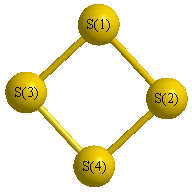 More geometry information
Calculated Bond Angles
| atom1 |
atom2 |
atom3 |
angle |
|
atom1 |
atom2 |
atom3 |
angle |
| S1 |
S2 |
S4 |
47.699 |
|
S1 |
S3 |
S4 |
47.699 |
| S2 |
S1 |
S3 |
47.699 |
|
S2 |
S4 |
S3 |
47.699 |
Electronic energy levels
Charges, Dipole, Quadrupole and Polarizability
Charges from optimized geometry at B1B95/daug-cc-pVTZ
Charges (e)
| Number |
Element |
Mulliken |
CHELPG |
AIM |
ESP |
| 1 |
S |
0.000 |
|
|
|
| 2 |
S |
0.000 |
|
|
|
| 3 |
S |
0.000 |
|
|
|
| 4 |
S |
0.000 |
|
|
|
Electric dipole moments
Electric dipole components in Debye
(What's a Debye? See section
VII.A.3)
| |
x |
y |
z |
Total |
| |
0.000 |
0.000 |
0.000 |
0.000 |
| CHELPG |
|
|
|
|
| AIM |
|
|
|
|
| ESP |
|
|
|
|
Electric Quadrupole moment
Quadrupole components in D Å
| Primitive |
|---|
| | x | y | z |
|---|
| x |
-48.768 |
0.000 |
0.000 |
| y |
0.000 |
-48.768 |
0.000 |
| z |
0.000 |
0.000 |
-53.999 |
|
| Traceless |
|---|
| | x | y | z |
|---|
| x |
2.616 |
0.000 |
0.000 |
| y |
0.000 |
2.616 |
0.000 |
| z |
0.000 |
0.000 |
-5.231 |
|
| Polar |
|---|
| 3z2-r2 | -10.462 |
|---|
| x2-y2 | 0.000 |
|---|
| xy | 0.000 |
|---|
| xz | 0.000 |
|---|
| yz | 0.000 |
|---|
|
Polarizabilities
Components of the polarizability tensor.
Units are
Å
3 (Angstrom cubed)
Change units.
| |
x |
y |
z |
| x |
12.660 |
0.000 |
0.000 |
| y |
0.000 |
12.660 |
0.000 |
| z |
0.000 |
0.000 |
8.999 |
<r2> (average value of r
2) Å
2
| <r2> |
166.508 |
| (<r2>)1/2 |
12.904 |
Jump to
S1C1
S1C3
Energy calculated at B1B95/daug-cc-pVTZ
| | hartrees |
|---|
| Energy at 0K | -1593.027371 |
| Energy at 298.15K | |
| HF Energy | -1593.027371 |
| Nuclear repulsion energy | 335.158483 |
The energy at 298.15K was derived from the energy at 0K
and an integrated heat capacity that used the calculated vibrational frequencies.
Vibrational Frequencies calculated at B1B95/daug-cc-pVTZ
| Mode Number |
Symmetry |
Frequency
(cm-1) |
Scaled Frequency
(cm-1) |
IR Intensities
(km mol-1) |
Raman Act
(Å4/u) |
Dep P |
Dep U |
|---|
| 1 |
A1 |
703 |
703 |
6.78 |
30.58 |
0.06 |
0.11 |
| 2 |
A1 |
407 |
407 |
5.08 |
40.16 |
0.14 |
0.25 |
| 3 |
A1 |
119 |
119 |
0.48 |
10.54 |
0.37 |
0.54 |
| 4 |
A2 |
220 |
220 |
0.00 |
0.14 |
0.75 |
0.86 |
| 5 |
B2 |
673 |
673 |
122.12 |
3.82 |
0.75 |
0.86 |
| 6 |
B2 |
339 |
339 |
0.16 |
7.70 |
0.75 |
0.86 |
Unscaled Zero Point Vibrational Energy (zpe) 1230.5 cm
-1
Scaled (by 1) Zero Point Vibrational Energy (zpe) 1230.5 cm
-1
See section
III.C.1 List or set vibrational scaling factors
to change the scale factors used here.
See section
III.C.2
Calculate a vibrational scaling factor for a given set of molecules
to determine the least squares best scaling factor.
Geometric Data calculated at B1B95/daug-cc-pVTZ
Point Group is C2v
Cartesians (Å)
| Atom |
x (Å) |
y (Å) |
z (Å) |
|---|
| S1 |
0.000 |
1.045 |
0.914 |
| S2 |
0.000 |
-1.045 |
0.914 |
| S3 |
0.000 |
1.573 |
-0.914 |
| S4 |
0.000 |
-1.573 |
-0.914 |
Atom - Atom Distances (Å)
| |
S1 |
S2 |
S3 |
S4 |
| S1 | | 2.0895 | 1.9027 | 3.1927 |
S2 | 2.0895 | | 3.1927 | 1.9027 | S3 | 1.9027 | 3.1927 | | 3.1457 | S4 | 3.1927 | 1.9027 | 3.1457 | |
More geometry information
Calculated Bond Angles
| atom1 |
atom2 |
atom3 |
angle |
|
atom1 |
atom2 |
atom3 |
angle |
| S1 |
S2 |
S4 |
106.113 |
|
S1 |
S3 |
S4 |
73.887 |
| S2 |
S1 |
S3 |
106.113 |
|
S2 |
S4 |
S3 |
73.887 |
Electronic energy levels
Charges, Dipole, Quadrupole and Polarizability
Charges from optimized geometry at B1B95/daug-cc-pVTZ
Charges (e)
| Number |
Element |
Mulliken |
CHELPG |
AIM |
ESP |
| 1 |
S |
0.269 |
|
|
|
| 2 |
S |
0.269 |
|
|
|
| 3 |
S |
-0.269 |
|
|
|
| 4 |
S |
-0.269 |
|
|
|
Electric dipole moments
Electric dipole components in Debye
(What's a Debye? See section
VII.A.3)
| |
x |
y |
z |
Total |
| |
0.000 |
0.000 |
1.361 |
1.361 |
| CHELPG |
|
|
|
|
| AIM |
|
|
|
|
| ESP |
|
|
|
|
Electric Quadrupole moment
Quadrupole components in D Å
| Primitive |
|---|
| | x | y | z |
|---|
| x |
-51.132 |
0.000 |
0.000 |
| y |
0.000 |
-52.987 |
0.000 |
| z |
0.000 |
0.000 |
-48.365 |
|
| Traceless |
|---|
| | x | y | z |
|---|
| x |
-0.456 |
0.000 |
0.000 |
| y |
0.000 |
-3.239 |
0.000 |
| z |
0.000 |
0.000 |
3.695 |
|
| Polar |
|---|
| 3z2-r2 | 7.390 |
|---|
| x2-y2 | 1.855 |
|---|
| xy | 0.000 |
|---|
| xz | 0.000 |
|---|
| yz | 0.000 |
|---|
|
Polarizabilities
Components of the polarizability tensor.
Units are
Å
3 (Angstrom cubed)
Change units.
| |
x |
y |
z |
| x |
8.196 |
0.000 |
0.000 |
| y |
0.000 |
19.722 |
0.000 |
| z |
0.000 |
0.000 |
13.110 |
<r2> (average value of r
2) Å
2
| <r2> |
199.299 |
| (<r2>)1/2 |
14.117 |
Jump to
S1C1
S1C2
Energy calculated at B1B95/daug-cc-pVTZ
| | hartrees |
|---|
| Energy at 0K | -1593.020937 |
| Energy at 298.15K | |
| HF Energy | -1593.020937 |
| Nuclear repulsion energy | 338.967513 |
The energy at 298.15K was derived from the energy at 0K
and an integrated heat capacity that used the calculated vibrational frequencies.
Vibrational Frequencies calculated at B1B95/daug-cc-pVTZ
| Mode Number |
Symmetry |
Frequency
(cm-1) |
Scaled Frequency
(cm-1) |
IR Intensities
(km mol-1) |
Raman Act
(Å4/u) |
Dep P |
Dep U |
|---|
| 1 |
Ag |
759 |
759 |
0.00 |
35.79 |
0.09 |
0.16 |
| 2 |
Ag |
309 |
309 |
0.00 |
33.51 |
0.17 |
0.29 |
| 3 |
Au |
256 |
256 |
0.00 |
0.00 |
0.00 |
0.00 |
| 4 |
B1u |
699 |
699 |
127.90 |
0.00 |
0.00 |
0.00 |
| 5 |
B2u |
161i |
161i |
16.54 |
0.00 |
0.00 |
0.00 |
| 6 |
B3g |
344 |
344 |
0.00 |
8.39 |
0.75 |
0.86 |
Unscaled Zero Point Vibrational Energy (zpe) 1102.9 cm
-1
Scaled (by 1) Zero Point Vibrational Energy (zpe) 1102.9 cm
-1
See section
III.C.1 List or set vibrational scaling factors
to change the scale factors used here.
See section
III.C.2
Calculate a vibrational scaling factor for a given set of molecules
to determine the least squares best scaling factor.
Geometric Data calculated at B1B95/daug-cc-pVTZ
Point Group is D2h
Cartesians (Å)
| Atom |
x (Å) |
y (Å) |
z (Å) |
|---|
| S1 |
0.000 |
0.942 |
1.249 |
| S2 |
0.000 |
0.942 |
-1.249 |
| S3 |
0.000 |
-0.942 |
1.249 |
| S4 |
0.000 |
-0.942 |
-1.249 |
Atom - Atom Distances (Å)
| |
S1 |
S2 |
S3 |
S4 |
| S1 | | 2.4973 | 1.8834 | 3.1279 |
S2 | 2.4973 | | 3.1279 | 1.8834 | S3 | 1.8834 | 3.1279 | | 2.4973 | S4 | 3.1279 | 1.8834 | 2.4973 | |
More geometry information
Calculated Bond Angles
| atom1 |
atom2 |
atom3 |
angle |
|
atom1 |
atom2 |
atom3 |
angle |
| S1 |
S2 |
S4 |
90.000 |
|
S1 |
S3 |
S4 |
90.000 |
| S2 |
S1 |
S3 |
90.000 |
|
S2 |
S4 |
S3 |
90.000 |
Electronic energy levels
Charges, Dipole, Quadrupole and Polarizability
Charges from optimized geometry at B1B95/daug-cc-pVTZ
Charges (e)
| Number |
Element |
Mulliken |
CHELPG |
AIM |
ESP |
| 1 |
S |
0.000 |
|
|
|
| 2 |
S |
0.000 |
|
|
|
| 3 |
S |
0.000 |
|
|
|
| 4 |
S |
0.000 |
|
|
|
Electric dipole moments
Electric dipole components in Debye
(What's a Debye? See section
VII.A.3)
| |
x |
y |
z |
Total |
| |
0.000 |
0.000 |
0.000 |
0.000 |
| CHELPG |
|
|
|
|
| AIM |
|
|
|
|
| ESP |
|
|
|
|
Electric Quadrupole moment
Quadrupole components in D Å
| Primitive |
|---|
| | x | y | z |
|---|
| x |
-51.347 |
0.000 |
0.000 |
| y |
0.000 |
-47.698 |
0.000 |
| z |
0.000 |
0.000 |
-52.660 |
|
| Traceless |
|---|
| | x | y | z |
|---|
| x |
-1.168 |
0.000 |
0.000 |
| y |
0.000 |
4.306 |
0.000 |
| z |
0.000 |
0.000 |
-3.138 |
|
| Polar |
|---|
| 3z2-r2 | -6.275 |
|---|
| x2-y2 | -3.649 |
|---|
| xy | 0.000 |
|---|
| xz | 0.000 |
|---|
| yz | 0.000 |
|---|
|
Polarizabilities
Components of the polarizability tensor.
Units are
Å
3 (Angstrom cubed)
Change units.
| |
x |
y |
z |
| x |
8.166 |
0.000 |
0.000 |
| y |
0.000 |
13.498 |
0.000 |
| z |
0.000 |
0.000 |
18.782 |
<r2> (average value of r
2) Å
2
| <r2> |
188.124 |
| (<r2>)1/2 |
13.716 |
