Jump to
S1C2
Energy calculated at BLYP/daug-cc-pVTZ
| | hartrees |
|---|
| Energy at 0K | -189.154805 |
| Energy at 298.15K | -189.155834 |
| HF Energy | -189.154805 |
| Nuclear repulsion energy | 62.545050 |
The energy at 298.15K was derived from the energy at 0K
and an integrated heat capacity that used the calculated vibrational frequencies.
Vibrational Frequencies calculated at BLYP/daug-cc-pVTZ
| Mode Number |
Symmetry |
Frequency
(cm-1) |
Scaled Frequency
(cm-1) |
IR Intensities
(km mol-1) |
Raman Act
(Å4/u) |
Dep P |
Dep U |
|---|
| 1 |
A' |
3378 |
3378 |
5.09 |
|
|
|
| 2 |
A' |
1770 |
1770 |
297.74 |
|
|
|
| 3 |
A' |
1247 |
1247 |
2.22 |
|
|
|
| 4 |
A' |
987 |
987 |
132.58 |
|
|
|
| 5 |
A' |
566 |
566 |
23.83 |
|
|
|
| 6 |
A" |
565 |
565 |
90.86 |
|
|
|
Unscaled Zero Point Vibrational Energy (zpe) 4256.1 cm
-1
Scaled (by 1) Zero Point Vibrational Energy (zpe) 4256.1 cm
-1
See section
III.C.1 List or set vibrational scaling factors
to change the scale factors used here.
See section
III.C.2
Calculate a vibrational scaling factor for a given set of molecules
to determine the least squares best scaling factor.
Geometric Data calculated at BLYP/daug-cc-pVTZ
Point Group is Cs
Cartesians (Å)
| Atom |
x (Å) |
y (Å) |
z (Å) |
|---|
| C1 |
0.000 |
0.443 |
0.000 |
| O2 |
-1.071 |
-0.363 |
0.000 |
| O3 |
1.168 |
0.194 |
0.000 |
| H4 |
-0.776 |
-1.308 |
0.000 |
Atom - Atom Distances (Å)
| |
C1 |
O2 |
O3 |
H4 |
| C1 | | 1.3404 | 1.1945 | 1.9148 |
O2 | 1.3404 | | 2.3081 | 0.9899 | O3 | 1.1945 | 2.3081 | | 2.4574 | H4 | 1.9148 | 0.9899 | 2.4574 | |
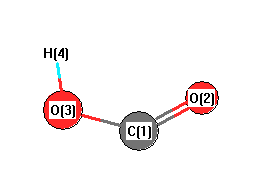 More geometry information
Calculated Bond Angles
| atom1 |
atom2 |
atom3 |
angle |
|
atom1 |
atom2 |
atom3 |
angle |
| C1 |
O2 |
H4 |
109.598 |
|
O2 |
C1 |
O3 |
131.073 |
Electronic energy levels
Charges, Dipole, Quadrupole and Polarizability
Charges from optimized geometry at BLYP/daug-cc-pVTZ
Charges (e)
| Number |
Element |
Mulliken |
CHELPG |
AIM |
ESP |
| 1 |
C |
0.497 |
|
|
|
| 2 |
O |
-0.246 |
|
|
|
| 3 |
O |
-0.472 |
|
|
|
| 4 |
H |
0.221 |
|
|
|
Electric dipole moments
Electric dipole components in Debye
(What's a Debye? See section
VII.A.3)
| |
x |
y |
z |
Total |
| |
-0.965 |
-1.633 |
0.000 |
1.897 |
| CHELPG |
|
|
|
|
| AIM |
|
|
|
|
| ESP |
|
|
|
|
Electric Quadrupole moment
Quadrupole components in D Å
| Primitive |
|---|
| | x | y | z |
|---|
| x |
-20.381 |
0.787 |
0.000 |
| y |
0.787 |
-14.563 |
0.000 |
| z |
0.000 |
0.000 |
-16.700 |
|
| Traceless |
|---|
| | x | y | z |
|---|
| x |
-4.749 |
0.787 |
0.000 |
| y |
0.787 |
3.977 |
0.000 |
| z |
0.000 |
0.000 |
0.772 |
|
| Polar |
|---|
| 3z2-r2 | 1.544 |
|---|
| x2-y2 | -5.818 |
|---|
| xy | 0.787 |
|---|
| xz | 0.000 |
|---|
| yz | 0.000 |
|---|
|
Polarizabilities
Components of the polarizability tensor.
Units are
Å
3 (Angstrom cubed)
Change units.
| |
x |
y |
z |
| x |
4.348 |
0.324 |
0.000 |
| y |
0.324 |
4.046 |
0.000 |
| z |
0.000 |
0.000 |
2.666 |
<r2> (average value of r
2) Å
2
| <r2> |
35.701 |
| (<r2>)1/2 |
5.975 |
Jump to
S1C1
Energy calculated at BLYP/daug-cc-pVTZ
| | hartrees |
|---|
| Energy at 0K | -189.158257 |
| Energy at 298.15K | -189.159284 |
| HF Energy | -189.158257 |
| Nuclear repulsion energy | 62.266624 |
The energy at 298.15K was derived from the energy at 0K
and an integrated heat capacity that used the calculated vibrational frequencies.
Vibrational Frequencies calculated at BLYP/daug-cc-pVTZ
| Mode Number |
Symmetry |
Frequency
(cm-1) |
Scaled Frequency
(cm-1) |
IR Intensities
(km mol-1) |
Raman Act
(Å4/u) |
Dep P |
Dep U |
|---|
| 1 |
A' |
3636 |
3636 |
94.99 |
|
|
|
| 2 |
A' |
1805 |
1805 |
209.86 |
|
|
|
| 3 |
A' |
1198 |
1198 |
197.82 |
|
|
|
| 4 |
A' |
1003 |
1003 |
91.39 |
|
|
|
| 5 |
A' |
592 |
592 |
5.41 |
|
|
|
| 6 |
A" |
539 |
539 |
80.43 |
|
|
|
Unscaled Zero Point Vibrational Energy (zpe) 4386.4 cm
-1
Scaled (by 1) Zero Point Vibrational Energy (zpe) 4386.4 cm
-1
See section
III.C.1 List or set vibrational scaling factors
to change the scale factors used here.
See section
III.C.2
Calculate a vibrational scaling factor for a given set of molecules
to determine the least squares best scaling factor.
Geometric Data calculated at BLYP/daug-cc-pVTZ
Point Group is Cs
Cartesians (Å)
| Atom |
x (Å) |
y (Å) |
z (Å) |
|---|
| C1 |
0.000 |
0.419 |
0.000 |
| O2 |
-0.950 |
-0.556 |
0.000 |
| O3 |
1.179 |
0.258 |
0.000 |
| H4 |
-1.827 |
-0.126 |
0.000 |
Atom - Atom Distances (Å)
| |
C1 |
O2 |
O3 |
H4 |
| C1 | | 1.3616 | 1.1895 | 1.9063 |
O2 | 1.3616 | | 2.2794 | 0.9762 | O3 | 1.1895 | 2.2794 | | 3.0298 | H4 | 1.9063 | 0.9762 | 3.0298 | |
More geometry information
Calculated Bond Angles
| atom1 |
atom2 |
atom3 |
angle |
|
atom1 |
atom2 |
atom3 |
angle |
| C1 |
O2 |
H4 |
108.130 |
|
O2 |
C1 |
O3 |
126.501 |
Electronic energy levels
Charges, Dipole, Quadrupole and Polarizability
Charges from optimized geometry at BLYP/daug-cc-pVTZ
Charges (e)
| Number |
Element |
Mulliken |
CHELPG |
AIM |
ESP |
| 1 |
C |
0.474 |
|
|
|
| 2 |
O |
-0.495 |
|
|
|
| 3 |
O |
-0.429 |
|
|
|
| 4 |
H |
0.449 |
|
|
|
Electric dipole moments
Electric dipole components in Debye
(What's a Debye? See section
VII.A.3)
| |
x |
y |
z |
Total |
| |
-2.827 |
0.232 |
0.000 |
2.836 |
| CHELPG |
|
|
|
|
| AIM |
|
|
|
|
| ESP |
|
|
|
|
Electric Quadrupole moment
Quadrupole components in D Å
| Primitive |
|---|
| | x | y | z |
|---|
| x |
-14.361 |
-0.839 |
0.000 |
| y |
-0.839 |
-18.446 |
0.000 |
| z |
0.000 |
0.000 |
-16.770 |
|
| Traceless |
|---|
| | x | y | z |
|---|
| x |
3.247 |
-0.839 |
0.000 |
| y |
-0.839 |
-2.881 |
0.000 |
| z |
0.000 |
0.000 |
-0.367 |
|
| Polar |
|---|
| 3z2-r2 | -0.733 |
|---|
| x2-y2 | 4.085 |
|---|
| xy | -0.839 |
|---|
| xz | 0.000 |
|---|
| yz | 0.000 |
|---|
|
Polarizabilities
Components of the polarizability tensor.
Units are
Å
3 (Angstrom cubed)
Change units.
| |
x |
y |
z |
| x |
4.811 |
0.212 |
0.000 |
| y |
0.212 |
3.380 |
0.000 |
| z |
0.000 |
0.000 |
2.720 |
<r2> (average value of r
2) Å
2
| <r2> |
36.073 |
| (<r2>)1/2 |
6.006 |
