All results from a given calculation for H2CO (Formaldehyde)
using model chemistry: QCISD(TQ)=FULL/daug-cc-pVTZ
19 10 17 12 22
States and conformations
| State |
Conformation |
minimum conformation |
conformer description |
state description |
| 1 |
1 |
yes |
C2V |
1A1 |
Energy calculated at QCISD(TQ)=FULL/daug-cc-pVTZ
| | hartrees |
|---|
| Energy at 0K | -114.377276 |
| Energy at 298.15K | |
| HF Energy | -113.914074 |
| Nuclear repulsion energy | 31.319659 |
The energy at 298.15K was derived from the energy at 0K
and an integrated heat capacity that used the calculated vibrational frequencies.
Vibrational Frequencies calculated at QCISD(TQ)=FULL/daug-cc-pVTZ
Geometric Data calculated at QCISD(TQ)=FULL/daug-cc-pVTZ
Point Group is C2v
Cartesians (Å)
| Atom |
x (Å) |
y (Å) |
z (Å) |
|---|
| O1 |
0.000 |
0.000 |
0.675 |
| C2 |
0.000 |
0.000 |
-0.531 |
| H3 |
0.000 |
0.935 |
-1.108 |
| H4 |
0.000 |
-0.935 |
-1.108 |
Atom - Atom Distances (Å)
| |
O1 |
C2 |
H3 |
H4 |
| O1 | | 1.2063 | 2.0141 | 2.0141 |
C2 | 1.2063 | | 1.0992 | 1.0992 | H3 | 2.0141 | 1.0992 | | 1.8706 | H4 | 2.0141 | 1.0992 | 1.8706 | |
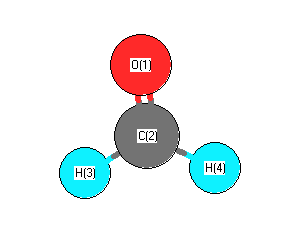 More geometry information
Calculated Bond Angles
| atom1 |
atom2 |
atom3 |
angle |
|
atom1 |
atom2 |
atom3 |
angle |
| O1 |
C2 |
H3 |
121.694 |
|
O1 |
C2 |
H4 |
121.694 |
| H3 |
C2 |
H4 |
116.612 |
|
Electronic energy levels
Charges, Dipole, Quadrupole and Polarizability
