Jump to
S1C2
Energy calculated at MP2=FULL/daug-cc-pVTZ
| | hartrees |
|---|
| Energy at 0K | -151.700758 |
| Energy at 298.15K | |
| HF Energy | -151.142992 |
| Nuclear repulsion energy | 52.890011 |
The energy at 298.15K was derived from the energy at 0K
and an integrated heat capacity that used the calculated vibrational frequencies.
Vibrational Frequencies calculated at MP2=FULL/daug-cc-pVTZ
| Mode Number |
Symmetry |
Frequency
(cm-1) |
Scaled Frequency
(cm-1) |
IR Intensities
(km mol-1) |
Raman Act
(Å4/u) |
Dep P |
Dep U |
|---|
| 1 |
Σ |
3483 |
3483 |
224.96 |
31.68 |
0.20 |
0.33 |
| 2 |
Σ |
2457 |
2457 |
1606.70 |
217.12 |
0.13 |
0.23 |
| 3 |
Σ |
1372 |
1372 |
23.50 |
9.00 |
0.04 |
0.07 |
| 4 |
Π |
614 |
614 |
0.07 |
0.78 |
0.75 |
0.86 |
| 4 |
Π |
592 |
592 |
12.45 |
4.82 |
0.75 |
0.86 |
| 5 |
Π |
458 |
458 |
23.65 |
0.21 |
0.75 |
0.86 |
| 5 |
Π |
453i |
453i |
136.75 |
9.64 |
0.75 |
0.86 |
Unscaled Zero Point Vibrational Energy (zpe) 4261.3 cm
-1
Scaled (by 1) Zero Point Vibrational Energy (zpe) 4261.3 cm
-1
See section
III.C.1 List or set vibrational scaling factors
to change the scale factors used here.
See section
III.C.2
Calculate a vibrational scaling factor for a given set of molecules
to determine the least squares best scaling factor.
Geometric Data calculated at MP2=FULL/daug-cc-pVTZ
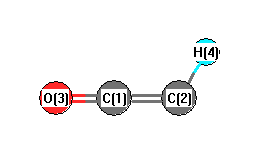
Point Group is C∞v
Cartesians (Å)
| Atom |
x (Å) |
y (Å) |
z (Å) |
|---|
| C1 |
0.000 |
0.000 |
0.029 |
| C2 |
0.000 |
0.000 |
-1.238 |
| O3 |
0.000 |
0.000 |
1.193 |
| H4 |
0.000 |
0.000 |
-2.294 |
Atom - Atom Distances (Å)
| |
C1 |
C2 |
O3 |
H4 |
| C1 | | 1.2675 | 1.1637 | 2.3240 |
C2 | 1.2675 | | 2.4312 | 1.0565 | O3 | 1.1637 | 2.4312 | | 3.4877 | H4 | 2.3240 | 1.0565 | 3.4877 | |
 More geometry information
Calculated Bond Angles
| atom1 |
atom2 |
atom3 |
angle |
|
atom1 |
atom2 |
atom3 |
angle |
| C1 |
C2 |
H4 |
180.000 |
|
C2 |
C1 |
O3 |
180.000 |
Electronic energy levels
Charges, Dipole, Quadrupole and Polarizability
Jump to
S1C1
Energy calculated at MP2=FULL/daug-cc-pVTZ
| | hartrees |
|---|
| Energy at 0K | -151.705479 |
| Energy at 298.15K | |
| HF Energy | -151.142261 |
| Nuclear repulsion energy | 52.514026 |
The energy at 298.15K was derived from the energy at 0K
and an integrated heat capacity that used the calculated vibrational frequencies.
Vibrational Frequencies calculated at MP2=FULL/daug-cc-pVTZ
| Mode Number |
Symmetry |
Frequency
(cm-1) |
Scaled Frequency
(cm-1) |
IR Intensities
(km mol-1) |
Raman Act
(Å4/u) |
Dep P |
Dep U |
|---|
| 1 |
A' |
3346 |
3346 |
49.53 |
74.71 |
0.23 |
0.37 |
| 2 |
A' |
2362 |
2362 |
1145.69 |
612.77 |
0.10 |
0.19 |
| 3 |
A' |
1246 |
1246 |
1.06 |
54.87 |
0.55 |
0.71 |
| 4 |
A' |
647 |
647 |
174.12 |
19.72 |
0.09 |
0.16 |
| 5 |
A' |
583 |
583 |
56.30 |
61.00 |
0.18 |
0.31 |
| 6 |
A" |
535 |
535 |
3.72 |
25.92 |
0.75 |
0.86 |
Unscaled Zero Point Vibrational Energy (zpe) 4359.4 cm
-1
Scaled (by 1) Zero Point Vibrational Energy (zpe) 4359.4 cm
-1
See section
III.C.1 List or set vibrational scaling factors
to change the scale factors used here.
See section
III.C.2
Calculate a vibrational scaling factor for a given set of molecules
to determine the least squares best scaling factor.
Geometric Data calculated at MP2=FULL/daug-cc-pVTZ
Point Group is Cs
Cartesians (Å)
| Atom |
x (Å) |
y (Å) |
z (Å) |
|---|
| C1 |
0.000 |
0.053 |
0.000 |
| C2 |
1.004 |
-0.790 |
0.000 |
| O3 |
-1.009 |
0.624 |
0.000 |
| H4 |
2.050 |
-0.566 |
0.000 |
Atom - Atom Distances (Å)
| |
C1 |
C2 |
O3 |
H4 |
| C1 | | 1.3111 | 1.1590 | 2.1412 |
C2 | 1.3111 | | 2.4596 | 1.0696 | O3 | 1.1590 | 2.4596 | | 3.2819 | H4 | 2.1412 | 1.0696 | 3.2819 | |
More geometry information
Calculated Bond Angles
| atom1 |
atom2 |
atom3 |
angle |
|
atom1 |
atom2 |
atom3 |
angle |
| C1 |
C2 |
H4 |
127.880 |
|
C2 |
C1 |
O3 |
169.437 |
Electronic energy levels
Charges, Dipole, Quadrupole and Polarizability
