Jump to
S1C2
Energy calculated at B2PLYP=FULLultrafine/daug-cc-pVTZ
| | hartrees |
|---|
| Energy at 0K | -151.886979 |
| Energy at 298.15K | |
| HF Energy | -151.701593 |
| Nuclear repulsion energy | 52.603028 |
The energy at 298.15K was derived from the energy at 0K
and an integrated heat capacity that used the calculated vibrational frequencies.
Vibrational Frequencies calculated at B2PLYP=FULLultrafine/daug-cc-pVTZ
| Mode Number |
Symmetry |
Frequency
(cm-1) |
Scaled Frequency
(cm-1) |
IR Intensities
(km mol-1) |
Raman Act
(Å4/u) |
Dep P |
Dep U |
|---|
| 1 |
Σ |
3473 |
3473 |
129.59 |
45.67 |
0.22 |
0.36 |
| 2 |
Σ |
2129 |
2129 |
331.08 |
17.73 |
0.05 |
0.10 |
| 3 |
Σ |
1301 |
1301 |
23.89 |
40.44 |
0.12 |
0.21 |
| 4 |
Π |
569 |
569 |
0.92 |
0.23 |
0.75 |
0.86 |
| 4 |
Π |
525 |
525 |
7.55 |
1.18 |
0.75 |
0.86 |
| 5 |
Π |
446 |
446 |
22.07 |
0.26 |
0.75 |
0.86 |
| 5 |
Π |
387i |
387i |
117.79 |
7.47 |
0.75 |
0.86 |
Unscaled Zero Point Vibrational Energy (zpe) 4028.0 cm
-1
Scaled (by 1) Zero Point Vibrational Energy (zpe) 4028.0 cm
-1
See section
III.C.1 List or set vibrational scaling factors
to change the scale factors used here.
See section
III.C.2
Calculate a vibrational scaling factor for a given set of molecules
to determine the least squares best scaling factor.
Geometric Data calculated at B2PLYP=FULLultrafine/daug-cc-pVTZ
Point Group is C∞v
Cartesians (Å)
| Atom |
x (Å) |
y (Å) |
z (Å) |
|---|
| C1 |
0.000 |
0.000 |
0.020 |
| C2 |
0.000 |
0.000 |
-1.239 |
| O3 |
0.000 |
0.000 |
1.202 |
| H4 |
0.000 |
0.000 |
-2.298 |
Atom - Atom Distances (Å)
| |
C1 |
C2 |
O3 |
H4 |
| C1 | | 1.2592 | 1.1820 | 2.3175 |
C2 | 1.2592 | | 2.4412 | 1.0584 | O3 | 1.1820 | 2.4412 | | 3.4996 | H4 | 2.3175 | 1.0584 | 3.4996 | |
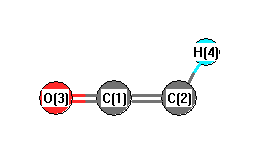 More geometry information
Calculated Bond Angles
| atom1 |
atom2 |
atom3 |
angle |
|
atom1 |
atom2 |
atom3 |
angle |
| C1 |
C2 |
H4 |
180.000 |
|
C2 |
C1 |
O3 |
180.000 |
Electronic energy levels
Charges, Dipole, Quadrupole and Polarizability
Jump to
S1C1
Energy calculated at B2PLYP=FULLultrafine/daug-cc-pVTZ
| | hartrees |
|---|
| Energy at 0K | -151.889612 |
| Energy at 298.15K | |
| HF Energy | -151.702510 |
| Nuclear repulsion energy | 52.430439 |
The energy at 298.15K was derived from the energy at 0K
and an integrated heat capacity that used the calculated vibrational frequencies.
Vibrational Frequencies calculated at B2PLYP=FULLultrafine/daug-cc-pVTZ
| Mode Number |
Symmetry |
Frequency
(cm-1) |
Scaled Frequency
(cm-1) |
IR Intensities
(km mol-1) |
Raman Act
(Å4/u) |
Dep P |
Dep U |
|---|
| 1 |
A' |
3353 |
3353 |
42.53 |
78.15 |
0.29 |
0.45 |
| 2 |
A' |
2103 |
2103 |
387.34 |
8.30 |
0.15 |
0.26 |
| 3 |
A' |
1243 |
1243 |
5.91 |
40.46 |
0.15 |
0.26 |
| 4 |
A' |
569 |
569 |
25.61 |
3.23 |
0.74 |
0.85 |
| 5 |
A' |
499 |
499 |
223.50 |
1.82 |
0.06 |
0.11 |
| 6 |
A" |
506 |
506 |
1.83 |
0.35 |
0.75 |
0.86 |
Unscaled Zero Point Vibrational Energy (zpe) 4135.7 cm
-1
Scaled (by 1) Zero Point Vibrational Energy (zpe) 4135.7 cm
-1
See section
III.C.1 List or set vibrational scaling factors
to change the scale factors used here.
See section
III.C.2
Calculate a vibrational scaling factor for a given set of molecules
to determine the least squares best scaling factor.
Geometric Data calculated at B2PLYP=FULLultrafine/daug-cc-pVTZ
Point Group is Cs
Cartesians (Å)
| Atom |
x (Å) |
y (Å) |
z (Å) |
|---|
| C1 |
0.000 |
0.051 |
0.000 |
| C2 |
1.083 |
-0.658 |
0.000 |
| O3 |
-1.078 |
0.510 |
0.000 |
| H4 |
2.128 |
-0.436 |
0.000 |
Atom - Atom Distances (Å)
| |
C1 |
C2 |
O3 |
H4 |
| C1 | | 1.2943 | 1.1716 | 2.1831 |
C2 | 1.2943 | | 2.4563 | 1.0689 | O3 | 1.1716 | 2.4563 | | 3.3427 | H4 | 2.1831 | 1.0689 | 3.3427 | |
More geometry information
Calculated Bond Angles
| atom1 |
atom2 |
atom3 |
angle |
|
atom1 |
atom2 |
atom3 |
angle |
| C1 |
C2 |
H4 |
134.754 |
|
C2 |
C1 |
O3 |
169.829 |
Electronic energy levels
Charges, Dipole, Quadrupole and Polarizability
