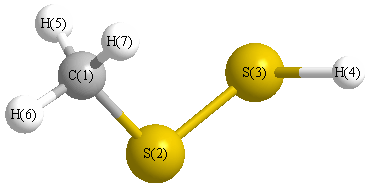
Vibrational Frequencies calculated at B1B95/daug-cc-pVTZ
| Mode Number |
Symmetry |
Frequency
(cm-1) |
Scaled Frequency
(cm-1) |
IR Intensities
(km mol-1) |
Raman Act
(Å4/u) |
Dep P |
Dep U |
|---|
| 1 |
A |
3171 |
3171 |
4.49 |
56.82 |
0.75 |
0.86 |
| 2 |
A |
3154 |
3154 |
4.59 |
80.64 |
0.75 |
0.85 |
| 3 |
A |
3065 |
3065 |
15.82 |
200.76 |
0.03 |
0.05 |
| 4 |
A |
2655 |
2655 |
4.00 |
166.46 |
0.22 |
0.35 |
| 5 |
A |
1476 |
1476 |
8.70 |
4.21 |
0.72 |
0.84 |
| 6 |
A |
1455 |
1455 |
9.13 |
5.50 |
0.75 |
0.86 |
| 7 |
A |
1338 |
1338 |
1.95 |
0.62 |
0.26 |
0.41 |
| 8 |
A |
973 |
973 |
5.01 |
1.38 |
0.08 |
0.16 |
| 9 |
A |
968 |
968 |
2.94 |
0.53 |
0.13 |
0.23 |
| 10 |
A |
883 |
883 |
4.89 |
9.90 |
0.41 |
0.59 |
| 11 |
A |
716 |
716 |
1.76 |
12.42 |
0.23 |
0.37 |
| 12 |
A |
526 |
526 |
0.61 |
11.90 |
0.12 |
0.21 |
| 13 |
A |
336 |
336 |
12.17 |
0.91 |
0.75 |
0.86 |
| 14 |
A |
237 |
237 |
0.19 |
5.12 |
0.51 |
0.68 |
| 15 |
A |
165 |
165 |
0.36 |
0.01 |
0.74 |
0.85 |
Unscaled Zero Point Vibrational Energy (zpe) 10558.0 cm
-1
Scaled (by 1) Zero Point Vibrational Energy (zpe) 10558.0 cm
-1
See section
III.C.1 List or set vibrational scaling factors
to change the scale factors used here.
See section
III.C.2
Calculate a vibrational scaling factor for a given set of molecules
to determine the least squares best scaling factor.
Charges, Dipole, Quadrupole and Polarizability
Charges from optimized geometry at B1B95/daug-cc-pVTZ
Charges (e)
| Number |
Element |
Mulliken |
CHELPG |
AIM |
ESP |
| 1 |
C |
-1.188 |
|
|
|
| 2 |
S |
-0.130 |
|
|
|
| 3 |
S |
-0.504 |
|
|
|
| 4 |
H |
0.306 |
|
|
|
| 5 |
H |
0.541 |
|
|
|
| 6 |
H |
0.491 |
|
|
|
| 7 |
H |
0.483 |
|
|
|
Electric dipole moments
Electric dipole components in Debye
(What's a Debye? See section
VII.A.3)
| |
x |
y |
z |
Total |
| |
-1.066 |
1.175 |
0.752 |
1.755 |
| CHELPG |
|
|
|
|
| AIM |
|
|
|
|
| ESP |
|
|
|
|
Electric Quadrupole moment
Quadrupole components in D Å
| Primitive |
|---|
| | x | y | z |
|---|
| x |
-30.810 |
-0.292 |
1.542 |
| y |
-0.292 |
-34.849 |
0.567 |
| z |
1.542 |
0.567 |
-33.008 |
|
| Traceless |
|---|
| | x | y | z |
|---|
| x |
3.118 |
-0.292 |
1.542 |
| y |
-0.292 |
-2.940 |
0.567 |
| z |
1.542 |
0.567 |
-0.178 |
|
| Polar |
|---|
| 3z2-r2 | -0.356 |
|---|
| x2-y2 | 4.039 |
|---|
| xy | -0.292 |
|---|
| xz | 1.542 |
|---|
| yz | 0.567 |
|---|
|
Polarizabilities
Components of the polarizability tensor.
Units are
Å
3 (Angstrom cubed)
Change units.
| |
x |
y |
z |
| x |
10.770 |
0.176 |
0.165 |
| y |
0.176 |
7.925 |
0.055 |
| z |
0.165 |
0.055 |
6.957 |
<r2> (average value of r
2) Å
2
| <r2> |
101.291 |
| (<r2>)1/2 |
10.064 |