All results from a given calculation for CH2Br2 (dibromomethane)
using model chemistry: QCISD(T)=FULL/daug-cc-pVTZ
19 10 17 12 22
States and conformations
| State |
Conformation |
minimum conformation |
conformer description |
state description |
| 1 |
1 |
yes |
C2V |
1A1 |
Energy calculated at QCISD(T)=FULL/daug-cc-pVTZ
| | hartrees |
|---|
| Energy at 0K | -5184.792036 |
| Energy at 298.15K | |
| HF Energy | -5183.964438 |
| Nuclear repulsion energy | 354.184673 |
The energy at 298.15K was derived from the energy at 0K
and an integrated heat capacity that used the calculated vibrational frequencies.
Vibrational Frequencies calculated at QCISD(T)=FULL/daug-cc-pVTZ
Geometric Data calculated at QCISD(T)=FULL/daug-cc-pVTZ
Point Group is C2v
Cartesians (Å)
| Atom |
x (Å) |
y (Å) |
z (Å) |
|---|
| C1 |
0.000 |
0.000 |
0.926 |
| H2 |
-0.893 |
0.000 |
1.531 |
| H3 |
0.893 |
0.000 |
1.531 |
| Br4 |
0.000 |
1.604 |
-0.123 |
| Br5 |
0.000 |
-1.604 |
-0.123 |
Atom - Atom Distances (Å)
| |
C1 |
H2 |
H3 |
Br4 |
Br5 |
| C1 | | 1.0781 | 1.0781 | 1.9168 | 1.9168 |
H2 | 1.0781 | | 1.7852 | 2.4710 | 2.4710 | H3 | 1.0781 | 1.7852 | | 2.4710 | 2.4710 | Br4 | 1.9168 | 2.4710 | 2.4710 | | 3.2082 | Br5 | 1.9168 | 2.4710 | 2.4710 | 3.2082 | |
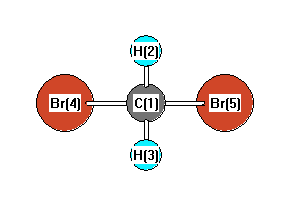 More geometry information
Calculated Bond Angles
| atom1 |
atom2 |
atom3 |
angle |
|
atom1 |
atom2 |
atom3 |
angle |
| H2 |
C1 |
H3 |
111.770 |
|
H2 |
C1 |
Br4 |
107.881 |
| H2 |
C1 |
Br5 |
107.881 |
|
H3 |
C1 |
Br4 |
107.881 |
| H3 |
C1 |
Br5 |
107.881 |
|
Br4 |
C1 |
Br5 |
113.617 |
Electronic energy levels
Charges, Dipole, Quadrupole and Polarizability
