Jump to
S2C1
Energy calculated at MP2/daug-cc-pVDZ
| | hartrees |
|---|
| Energy at 0K | -151.616462 |
| Energy at 298.15K | |
| HF Energy | -151.201334 |
| Nuclear repulsion energy | 62.518681 |
The energy at 298.15K was derived from the energy at 0K
and an integrated heat capacity that used the calculated vibrational frequencies.
Vibrational Frequencies calculated at MP2/daug-cc-pVDZ
| Mode Number |
Symmetry |
Frequency
(cm-1) |
Scaled Frequency
(cm-1) |
IR Intensities
(km mol-1) |
Raman Act
(Å4/u) |
Dep P |
Dep U |
|---|
| 1 |
Σg |
2101 |
2101 |
0.00 |
92.03 |
0.33 |
0.49 |
| 2 |
Σg |
928 |
928 |
0.00 |
9.32 |
0.71 |
0.83 |
| 3 |
Σu |
1547 |
1547 |
652.32 |
0.00 |
0.33 |
0.50 |
| 4 |
Πg |
165i |
165i |
0.00 |
0.25 |
0.75 |
0.86 |
| 4 |
Πg |
165i |
165i |
0.00 |
0.25 |
0.75 |
0.86 |
| 5 |
Πu |
129 |
129 |
16.09 |
0.00 |
0.75 |
0.86 |
| 5 |
Πu |
129 |
129 |
16.09 |
0.00 |
0.75 |
0.86 |
Unscaled Zero Point Vibrational Energy (zpe) 2252.4 cm
-1
Scaled (by 1) Zero Point Vibrational Energy (zpe) 2252.4 cm
-1
See section
III.C.1 List or set vibrational scaling factors
to change the scale factors used here.
See section
III.C.2
Calculate a vibrational scaling factor for a given set of molecules
to determine the least squares best scaling factor.
Geometric Data calculated at MP2/daug-cc-pVDZ
Point Group is D∞h
Cartesians (Å)
| Atom |
x (Å) |
y (Å) |
z (Å) |
|---|
| C1 |
0.000 |
0.000 |
0.655 |
| C2 |
0.000 |
0.000 |
-0.655 |
| C3 |
0.000 |
0.000 |
1.982 |
| C4 |
0.000 |
0.000 |
-1.982 |
Atom - Atom Distances (Å)
| |
C1 |
C2 |
C3 |
C4 |
| C1 | | 1.3099 | 1.3267 | 2.6366 |
C2 | 1.3099 | | 2.6366 | 1.3267 | C3 | 1.3267 | 2.6366 | | 3.9633 | C4 | 2.6366 | 1.3267 | 3.9633 | |
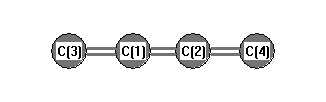 More geometry information
Calculated Bond Angles
| atom1 |
atom2 |
atom3 |
angle |
|
atom1 |
atom2 |
atom3 |
angle |
| C1 |
C2 |
C4 |
180.000 |
|
C2 |
C1 |
C3 |
180.000 |
Electronic energy levels
Charges, Dipole, Quadrupole and Polarizability
Jump to
S1C1
Energy calculated at MP2/daug-cc-pVDZ
| | hartrees |
|---|
| Energy at 0K | -151.604083 |
| Energy at 298.15K | |
| HF Energy | -151.150184 |
| Nuclear repulsion energy | 62.148610 |
The energy at 298.15K was derived from the energy at 0K
and an integrated heat capacity that used the calculated vibrational frequencies.
Vibrational Frequencies calculated at MP2/daug-cc-pVDZ
| Mode Number |
Symmetry |
Frequency
(cm-1) |
Scaled Frequency
(cm-1) |
IR Intensities
(km mol-1) |
Raman Act
(Å4/u) |
Dep P |
Dep U |
|---|
| 1 |
Σg |
2058 |
2058 |
0.00 |
32.62 |
0.21 |
0.35 |
| 2 |
Σg |
900 |
900 |
0.00 |
55.02 |
0.18 |
0.31 |
| 3 |
Σu |
1536 |
1536 |
478.29 |
0.00 |
0.00 |
0.00 |
| 4 |
Πg |
189 |
189 |
0.00 |
0.00 |
0.75 |
0.86 |
| 4 |
Πg |
275i |
275i |
0.00 |
5.89 |
0.75 |
0.86 |
| 5 |
Πu |
170 |
170 |
6.08 |
0.00 |
0.00 |
0.00 |
| 5 |
Πu |
82 |
82 |
34.00 |
0.00 |
0.00 |
0.00 |
Unscaled Zero Point Vibrational Energy (zpe) 2330.0 cm
-1
Scaled (by 1) Zero Point Vibrational Energy (zpe) 2330.0 cm
-1
See section
III.C.1 List or set vibrational scaling factors
to change the scale factors used here.
See section
III.C.2
Calculate a vibrational scaling factor for a given set of molecules
to determine the least squares best scaling factor.
Geometric Data calculated at MP2/daug-cc-pVDZ
Point Group is D∞h
Cartesians (Å)
| Atom |
x (Å) |
y (Å) |
z (Å) |
|---|
| C1 |
0.000 |
0.000 |
0.660 |
| C2 |
0.000 |
0.000 |
-0.660 |
| C3 |
0.000 |
0.000 |
1.993 |
| C4 |
0.000 |
0.000 |
-1.993 |
Atom - Atom Distances (Å)
| |
C1 |
C2 |
C3 |
C4 |
| C1 | | 1.3190 | 1.3338 | 2.6528 |
C2 | 1.3190 | | 2.6528 | 1.3338 | C3 | 1.3338 | 2.6528 | | 3.9867 | C4 | 2.6528 | 1.3338 | 3.9867 | |
More geometry information
Electronic energy levels
Charges, Dipole, Quadrupole and Polarizability
